 +
+
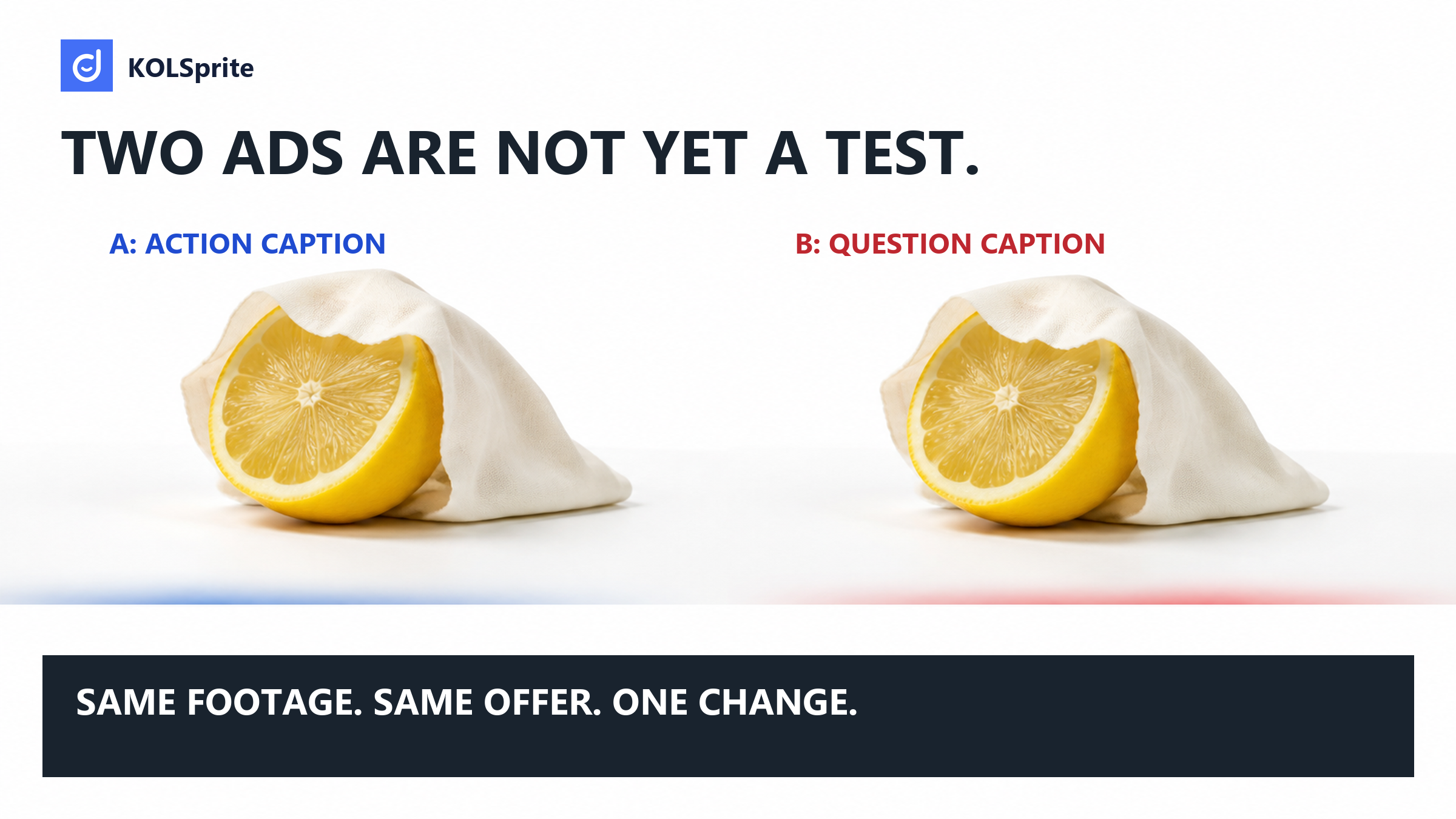
Two food-wrap ads run at the same time. One opens on a kitchen counter, uses a question, and shows a discount. The other starts with a close shot, uses a statement, and shows the full price. Suppose one gets a better result. Which change should the team keep?
This is a hypothetical counterexample, not a campaign report. The result would not isolate the opening, the shot, or the offer. The team changed all three. Two ads running at once are not automatically an experiment. A useful TikTok split test starts with a decision that one controlled difference could help resolve.
The counterexample might still produce useful work. A team could learn that one complete treatment deserves more attention. It could notice a production flaw or an unclear offer. But it could not fairly conclude that questions beat statements or that a close shot caused the stronger result.
The distinction matters when the next decision costs money. If the team plans to commission ten more question-led scripts, it needs evidence about that choice. If it only wants to choose between two complete ads, the question is narrower in one way and broader in another. The answer would concern those whole treatments, not the merit of each part.
A controlled test reduces the number of plausible explanations by holding other conditions steady. It does not remove every limit. The result still belongs to the tested product, audience, period, and setup. A small team gets more value by stating those boundaries than by calling a single result a creative law.
| Design question | Official split-test description | Uncontrolled comparison | Implication for this brief |
|---|---|---|---|
| Who sees each version? | TikTok's January 2026 split-testing help describes equal audience groups, each exposed to one ad group. | Two separate posts or ordinary ad launches do not establish that same audience split. | Use the platform's test setup when the question needs a controlled paid comparison. |
| What changes? | The help describes comparing two versions while other variables remain consistent. | Changing the offer, footage, and opening together leaves several explanations open. | This example changes only the opening caption's framing. |
| When is there a winner? | The platform reports a winner only when its statistical criteria are met. | A visible difference in a dashboard is not enough to establish a winner. | An inconclusive outcome remains a possible, valid end to the test. |
Scope: official paid split-test design compared with uncontrolled side-by-side posting. Market: US-oriented ecommerce advertising. Access date: 2026-09-03. Sample: one official help page, no test accounts or results. Cleaning: retained the audience split, control principle, and winner condition; no sample counts or uplift were added. Limit: account eligibility and current setup options were not checked.
The fictional food-wrap team is unsure whether its first caption should name an action or ask about a need. The product action is easy to film: a person folds the wrap around a cut lemon. The test concerns the first caption, not food storage performance. It makes no claim about freshness, safety, or how long food will last.
The spending decision is whether to use one of those caption approaches in the next paid edit of this same demo. That is a modest decision, but it is real. It does not require a new location, actor, or product shoot. Both versions can use the same owned footage.
Changing the opening caption while also changing the first shot would test a bundle. That may be a sensible later question, but it is not this one. The test needs two treatments that differ in one intended element, plus a written list of the elements that stay fixed.
Even this narrow comparison has a limit. The two captions differ in their exact words, not only in whether they end with a question mark. The result would favor one tested caption approach for this demo. It would not isolate a pure effect of grammar or prove that questions work for every product. That is why the next spending decision concerns this edit, not a rule for every future script.
Claim a three-day KOLSprite web trial to study script treatments before writing original variants. Controlled delivery and results belong in Ads Manager. MCP is separate.
Register and claim a three-day trial
Decision: Choose the opening-caption framing for the next paid edit of this same food-wrap demo. Do not use the result to choose a new product claim or a new audience.
Hypothesis: A question about the viewer's need may lead to a different paid purchase result than a line naming the action. This is an open hypothesis. No direction or uplift is assumed.
Single variable: The words in the first on-screen caption. Treatment A says, “See how this wrap covers a lemon.” Treatment B says, “Need a cover for that cut lemon?” Both are original copy for this fictional example.
Shared visual and sound: Use the same close shot of the hand placing the wrap around the same cut lemon. The caption occupies the same place for the same duration, in the same type style. Keep the underlying audio unchanged. Do not add a spoken question to one version.
Preflight check: Compare the two exports side by side before setup. After the first caption ends, the files should show the same sequence with the same sound and text. Save the approved versions and record the test settings before launch. If an editor changes the product shot in only one file, restore the shared shot. A file labeled “B” is not enough to confirm that the intended difference is the only difference.
Shared body and close: Show the fold, the wrapped item, and the same final product view. Use the same body caption, “Fold the wrap around the cut lemon,” and the same close, “Check the product details and care directions.” Verify that the real product can support the action before adapting this draft.
Shared paid conditions: Use one eligible purchase-focused platform split test. Keep the audience definition, objective, placement choices, offer, product page, and measurement event fixed. Use the platform's equal audience split rather than creating two unrelated launches.
Primary decision metric: Purchase cost as reported for the eligible purchase-cost comparison in the platform test. Confirm that this metric and event are supported and working before launch. If they are not, revise the specification before spending; do not quietly substitute clicks after seeing the results.
Illustrative planning limits: The fictional team reserves $600 total, split equally between the two arms, for a fixed fourteen-day window. These are invented planning inputs, not platform minimums or a claim of adequate statistical power. If setup requirements or the expected data make that plan unsuitable, do not launch it unchanged.
Stop and review rule: Let the planned window finish without choosing a winner from an early lead. Stop early for a broken purchase event, wrong offer, or unusable product page. Record that as a compromised test, not a creative loss.
Decision rule: Adopt a caption approach for this demo only when the platform identifies a winner on the chosen metric and no recorded setup failure undermines the comparison. If no winner is reported, keep the existing caption and record that the test did not resolve the choice. Do not claim the versions are equal.
Bring your test question to Discord, not a screenshot of private results. The best feedback may be that the comparison needs a clearer purpose.
 +
+
Join the KOLSprite Discord community
An inconclusive result does not mean the work was pointless. It means this test did not support the decision at the required level. The treatments might be similar in effect. The evidence might be too thin. A setup problem might have weakened the comparison. Those possibilities are not interchangeable.
First separate a valid but unresolved test from a broken one. If the purchase event stopped working, the result cannot answer the intended purchase question. If the setup remained sound but the platform did not identify a winner, the team has a narrower statement: the test did not establish a preference between these versions under these conditions.
That wording may feel less satisfying than choosing the lower number. It is more useful for the next decision. A small observed lead does not earn the right to shape a whole creative program. Nor should a team keep spending merely to make its favorite version win. Any larger follow-up needs its own reason and a revised plan made before launch.
A secondary metric can tempt the team to move the finish line. Suppose, as a thought experiment, one caption earns cheaper clicks but the purchase test has no winner. The click pattern could inspire another question. It cannot settle the purchase decision that was written into this brief. Report it as a separate observation and keep the main result unresolved. Changing the success metric after seeing the dashboard rewards whichever story looks most appealing, not the question the test was built to answer.
KOLSprite can help create the treatments, not run the experiment. Supported script analysis can examine permitted public reference transcripts and suggest ways to frame a product action. The team can then write two original caption treatments and record the shared elements that must not change.
The TikTok video analyzer guide can help turn that research into a brief. A reference may suggest that an action is clear enough to lead with. Its public response does not prove that an action-led caption will win a paid purchase test for this product.
KOLSprite cannot randomize audiences, run TikTok Ads Manager tests, or determine statistical significance from public videos. Those boundaries matter even when both scripts came from the same research session. The source of an idea and the evidence for its effect are different things.
When a creator is filming the shared footage, the influencer campaign brief should distinguish fixed test elements from creative choices. A different gesture, crop, or spoken line can change the treatment. Freedom belongs where it will not blur the one question being tested.
A test should earn its place in the budget by changing a decision. If the team would use the same caption regardless of the outcome, the experiment is theater. If the difference is too small to matter to the next edit, a larger question may deserve the work instead.
For TikTok Shop ads, that next question could concern a real gap in product proof. It should not be chosen only because the first test was inconclusive. Review what remained uncertain and whether resolving it would change spending or production.
In the fictional food-wrap brief, an unresolved caption test justifies keeping the current version while deciding whether further evidence is worth its cost. It does not justify claiming no difference, scaling the early leader as a proven winner, or making a new freshness claim. Sometimes the correct result is a smaller conclusion and no change to the ad.
Latest Articles

As an essential, data-driven toolkit for TikTok influencers and marketers, KOLSprite provides powerful features for effortless creator discovery, trending content identification, and actionable real-time insights.
It empowers users to make smarter decisions and significantly boosts their TikTok business.

 Refer & Earn