 +
+
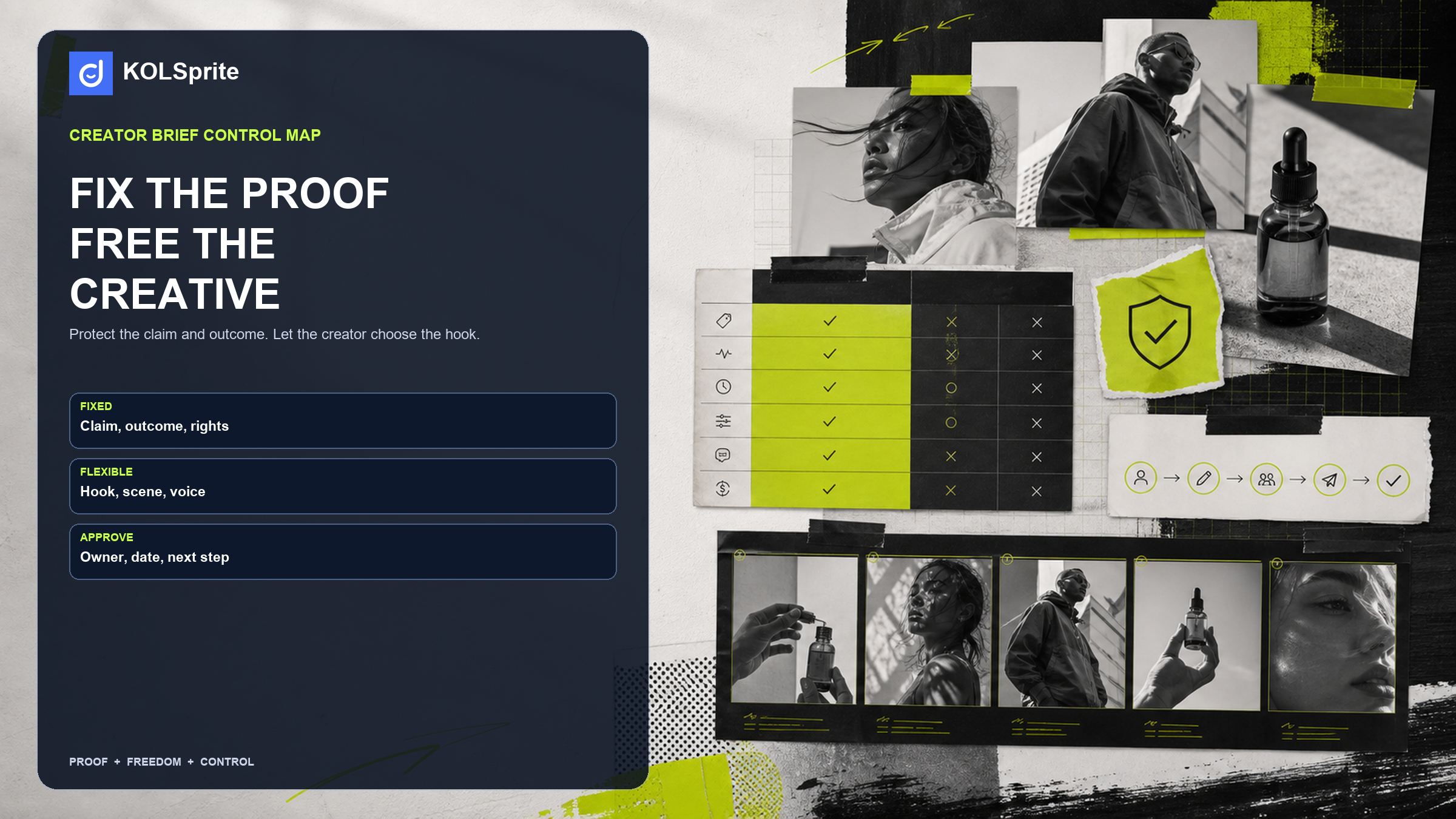
Brand managers and agencies know this result: the creator followed the brief, but the video still feels like an ad no one would choose to watch. An influencer campaign brief works better when it separates facts from creative choices. Set five fixed fields for proof and project needs. Then let the creator choose the hook, scene, and voice. The result is a one-page brief that protects claims, deliverables, rights checks, and approvals without turning the creator into a script reader.
A product manual is not a creative brief. It lists everything the brand knows and leaves little room for a useful video. A vague request has the opposite flaw. It says "make it authentic" but gives no proof, deadline, deliverable, or approval path. Both lead to revisions because the rules appear after work starts.
Ask a better question: "What must the audience understand, and what can the creator choose to make it clear?" The answer sets a boundary, not a script. It protects the project while leaving room for the creator's own format.
The supplied 2026 U.S. keyword snapshot lists volume 10 for this phrase, a 25% rise in trend, and difficulty of 1. These are search signals. They do not prove that one brief will improve results. Influencer brief templates from Smartsheet cover items such as audience, deliverables, owners, dates, outreach, and review. Use that list to check for gaps, then make each choice fit your campaign.
| Fixed by brand | Chosen by creator | Why the boundary matters |
|---|---|---|
| Approved product claim and proof required | Hook | The claim needs substantiation; the opening needs a native voice. |
| Deliverable, deadline, and approval route | Scene | Operations need certainty; the setting should fit the creator’s audience and style. |
| Disclosure and rights process | Voice and wording around approved facts | Compliance and usage require review; tone should not be copied from brand ads. |
| Product availability and required inclusion | Demonstration order | The buyer needs accurate information; the creator can make the sequence watchable. |
Limitation: This matrix helps the creative team. It is not legal advice. The right experts must still review claims, contracts, usage rights, and platform rules.
Use this full one-page brief with your next creator. The short format makes each key rule easy to find.
| Section | Write this |
|---|---|
| 1. Audience and job | [Audience] needs to understand [product outcome] in [real situation]. |
| 2. Required proof | Show [visible product action]. Use only approved wording for [claim]. Do not state [unapproved claim]. |
| 3. Deliverable and route | [Format and quantity], due [date], submitted to [owner] through [approved route]. |
| 4. Disclosure and rights check | Follow the campaign’s written disclosure and rights process. Confirm approvals before publishing or reusing content. |
| 5. Learning question | We want to learn whether [proof angle] makes [buyer question] clearer. |
| Creator choice A | Choose the hook that fits your normal format. |
| Creator choice B | Choose the scene that credibly shows the use case. |
| Creator choice C | Use your own voice around the approved facts. |
Fill the brackets before outreach. Then review them with the person who owns product claims and approvals. A creator should not have to guess which facts are fixed or who can approve a change.
Register for KOLSprite and claim a three-day trial to collect creator and video examples before you set the brief's fixed and flexible fields.
Register and claim a three-day trial
Too controlling: “Open with our exact slogan, show the box for five seconds, say this is the best solution, then use our approved joke.”
Too vague: “Make a fun video showing why the product is great.”
Bounded brief language: “Show the product being stored under a desk and used in a short work break. Use only the approved product facts in the campaign materials. Choose an opening and setting that fit your usual content. Send the draft through the agreed review route before publishing.”
The third version names the proof the brand needs but leaves the opening and tone to the creator. It also removes "best," a claim the brief does not support.
For U.S.-facing endorsements, the FTC's Disclosures 101 guidance explains why a material connection needs clear disclosure. Apply your own legal and platform review. Do not leave disclosure wording to the last creative edit.
Public creator and video research can make a brief more useful. Look for proof steps, customer questions, and creative choices. Save the source and note only what you saw. KOLSprite can help teams research content and creators, save proof examples, and record what to repeat or avoid in supported collaboration work.
In the review meeting, open the saved KOLSprite examples beside the brief and point to the exact proof step that informed a fixed field. Keep the creator's hook, scene, and voice outside that fixed field unless the campaign truly requires them. KOLSprite supplies the example; the brand owner approves the claim and the boundary.
Research is a starting point, not approval. It cannot replace legal review, support for a claim, contract terms, rights checks, or platform rules. Nor can one public example prove what will work for another product or creator. Use it to write a sharper campaign question.
Join the KOLSprite Discord community to discuss creator briefs, evidence standards, and practical campaign handoffs.
 +
+
Join the KOLSprite Discord community
Send the one-page brief with a short note. Name the creator's choices, fixed rules, main contact, and review route. Invite questions before production, especially when the required proof may clash with the creator's usual format. Resolve that issue early instead of rejecting a finished video for a rule you never shared.
Keep rights and payment talks in the approved private process. The brief may point to that process, but it should not invent terms or imply that a public post grants reuse rights. For physical products, link the brief to a creator seeding sample tracking workflow.
After the post goes live, record what the team saw and what remains unclear. Did the proof appear soon enough? Did the scene explain the buyer's situation? Did a gap in the brief cause a revision? Keep the answer factual and attach the content link. The next brief can keep one useful rule or change one choice for a clear reason.
Begin product research with this TikTok UGC strategy guide. Keep business and legal scope clear with the influencer contract scope evidence guide. A strong influencer campaign brief does not promise a hit. It gives the right people enough clarity to make one credible piece of work.
Not every revision belongs with the creator, and not every question needs a meeting. Name the type of feedback first. A proof issue means a required product action or approved fact is missing. A creative issue concerns the hook, scene, or voice the creator controls. A project issue concerns the date, file, disclosure, or review route. Rights and contract issues belong in the approved private process.
| Revision type | Question to send | Owner |
|---|---|---|
| Proof | Can the required product action be shown more clearly? | Creator with product approver |
| Creative choice | Is there another hook or scene that keeps the proof intact? | Creator |
| Operating | What file, date, or review step is missing? | Campaign owner |
| Rights or terms | Which approved process needs to decide this? | Operations or legal |
Limitation: These labels make feedback clearer. They do not let anyone change a contract, give a legal view, or approve a claim without support.
Send feedback with the matching brief section and one fact. "Make it more on brand" gives the creator no clear action. "The storage demo does not appear before the final frame" explains the gap without taking over the full edit. For a creator choice, ask a question: "Could you try a different opening while keeping the storage proof?"
Too many personal opinions can undo a good brief. Limit review to people who own a fixed field, and ask each person to comment on that field. Product owners check facts. Campaign owners check deliverables and the review route. Legal or named approvers check the right compliance steps. The creator keeps the choices the brief left open.
Combine all feedback into one reply and remove conflicts. If the brand cannot agree on a fixed rule, settle it inside the team. Do not ask the creator to choose between mixed directions. One clear reply saves time and trust. It also shows whether a problem came from the content or the brand's own review.
When the campaign ends, keep the final brief, approved project record, published link when available, and a short learning note together. Record which proof was clear, what caused edits, and what the team would keep or change. Do not credit one creative choice for success unless the evidence supports it. This file guides the next choice; it is not a performance claim.
This last step makes the influencer campaign brief a working tool, not a one-time file. It carries forward useful rules, leaves room for new creator choices, and gives the next team a factual place to start.
Set the content relationship with the TikTok UGC strategy guide, connect logistics through the creator seeding workflow, and define commercial scope with the influencer contract evidence guide. After publication, add maintained inbound links from the first two pages.
Latest Articles
As an essential, data-driven toolkit for TikTok influencers and marketers, KOLSprite provides powerful features for effortless creator discovery, trending content identification, and actionable real-time insights.
It empowers users to make smarter decisions and significantly boosts their TikTok business.
 Refer & Earn