 +
+
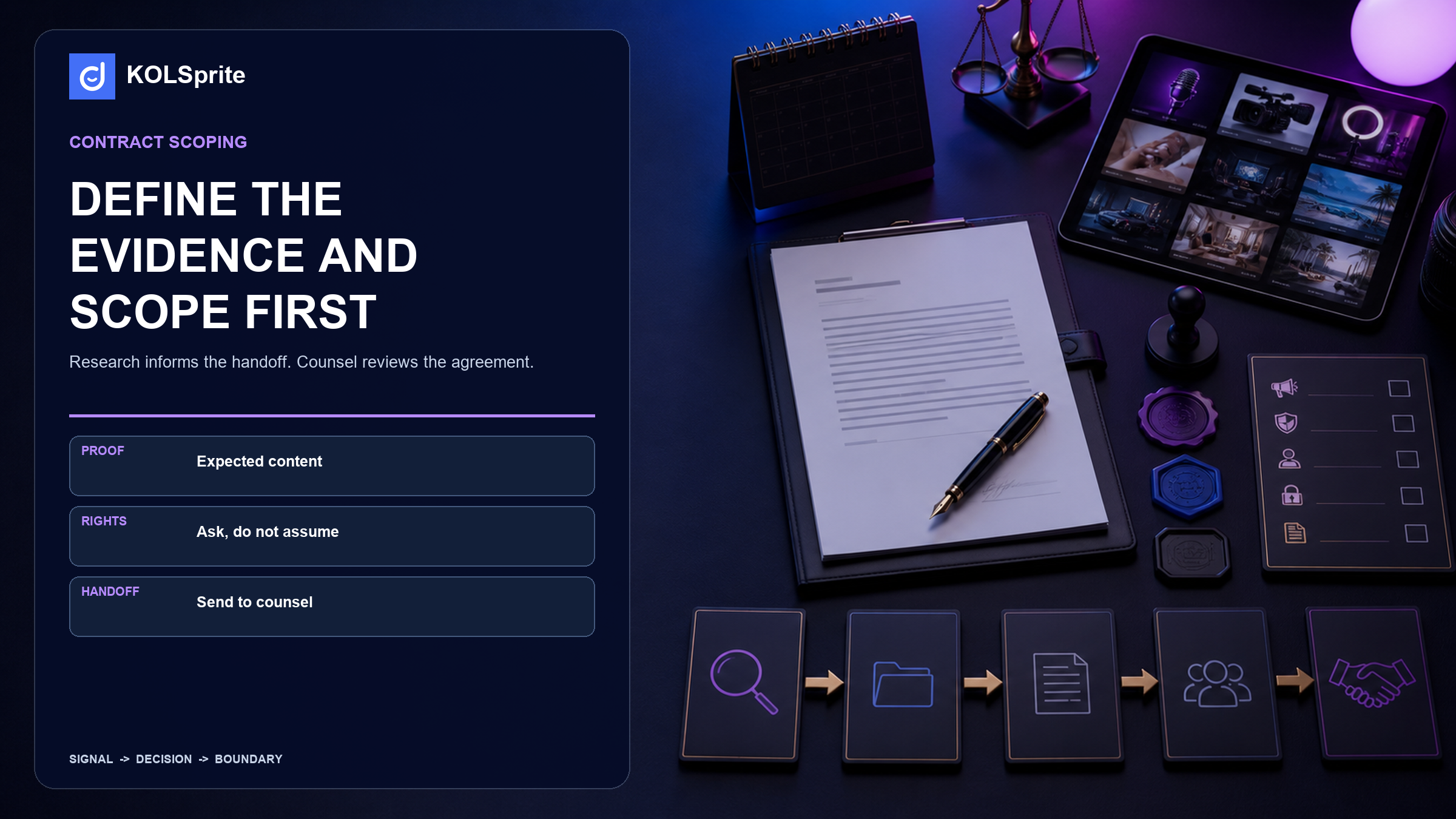
Direct response: Make a specific scope sheet before a lawyer writes or reviews an agreement. Show why you chose the creator, what content you want, what review you need, which rights questions remain open, and who owns the disclosure check. The sheet helps the business plan, but it is not a contract.
Here is the 10-second response: save the posts that show why the creator fits, name the content and evidence you need, list review steps and timing, send rights and disclosure questions to the right people, then send the package to counsel.
This article is not legal advice. It does not give you a contract template, legal terms, legal answers, or a way to grant rights. Creator deals depend on the people, place, rights, platform rules, and facts of the job, so use a qualified lawyer for legal work.
Vague deals often start with a vague choice. A team selects a creator, someone discusses price, and a generic form appears before anyone agrees on the content, review, timing, rights, or disclosure work. That usually leads to difficult back-and-forth later, when the project is already under time pressure.
Start with a pre-legal scope sheet instead. It gives the lawyer and campaign team a plain set of facts: why the creator fits, what buyer concern the content must help with, what it needs to show, what checks are needed, and what remains unclear. Keep it specific and useful without trying to sound like legal writing.
Save the facts that led to the choice and link to public posts that show the fit. The creator may explain this type of product well, show a believable daily use, or make the sort of evidence your buyer needs. State what you observed, but do not claim to know their private audience, future results, or legal record from public posts.
For basic disclosure questions, read the FTC's Disclosures 101 for Social Media Influencers and TikTok's current branded content disclosure guidance. These pages provide general rules and tool notes, but they do not replace advice from your own lawyer.
| Part | What the campaign team adds | Why the lawyer needs it |
|---|---|---|
| Why this creator | Public content pieces, context, and the buyer need they fit | Demonstrates the business reason for the deal |
| Content goal | Content type, product, evidence job, and facts that must stay true | Demonstrates what the deal is about |
| Work details | Dates, product ship plan, key contacts, and known limits | Demonstrates what may affect the work |
| Review needs | What must be checked and who will check it | Helps avoid review confusion |
| Rights questions | Where and why the brand hopes to use the work | Demonstrates what legal review must cover |
| Disclosure owner | Who will check the needed steps | Keeps the task from being lost |
Method note: This sheet is a business brief for counsel. It is not a legal form. Let the lawyer decide the legal terms, rights, and wording for the actual deal.
Use plain words. Say, "one short vertical demo that shows the morning setup and names a supported product feature," rather than "one organic asset." That gives the team something concrete to plan, check, and price without telling a lawyer how to write the agreement.
Use KOLSprite to save the public creator and content examples that explain the intended deliverable. New accounts can claim a three-day trial.
Register and claim a three-day trial
Start each content request with a buyer question: what does a person need to see before this product makes sense? The answer may be an unboxing, a day-in-the-life use, a close view of a feature, or a simple how-to. That evidence job keeps the brief from becoming a vague request for "authentic content."
| Prompt | Helpful business response | Question for counsel or review |
|---|---|---|
| What will be made? | Name the content type, count, product, and key evidence | Does the agreement match the scope? |
| What needs review? | Name facts, safety limits, or key campaign details | How should review be handled? |
| What is a preference? | Keep nice-to-have style notes apart from must-have facts | What belongs in a brief, not terms? |
| How might the brand use it? | List the hoped-for use and channels as open questions | What permission or limit may be needed? |
| What must be disclosed? | Name the paid link and who owns the check | What steps or tools may apply? |
Method note: These are prompts, not contract words. They help a campaign team ask specific questions. Counsel should decide how the credible deal handles them.
Keep extra uses out in the open. A request to reuse a video in ads, alter it, use it in another place, or use it later may raise more questions, so put the hoped-for use on the scope sheet at the start. Let counsel explain what it means rather than hiding it inside a creator fee discussion.
KOLSprite can help save the public posts and creator context behind the choice, making the research record easier to share. It does not give legal advice, write binding terms, grant rights, or check that a video follows all laws or platform rules. Keep that limit specific in every handoff.
Keep the scope sheet focused on facts the campaign team can confirm, such as which product will be sent, when it is needed, who can answer product questions, and what facts are already approved for the content. When you do not know an answer, mark it open rather than filling the gap with a promise to the creator or a guess about the deal.
It also helps to list the creator's practical needs, including the right product size, a delivery date, a point of contact, or more facts about how the product works. Those are production details, so put them in the plan to help the content get made well, then keep them separate from legal terms.
Do not leave rights and disclosure until the end of the shoot, when the plan is harder to change. The FTC guide says people should clearly see a material connection, while TikTok has its own branded-content tools and steps. Read the primary sources, then ask your lawyer how they apply to the actual job.
Also check the current TikTok Terms of Service and any Shop or paid-content rules that fit the work. Platform terms can change, so an old screenshot from a past job is not enough for a new campaign.
Put one owner beside each open question. The campaign lead owns the content goal, the brand or media lead owns the hoped-for use, counsel owns legal review, and the creator or agency contact can confirm the practical work plan. This is a work map, not a legal response.
That ownership map is what makes a TikTok influencer contract process easier to manage before legal drafting begins.
Label each note as a known business fact, an open business question, or a legal question. For example, "the brand hopes to post the video on its own social pages" is a hoped-for use, not permission. "The creator wants payment before filming" is a business request, not an answer about payment terms.
Stop and clear things up when the work is still vague. Watch for a missing content count, a review plan with no owner, a plan to reuse content with no specific business reason, product claims you cannot support, no person assigned to disclosure, or a date that depends on a product shipment no one has checked.
Discuss deliverable clarity and workflow questions with the KOLSprite community. Keep rates, private data, and legal advice with the appropriate professionals.
 +
+
Join the KOLSprite Discord community
These are reasons to ask better questions, not legal rulings. The point is to give counsel a clean and accurate set of facts before they begin their work.
At this stage, the campaign producer should verify that the scope sheet reflects the current creative plan rather than an early concept. Check the product version, delivery timing, required disclosures, review participants, and intended media use against the latest brief. Small inconsistencies can create avoidable revisions, particularly when a creator has already scheduled filming or when multiple internal teams expect different outcomes from the same content.
Keep creative notes separate from legal questions. The team can name the product, buyer moment, facts that must stay true, content count, dates, and hoped-for use, while counsel can review the deal, rights, disclosure, and other legal points. That split helps everyone understand what they own.
Use the same care with claims. The scope can list product facts that are acceptable to demonstrate and flag claims that need review, but it should not tell a creator to make a health, result, or comparison claim simply because it sounds strong. Send uncertain claims to the right brand reviewer and counsel.
Before legal review, make the package brief but complete. Include the one-page scope sheet, public posts that demonstrate the fit, approved product facts, timing, contact names, and a list of open questions. Put time-sensitive facts at the top, because a lawyer should not need to search a long message thread to understand the campaign.
Date the sheet, name the campaign owner, and mark when product facts, planned use, or dates change. Send new facts to counsel rather than relying on an old file. If an agency runs creator communication, still name an in-house owner for product claims, planned use, and the legal handoff.
Keep the working record easy to review. Use links to the specific public posts, not just a creator profile, and note when each example was checked. When a creative direction changes, update the buyer question and evidence job before you ask counsel to review the package again. That limited step keeps business, creative, and legal review focused on the same current plan.
When the creator or agency asks a question outside the scope sheet, record it as an open question and send it to the right owner. Do not answer rights, payment, or disclosure questions from memory just to keep the project moving. A short pause for the correct review is better than a confident but unsupported response.
A TikTok influencer contract process works better when the business facts are specific first and a qualified lawyer reviews the deal last. Save why the creator fits, name the evidence job, put rights and disclosure questions in the open, and then let counsel do the legal work. This article is not legal advice, and the scope sheet is not a contract template.
Keep scope connected to the campaign decision. Prepare the commercial conversation with the creator negotiation guide. Set compensation context with the TikTok creator rate-card guide, then preserve the selection evidence with the TikTok KOL analysis workflow.
Latest Articles
As an essential, data-driven toolkit for TikTok influencers and marketers, KOLSprite provides powerful features for effortless creator discovery, trending content identification, and actionable real-time insights.
It empowers users to make smarter decisions and significantly boosts their TikTok business.
 Refer & Earn