 +
+
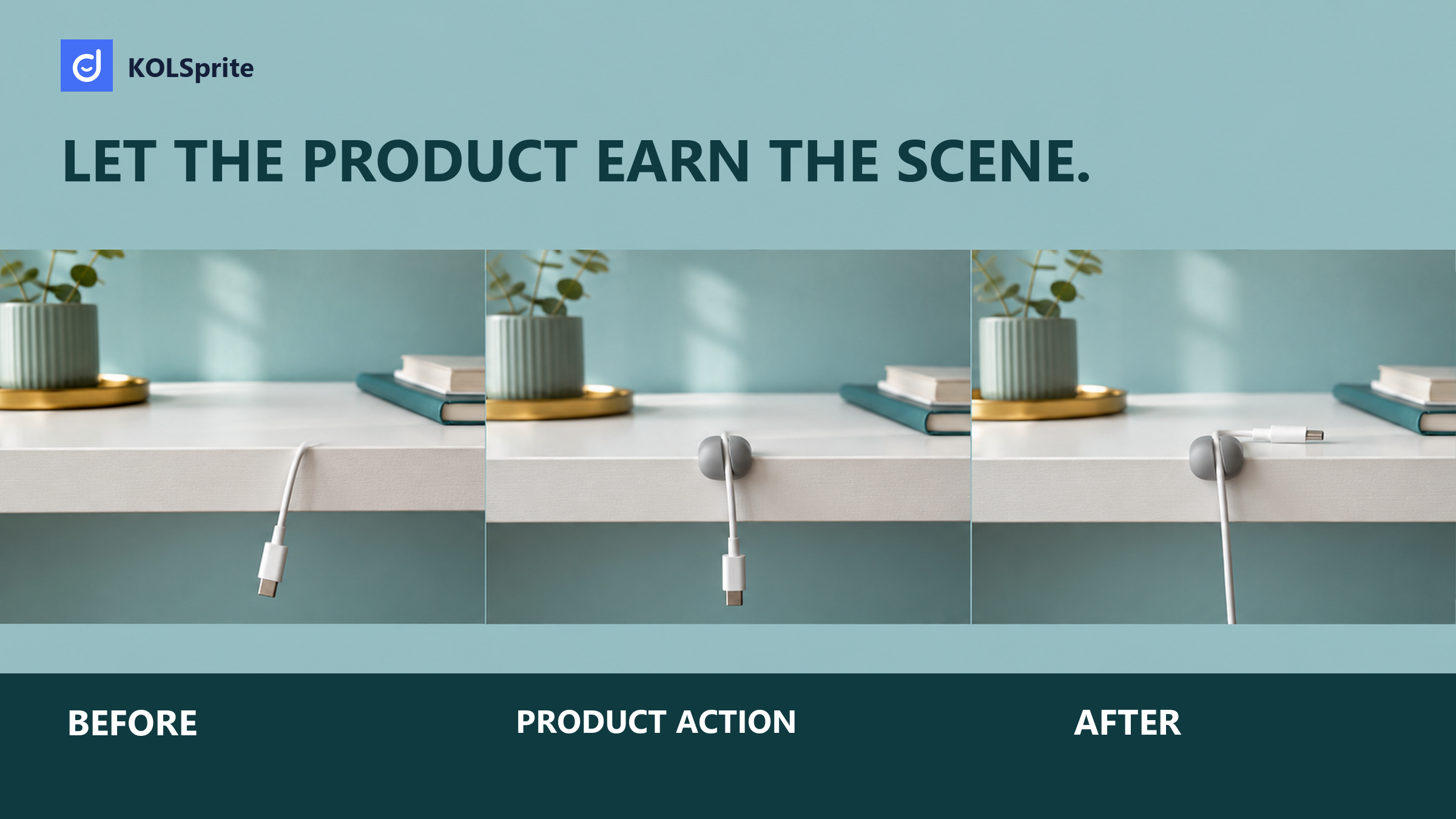
In this explicitly fictional scene, a person unplugs a laptop. The cable tip slips behind the desk. A hand reaches back for it, misses, then finds it. Nothing terrible has happened. There is no late meeting, lost client, or ruined morning. There is just a cable that has nowhere to wait.
That is enough tension for a small product story. A brand writer can give the invented cable organizer a simple role: a place for the loose end that creates a visible change. The product does not need to rescue a life or transform a workday. It needs to earn its part in the scene through an action the camera can show.
The opening works because the viewer can understand the situation before hearing a claim. A cable is useful while it is plugged in. Once unplugged, its tip has no set place. The desk edge creates the visual tension. The organizer has a clear possible role: hold that loose end where the person can reach it.
This is a fictional writing example, not a testimonial or a record of product use. The proposed object has a groove that can hold the pictured cable. A real shoot would need to confirm that the actual organizer and cable fit. If they do not, the script must change. The prop cannot borrow proof from the neatness of the set.
A weaker version would begin with a messy desk and end with a spotless one. That looks like a transformation, but most of the change could come from removing papers, cups, and unrelated cords. The organizer would be present without causing the visible difference. It would be decoration in a cleanup story.
The narrower scene gives the product more work, not less. Only the cable tip's resting place changes. If the object cannot account for that change, the story has nowhere to hide.
Consider this original but deliberately weak line: “This little organizer gave me my mornings back.” It sounds personal. It also claims a broad result and implies lived experience. Neither belongs in a fictional product demo. The line asks a desk shot to prove a change in someone's day.
The honest replacement is smaller: “Now the loose end has a place to wait.” It describes what the viewer should be able to see. There is still a story: a thing was hard to find, an object changed its resting place, and the person could reach it in the closing shot. The stakes are ordinary because the product's job is ordinary.
Another tempting line is “No more cable mess.” That claim outruns a scene about one cable. It could imply that every cord on the desk is now under control. The rewrite should keep the scale: “This cable stays at the edge in this setup.” Even that line belongs only in a real edit where the filmed action supports it.
The goal is not to drain the copy of feeling. A small pause before the hand finds the cable can convey the nuisance. A quiet final shot can convey the relief of knowing where it is. Those choices create tone without inventing a customer outcome.
Try KOLSprite web research for three days to study public questions and script structure. Write a new story and verify every claim yourself. MCP is separately billed.
Register and claim a three-day trial
| Source and scope | Documented guidance | Original scene choice | Boundary |
|---|---|---|---|
| TikTok's 2021 storytelling frameworks, an older evergreen reference | The article includes product-origin, results-first, and routine-based story forms. | This draft uses a small break in a desk routine, then shows one relevant product action. | An older narrative framework is not current performance evidence or a source of customer experience. |
| TikTok Creative Codes, structural guidance | The guidance separates hook, body, and close, with value communicated early. | The slipped tip opens the question, the groove provides the action, and the final reach closes it. | A clear structure cannot verify the product claim or guarantee a brand result. |
Scope: two official narrative and structure references compared with an original fictional scene. Market: US-oriented brand content. Access date: 2026-09-03. Sample: two documentary sources, including a 2021 article; no customer cases. Cleaning: separated older story forms from performance claims and kept all scene copy original. Limit: no current trend, conversion effect, or firsthand product experience is asserted.
The useful lesson is about order. A scene can establish a question, let the object act, and show what changed. The source does not choose the cable, the dialogue, or the claim. Those are editorial decisions that need their own visual support.
Fictional setup: One desk, one laptop cable, one organizer with a groove suited to that cable. The only promised change is the loose end's resting place. This is a script for instruction, not a report of an actual shoot or a proven product result.
Picture: A fixed shot shows the desk edge and the plugged-in laptop. A hand unplugs the cable. Its tip slips behind the desk. The hand reaches to where the tip had been, then follows it down.
Spoken line: “Unplug it, and the loose end slips behind the desk.” On-screen text: “Where does the loose end go?” Let the slipping tip remain visible long enough to establish the problem. No exaggerated reaction or invented crisis is needed.
Evidence and limit: The shot shows one cable moving in this staged setup. It does not show how often this happens to a real person. The actor is demonstrating a situation, not giving a testimonial.
Picture: Move closer, keeping the same desk edge and cable in view. Show the organizer, then the hand placing the cable in its groove. Keep the loose tip on the desk side of the edge. Film the placement clearly enough that the viewer can see what holds what.
Spoken line: “This gives the loose end a place to wait.” On-screen text: “One cable. One resting place.” The line belongs over the action, not over a beauty shot of the packaging.
Evidence and limit: The intended proof is visible fit and placement. Before adapting the script, confirm the actual product can hold this cable under the filmed conditions. Do not imply that the groove fits every cable or that the base never moves.
Picture: Return to the original framing. Leave the unrelated desk items where they were. The hand reaches for the loose tip in its new resting place and lifts it to reconnect the laptop. The organizer stays visible.
Spoken line: “The loose end is here when I reach for it.” On-screen text: “Check the fit for your cable and desk.” End on the actual cable and groove, not a broad claim about a better workday.
Evidence and limit: The closing action supports a claim about the shown reach. It does not prove long-term hold, time saved, fewer damaged cables, or improved focus. Those claims would need different evidence.
Caption draft: “A small desk problem, shown at its actual size. This setup gives the unplugged cable a visible resting place. Check the product's fit details against your cable and the surface where you plan to use it.” No customer result or guarantee is implied.
Share an original scene outline in Discord and ask whether the product changes the story. Keep real customers' private details out of the draft.
 +
+
Join the KOLSprite Discord community
The story depends on a before and after. That makes the edit important. If the cable changes between scenes, the viewer cannot judge the same setup. If the desk gets cleared while the organizer appears, the product may seem responsible for a wider change than it made.
Continuity is not just a visual nicety here. The same cable, desk edge, and hand action help define the claim. A close shot can make the groove legible, but a cut that skips the placement would hide the very action the story needs. The product should not receive credit for a change the viewer cannot inspect.
There is room for style within that constraint. The first scene can feel mildly awkward. The second can be close and precise. The final shot can be quiet. Music and pacing may shape the mood, but they should not ask the audience to infer an unshown life change.
The revised first line describes the action instead of presenting the actor as a satisfied user. That choice matters when a brand films a scripted scene. A natural voice is welcome; a made-up personal history is not. The camera can show the cable slipping once. It cannot turn that staged moment into evidence that this happens every morning or that a buyer's routine has improved.
The influencer campaign brief can make that distinction clear. Keep the cable, visible placement, and claim boundary fixed. Leave the creator room to choose a natural delivery and a setting that can support the same action.
KOLSprite's supported script breakdown can help identify how a public reference moves from a situation to a product action. Its supported public comment analysis can also surface questions worth checking. Read the original comments in context before deciding that a theme belongs in this story.
A question about cable thickness would point toward fit. A question about surface hold would point toward a different demonstration. Neither question proves that the product meets the need. The useful output is an original scene brief tied to a demonstrable action, not a customer story assembled from comments.
The TikTok video ideas guide can help decide whether the available footage answers that question. If the proof is missing, the writer can narrow the scene or request the needed demonstration. A summary of a reference should never fill a gap in the owned product's evidence.
KOLSprite does not supply verified customer testimonials, invent firsthand experience, or establish that a story will convert. A fictional scene can be useful for drafting as long as it stays clearly labeled. When a real person later describes an actual experience, that is a different source with its own permissions and factual checks.
A TikTok content strategy can give this scene one clear job among other assets. It answers a question about the loose end. It does not need to cover the full product range, every use case, and a founder's story at once.
Now picture the closing shot with the organizer removed. The desk is still ordinary. The hand makes the same reach. But the cable's resting place no longer has a visible explanation. Put the object back, and that small change makes sense again. The story belongs to the product only as long as its absence leaves that gap.
Newer Article
<<TikTok Spark Ads: Is This Post Worth Promoting?
Latest Articles

As an essential, data-driven toolkit for TikTok influencers and marketers, KOLSprite provides powerful features for effortless creator discovery, trending content identification, and actionable real-time insights.
It empowers users to make smarter decisions and significantly boosts their TikTok business.

 Refer & Earn