 +
+
For US sellers, TikTok Shop Seller Center is where an approved product, offer, and content plan become real work. It cannot settle whether that plan is ready. This guide maps what belongs in Seller Center and what needs public-market research before another setting is completed.
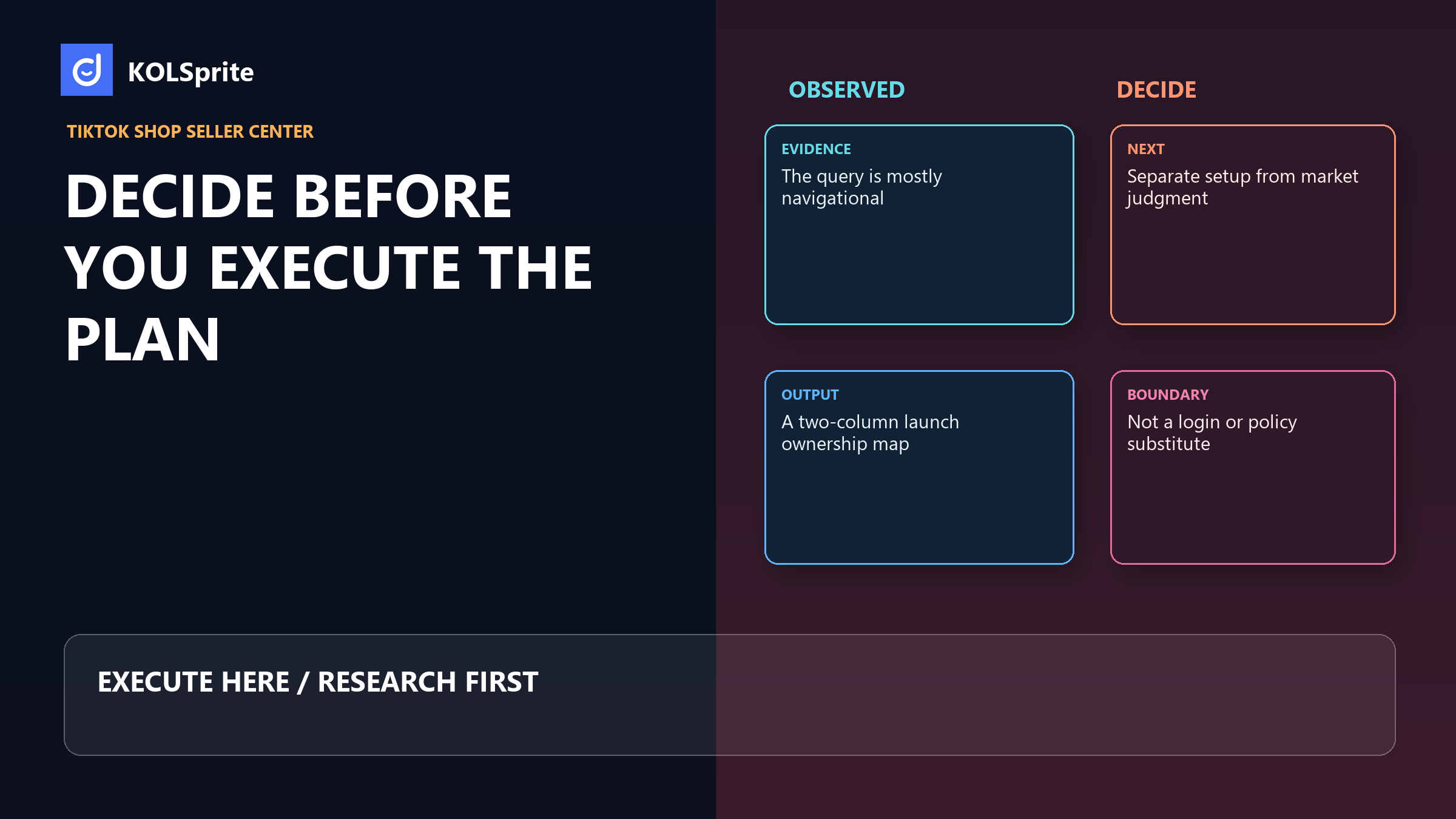
Use Seller Center for approved practical work. Pause when a task assumes an unresolved product, category, creator, or buyer question. The two-column map below turns a setup queue into a launch-room decision, so the team knows when to proceed and when to research first.
A completed setting feels like progress because it leaves a visible trace. A listing draft exists. A shipping option is selected. An account task disappears. None of those actions proves that the product promise is clear or that the team has chosen the right buyer. That gap becomes expensive when an unfinished decision gets treated as a configuration problem.
Consider a common launch-room moment. One person is preparing a first US listing. Another is collecting creator examples. A third asks whether the product belongs in a category with a different buyer expectation. The Seller Center task is real, but the group has bundled it with questions the platform cannot settle. The result is familiar: a technically complete listing followed by a scramble to explain what it is for.
DataForSEO recorded 27,100 US monthly searches for “TikTok Shop seller center” on September 8, 2026. The search results are heavily navigational because sellers want to find and use the system. TikTok Shop Seller Academy guidance explains platform tasks. It does not validate a category guess or product position. Keep those jobs separate from the start.
| Seller Center can execute | Research must clarify first |
|---|---|
| Account and shop configuration tasks | Whether the offer solves a defined buyer problem |
| Listing details for an approved product | Whether a category label matches buyer expectations |
| Operational requirements and platform workflow | Which public product, creator, or video examples are comparable |
| Submission of required platform information | What claim a listing or creator brief can support |
| Execution of a chosen launch plan | Why this product, audience, and content angle were chosen |
Scope: separate launch setup from market research. Market: US. Access date: September 8, 2026. Sample: current official Seller Center and Seller Academy guidance. Cleaning: keep policy steps separate from market claims. Limit: current policy and account requirements remain governed by Seller Center.
The map has two sides. The left asks, “What can we do now?” The right asks, “What fact do we still need?” If the team cannot name that fact, the task on the left cannot supply it.
Imagine a compact desk accessory for students and home-office buyers. Seller Center may need product details, shipping choices, and account steps. That is setup work. Before listing it, decide which buyer use case the item can own. Check whether the package promise is clear. Then find public examples that fit that use case.
On the left, write “Prepare listing details.” Next, name the guess behind it: “We know what buyer problem the title and images must explain.” If that guess is weak, move it to the right. Look for comparable public products, creators, or videos. Do not click through setup screens to avoid the open question.
That handoff is not a rejection of Seller Center. It protects the work Seller Center is good at. A platform can execute a chosen listing structure. It cannot tell a seller whether a broad category label hides the buyer expectation that will drive returns, questions, or weak conversion. For that issue, start with the category decision before finalizing the execution task.
Register for KOLSprite and claim a three-day trial of the web product. MCP access is sold separately.
Register and claim a three-day trial
A practical handoff rule has three parts. First, find the action: create, submit, configure, publish, or update. Second, state the decision it assumes: product promise, buyer, price, claim, creator angle, or comparison set. Third, ask whether the assumption has a named source. If it does, continue in Seller Center. If it does not, move the task into research with an owner and a narrow question.
For example, “submit a listing” assumes the product variation and buyer promise are settled. “Choose a content angle” assumes the team has inspected comparable public context. “Set a shipping option” assumes practical readiness, not product-market fit. The rule stops a team from giving every open question to the person who happens to be logged in.
Use the map during a 15-minute launch check. Read each queued Seller Center task aloud. Put a mark beside any task that depends on a decision still described with words such as “probably,” “similar,” or “should work.” Those words are not proof of failure. They are a signal that the task belongs in the right column until the team can say what it is comparing and why.
Public research becomes useful when it returns to the exact execution task it paused. If the question is category fit, the output may be a short statement of the buyer expectation and the evidence that supports it. If the question is a creator brief, the output may be a small set of observable content patterns and a limitation. If the question is product comparison, the output needs a comparison rule, not a long list of links.
KOLSprite web research can help the team check public product, creator, or video context before returning to the work queue. It gives the team a clear handoff: enter an approved question and close matches, check the useful context, then return a map that names what Seller Center does and what research made clear. For a repeatable public-data handoff, the KOLSprite MCP workflow can carry the same bounded question. It does not create listings or change account settings.
Input: an approved product question, public comparable records, and one Seller Center task. Action: inspect public market context in KOLSprite, then record the conclusion that applies to the paused task. Output: an execution-versus-research map with a named owner, evidence, and boundary.
KOLSprite cannot create listings, submit compliance materials, change account settings, or replace Seller Center policy and account requirements. The platform remains the source for platform execution rules.
Decide who can close each open question
A map is only useful when it names an owner. The person in Seller Center owns the practical task after its dependency is settled. The person researching a product, creator, or buyer question owns a written return: what was observed, what it means for the paused task, and what still cannot be assumed. A manager owns the decision when the evidence changes the launch plan.
That division keeps research from becoming a holding area. A researcher should not return with twenty examples and an implied advice. They should return with a statement such as, “The public comparison supports this buyer use case. But it does not establish the claim in the draft listing.” The execution owner can then either revise the listing or keep the task paused for the missing evidence.
Use a deadline that fits the decision. A missing shipping document is an practical block. A missing buyer definition is a launch-quality block. They deserve different owners and different review standards. Treating both as tickets in the same queue hides the fact that one is an execution task and the other changes what the team is offering.
When a decision returns from research, record it beside the original Seller Center task. The pairing keeps the finding connected to the screen it is meant to inform. It also lets the execution owner challenge the conclusion before it becomes a hidden assumption in the listing or launch plan.
Join the KOLSprite Discord to discuss the question behind your next test.
 +
+
Join the KOLSprite Discord community
A listing can be technically ready and still be unclear to a buyer. Before returning to the Seller Center workflow, check that the title, images, variation naming, and promise all describe the same product job. The question is not whether every field is filled. The question is whether the fields make one defensible promise. Use listing readiness to test that relationship.
When the decision is approved, go back to the left side of the map and execute it cleanly. This is where practical speed matters. The team should not reopen a settled buyer question every time it reaches a setting. The point of the map is to distinguish an unresolved decision from ordinary execution, then let each move without carrying the other’s burden.
For a product question that remains open, use a product-level comparison before returning to the Seller Center task. That keeps the public research tied to one decision rather than to a general setup delay.
Good launch rooms do not reward the person who completes the most screens. They reward the team that can say which decisions were made, what evidence supports them, and who owns the next uncertainty. Seller Center becomes easier to use once it stops carrying decisions it was never designed to make.
Before a launch review ends, read the two-column map from top to bottom. Cross out any right-column question that has a named, reviewed answer. Move its paired task back to execution. Leave unresolved questions visible, with a small description of the evidence that would let the team make a call. This turns a broad sense of “we are still working on it” into a short list of concrete dependencies.
The map also creates a useful record for the next launch. A future team can see which assumptions repeatedly delayed execution and decide whether those questions should be resolved earlier in product planning. That is a process improvement grounded in actual decisions, rather than a new layer of setup for its own sake.
TikTok Shop seller center works best when the execution queue carries only decisions the team can already explain. That leaves unresolved buyer and product questions in a visible research lane.
It also keeps a rushed decision from becoming invisible once the launch is live. The task, its assumption, and the evidence remain together for the next review.
After the map is complete, the execution queue should be shorter and clearer. Some tasks will move forward immediately. A few will wait for a product comparison, category check, or content review. That is progress because the pause is specific. It is not a general request for more research.
Use the same map again when a new question appears. Add the task, name the assumption, and decide whether the platform can execute it or whether the team needs evidence first. A first launch gets calmer when research and execution stop competing for the same checkbox.
Latest Articles
As an essential, data-driven toolkit for TikTok influencers and marketers, KOLSprite provides powerful features for effortless creator discovery, trending content identification, and actionable real-time insights.
It empowers users to make smarter decisions and significantly boosts their TikTok business.

 Refer & Earn