 +
+
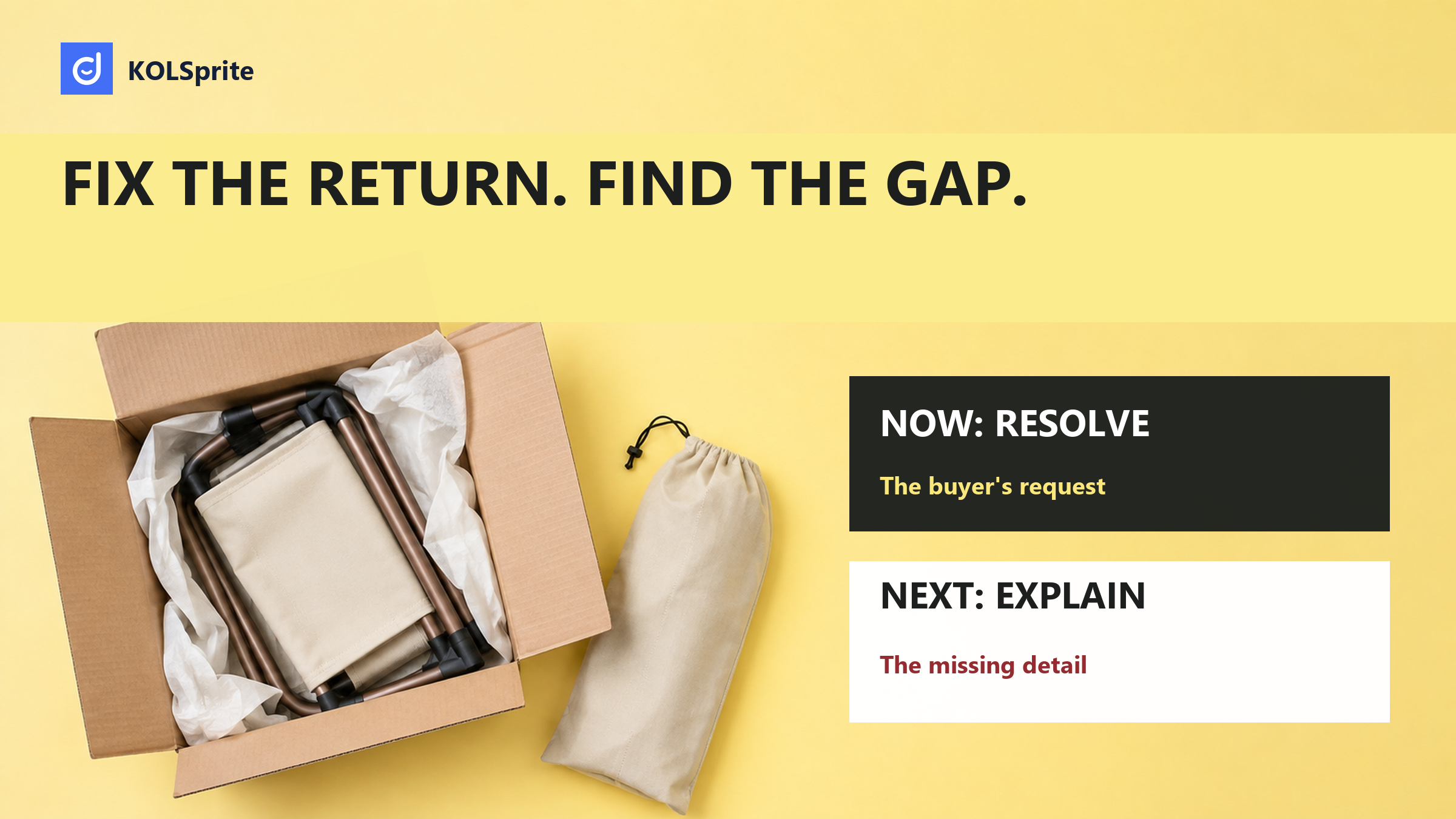
Imagine opening a return request that says a part is missing. The buyer needs an answer; a colleague is already asking whether the video showed something the package never included. Neither question can wait for the same investigation. Begin with the order record in Seller Center, while keeping the suspected content mismatch available for a separate review.
The buyer needs a timely answer. The team needs an honest record of what happened. A public comment can suggest a question worth reviewing, but it cannot decide a refund or prove why someone returned an item. Keep the lanes separate, then connect them through a short handoff.
This example is illustrative. A buyer says a folding camp stool arrived without the carry bag shown in a launch clip. The service owner opens the order, checks the request type and order state, follows the Seller Center path, and tells the buyer when they will hear next. The note says only that the buyer reported a missing carry bag.
After the immediate action is in motion, the content owner gets a separate note. “Review whether the launch clip makes the carry bag look included with every bundle.” Compare the clip, selected SKU, product page, and public questions about included parts. This is a language review. It is not a finding against fulfillment or a decision about the buyer’s request.
The catalog owner may find that the carry bag is included only in one bundle. If so, the fix might be a sharper product title, a visible bundle label, a revised script line, or all three. They may also find that the sold item was packed incorrectly. That needs an operations path, not a caption rewrite. The point of the split is to send each possibility to the person who can verify it.
Open the actual order and identify the request, its order state, and the time-sensitive action. Assign one owner for the customer response and one backup. The customer-facing owner should not wait for a marketing debate before taking the required next step. A buyer with a missing part needs a clear case response, not a promise that the content team will investigate.
Record what you know without adding a cause. “Buyer reports the carry bag was missing” is useful. “Our video caused the return” is an untested conclusion. The distinction protects the buyer and the team. It also leaves room for a real review later, when the product page, packing record, support notes, and public creative can be compared by the people who can access them.
Use plain labels in the case note: request type, order state, stated issue, next required action, owner, and due time. That structure lets a lead see whether the support lane is moving. It does not turn support into a research project.
| Stage in US guidance | First fact to confirm | Keep separate |
|---|---|---|
| Cancellation | The order state and the request in Seller Center. | Shipping alone does not necessarily close a cancellation request. |
| Return request | The window shown at checkout or the default thirty calendar days from Delivered. | A return request is not a finding about why the product disappointed someone. |
| Refund handling | The current category and order-level requirements. | A generic response-time target cannot replace the applicable handling deadline. |
Source: TikTok Shop US aftersales policy and linked aftersales requirements. Scope: cancellation, return, and refund handling stages. Market: US. Access date: 2026-09-03. Sample: official policy documents. Cleaning: documentary review; no private orders or outcomes. Limit: Seller Center and current policy control each live case. Aftersales policy and aftersales requirements.
This is why a spreadsheet of generic response times is risky. A team may know its normal service goal, but it should not replace the order-level handling window with a home-made rule. Shipping alone does not settle every cancellation question. A return request is not automatically the same as a refund decision. Let the case screen establish the facts the support owner must use.
Use a three-day KOLSprite web trial to review public buyer questions. Keep private refund decisions in Seller Center. MCP access is billed separately.
Register and claim a three-day trial
The service lane is immediate. It covers the buyer, the order record, the applicable action, and the promised follow-up. Keep it private. Do not paste customer details into a creative review, and do not ask a social manager to rule on eligibility.
The learning lane begins after the case is stable. Its question is narrower: did public language create an expectation that the approved offer did not meet? Review the claim, the listed included items, the product page, and recurring public questions. A single case may be a fulfillment mistake. Several similar questions may show that the content leaves an important detail unclear. Neither result should be forced from one anecdote.
Set a review date rather than holding the support case open. That small move prevents a familiar failure: the team promises to “look into it,” then no one owns the later conversation. The case owner can close their task while the catalog or content owner receives a specific issue to assess.
Lane one, private case owner: identify the request and order state; act through Seller Center; record the buyer’s stated issue; set the next contact point. Do not promise a cause before the case facts support one.
Lane two, offer review owner: after the service action is underway, compare the public video, SKU wording, product page, and original public comments. Ask one question: “Could a reasonable viewer think this item includes the carry bag?” Mark the answer as open until merchant-owned records are checked.
Handoff sentence: “The buyer report is being handled in the order workflow. Please review whether our public promise clearly separates the standard item from the bundle.” Put an owner and review date on that sentence. It is enough to move the work without mixing a customer case with a marketing conclusion.
Public comments can help the content owner hear the language shoppers use. They can surface questions such as “Does it come with the carry bag?” or “Which bundle is this?” They cannot reveal private orders, establish a return rate, or prove that a comment caused a return. Read the original comments before turning a summary into a change request.
KOLSprite’s AI Comment Analysis can organize public questions and purchase-intent signals from a public video. For this use, its output is a public-language note for the content owner. It is not a returns console, a private order lookup, or evidence of refund entitlement. That limit keeps a useful research aid in its proper place.
For the camp-stool example, a useful KOLSprite output keeps the question about the carry bag beside its original comment. The content owner can compare that wording with the package description. The support agent still uses the actual order record to handle the return.
Look for repeatable wording, not dramatic outliers. If several viewers ask the same inclusion question, copy the exact question into the brief. If the comments are mixed, say so. A clean record of uncertainty is better than a forced pattern that sends the team toward the wrong fix.
Share an anonymized product-expectation question in Discord. Leave names, order numbers and private messages out of the discussion.
 +
+
Join the KOLSprite Discord community
When the review finds an unclear promise, change the smallest surface that can solve it. A listing title may need the bundle name. A product image may need a clear included-items view. A video may need a spoken line before the product tag appears. Do not rewrite every asset because one detail was vague.
When the review finds a packing, quality, or stock issue, send it to operations with the order evidence they need. Content can acknowledge a known limitation in future work, but it cannot repair a missing item. When the review finds no clear issue in the public offer, retain that result too. Not every return should create a creative change.
For a related shipping conversation, see TikTok Shop shipping. To examine the difference between public interest and outcome data, read Amazon return rate. The operational question remains simple: resolve the request first, then review the promise with the right records.
Once a week, a support lead and content owner can review a short list of recurring public-language questions and verified offer gaps. Keep the list small. Include the exact asset, the exact wording, the owner, and the change made. Exclude customer names and case details. This turns aftersales insight into better creative without turning public research into a substitute for support data.
Give each change a check-back point. After a new product image or revised script is live, the owner can scan fresh public questions to see whether the same confusion remains visible. That is a signal to investigate, not a success claim. The real operational record stays in the systems that handle orders and service.
Make ownership visible in a single row. The support lead owns the current buyer request. The catalog lead owns exact item wording. The content lead owns the public claim. An operations lead owns packing or stock findings. Each person can add a fact, a next action, and a date. No one should need to guess who will reply or who will change an asset.
Keep evidence with its lane. A case record belongs with support. A SKU sheet belongs with the catalog owner. A public question belongs with the creative review. This sounds basic, but it stops one weak piece of evidence from doing too much work. It also gives a new team member a clear path when the same question returns next week.
A useful review can end in “no change.” The current video may name the bundle well. The listing may show the included part. The case may have come from a one-off packing error. That conclusion is still useful because it prevents a broad content rewrite with no clear reason. Good operations do not make every report into a campaign.
Closing the service case does not establish why the expectation failed. A missing-part report could still leave an unresolved question about packing or presentation. Record what the order evidence supports and leave the cause unassigned when it cannot distinguish between explanations. A confident label would make the review look finished without making the next correction more reliable.
Use comment analysis for ecommerce to find wording worth investigating. Repeated public questions can direct attention to an unclear promise, but they cannot establish what this buyer received. Keep that distinction in the review record so a later content edit is traceable to evidence.
Older Article
TikTok Spark Ads: Is This Post Worth Promoting?>>
Latest Articles

As an essential, data-driven toolkit for TikTok influencers and marketers, KOLSprite provides powerful features for effortless creator discovery, trending content identification, and actionable real-time insights.
It empowers users to make smarter decisions and significantly boosts their TikTok business.

 Refer & Earn