 +
+
If you manage an Amazon catalog and returns are rising, TikTok can help you see how shoppers understand the product before they buy. It cannot reveal why your Amazon customers returned an item. That answer must come from your return-reason reports, reviews, support tickets, and product data. The useful move is to connect those private facts with public product demonstrations. This guide shows how to turn an Amazon return rate problem into an expectation-gap review, using a vacuum-storage-bag case and a completed proof matrix. You will leave with a clear test for your listing, creator brief, or product instructions.
Start with the return reason, not the viral video. Translate each repeated reason into a shopper expectation. Then study TikTok demonstrations of the same product format to see which expectations creators make visible, which ones they skip, and which claims need tighter limits.
Returns are often the bill for a promise the content did not explain.
A return percentage tells you that something happened after purchase. It does not tell you whether the problem came from fit, damage, confusing instructions, quality, delivery, compatibility, an exaggerated claim, or a shopper who simply changed their mind. Two products can have the same return level and require completely different fixes.
Build the review at the SKU level. Pull the return reason, customer wording, return date, order date, variant, fulfillment method, and any support contact that happened before the return. Group only reasons that point to the same failed expectation. "Too small" and "does not fit a queen comforter" may belong together. "Pump stopped charging" belongs in a separate product-quality lane. "I expected the suitcase to weigh less" is a content and education problem because compression changes volume, not weight.
Amazon's official guidance on product videos recommends showing size, features, and functionality so customers can make informed decisions. That is the role a demonstration can play. It may reduce uncertainty, but it does not replace a product fix when the item is defective or the listing is wrong.
The phrase "make better content" is too vague to act on. Convert each return cluster into a job the next piece of content must perform. The job should be observable. A reviewer should be able to watch the video and answer yes or no.
| Return signal | Likely expectation gap | Proof job | Owner |
|---|---|---|---|
| Bag held less than expected | Capacity was shown without a useful reference | Show the exact bag size, garment type, and count before compression | Content and listing |
| Seal failed after packing | Closing steps or fill limit were unclear | Show the zipper check, fill line, valve, and a normal post-pack inspection | Product, support, and content |
| Pump felt slow or weak | Speed was implied but not measured | Show an honest start-to-finish time for one supported bag | Content and product |
| Suitcase was still heavy | Volume reduction was confused with weight reduction | State that compression saves space and does not remove weight | Listing and creator brief |
| Item arrived damaged | Not a demonstration problem until packaging is ruled out | Audit fulfillment and packaging before changing creative | Operations |
This translation step prevents the creative team from hiding an operational issue behind a new video. It also protects the product team from dismissing a communication failure as "customer misuse." The evidence decides which owner moves first.
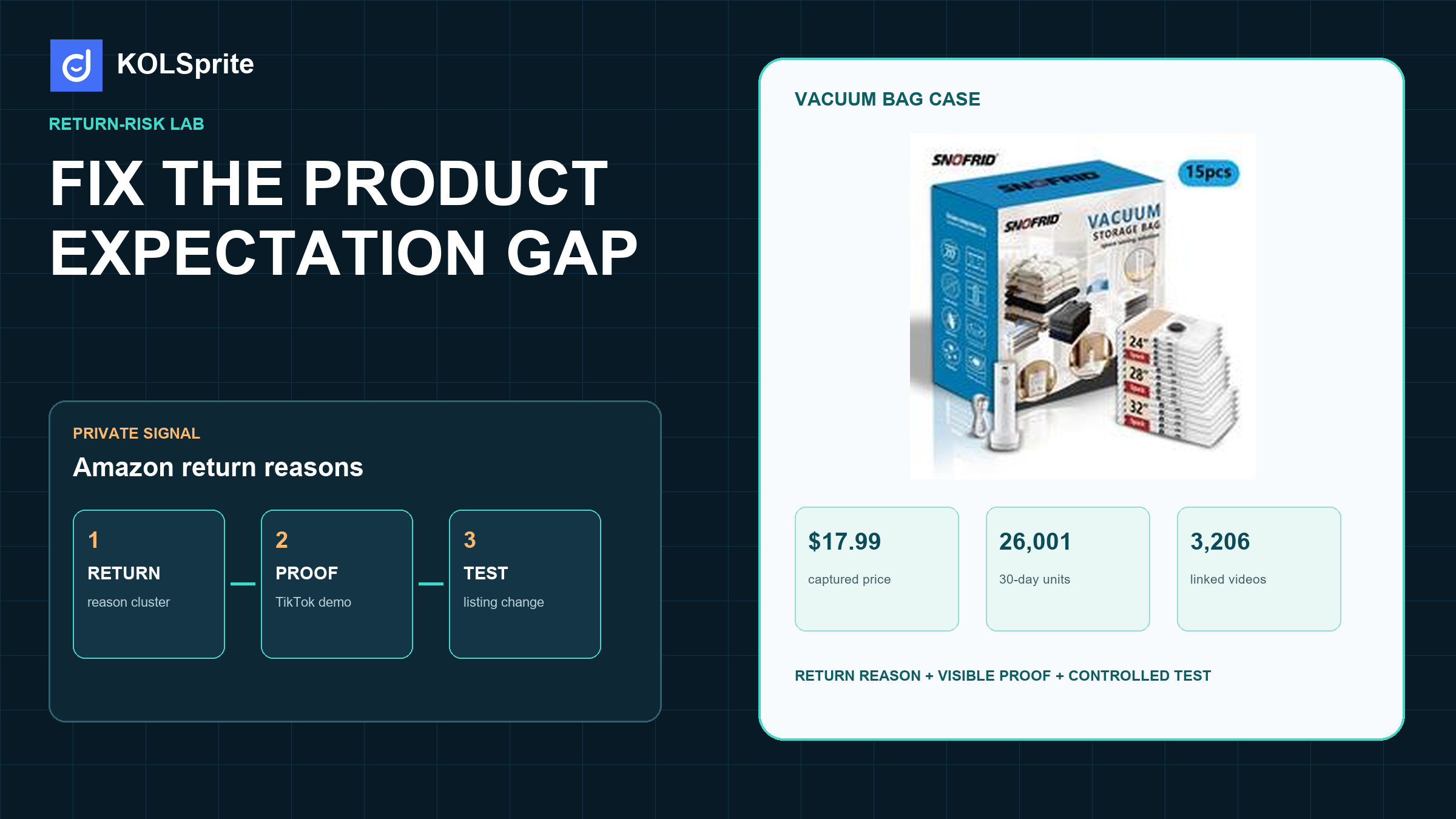
We used KOLSprite to search the US TikTok Shop market for vacuum storage bags, then followed one exact product into its linked videos. The selected Snofrid cordless travel set was listed at $17.99 in the captured record. It showed a 4.6 rating, 7,761 reviews, 26,001 units in the latest 30-day field, 458 linked creators, and 3,206 linked videos. Those fields describe visible TikTok Shop activity. They do not describe Amazon demand, margin, or returns.
The first linked-video records covered different buyer situations. One showed a traveler trying to fit more into a suitcase. Another framed the problem around fragile souvenirs and an already full bag. A third claimed that several suitcases of clothes could fit into one. A Spanish-language video used coats and sweaters, which made bulky seasonal storage easy to understand. The largest visible play counts in the reviewed records ranged from about 2.1 million to 5.2 million.
The numbers are not the main lesson. The situations are. The creators were not merely holding a plastic bag. They were explaining capacity, packing pressure, bulky garments, and travel constraints. That gives an Amazon team four proof jobs to compare with its own return reasons.
Research note. KOLSprite US product search and exact product-linked video records for product ID 1732150942467199345, accessed July 31, 2026. The product page reported 3,206 linked videos; this review used the first decision-useful records, not a complete census. Public TikTok fields were kept separate from Amazon return, cost, and attribution data.
Suppose the Amazon return report shows three repeated complaints: the medium bag looks smaller than expected, the pump takes longer than the shopper assumed, and a packed suitcase remains overweight. The TikTok evidence suggests how to make the next test concrete, but it does not prove that those changes will reduce returns.
| Amazon evidence | TikTok observation | Change to test | Success measure | Stop rule |
|---|---|---|---|---|
| Capacity complaints on the medium bag | Strong demos use recognizable garments and a before view | Add a size-labeled demo with six shirts and one light jacket | Fewer capacity-related returns and questions | Stop if the actual bag varies from the stated dimensions |
| Shoppers call the pump slow | Speed claims appear without a consistent timer | Show one continuous, timed compression under normal conditions | Fewer speed complaints; no rise in abandonment | Stop if test times vary beyond the stated range |
| Overweight-luggage complaints | Space-saving language can sound like total packing relief | Add a plain volume-versus-weight warning near the demo | Fewer weight-related returns and support contacts | Keep the warning even if click-through falls |
The warning in the last row matters. A content change is not successful merely because it attracts more clicks. If it filters out a shopper with the wrong expectation, a lower click rate may be healthy. Measure the downstream cost, not just the top of the funnel.
Open KOLSprite product search with the exact product format, not a broad lifestyle term. Clean the result set before counting anything. A vacuum-bag query can return pumps, organizers, and unrelated travel accessories. Keep products that solve the same job with the same basic mechanism.
Next, open the exact product's linked videos in video search. Save the product ID, creator, video ID, date, duration, visible metrics, and the demonstration job. Do not paste every raw row into a meeting deck. Keep the three to five examples that change a decision. A practical research card needs only the buyer situation, the proof shown, the claim boundary, and the test it suggests.
Finally, compare that card with Amazon's private evidence. KOLSprite contributes the outside view: what creators show, which situations repeat, and how the product is framed on TikTok. Your Amazon and operations systems supply the inside view: return reasons, refund cost, defects, variant patterns, and whether the change worked.
Choose one expectation gap for the first test. Rewriting the title, images, video, instructions, and packaging at the same time may improve the product, but it makes the learning hard to read. If the urgent issue is material, fix it. If the issue is educational, isolate the clearest content change.
A small catalog may need a longer observation window. A fast-moving SKU may produce a readable cohort sooner. Set the minimum order count before looking at the result so the team does not stop as soon as the chart moves in the desired direction.
Do not use a demonstration to explain away breakage, missing parts, unsafe behavior, inaccurate dimensions, or a product that fails normal use. The right action may be a supplier correction, packaging change, listing pause, or removal. A creator should not be asked to soften a claim that the item cannot support.
Also avoid copying the most-viewed TikTok script. A large video may owe its reach to the creator, timing, offer, or entertainment value. Extract the proof job, then build an original test around your product's actual instructions and customer evidence. The goal is a clearer decision, not a look-alike video.
Once the process works, create a small library of expectation gaps: size, setup, compatibility, speed, cleanup, maintenance, comfort, and claim limits. The library helps a product team review a new item before launch. It also helps the content team ask better questions before a creator receives the sample.
For upstream research on whether a trend deserves any inventory at all, use the Amazon product research validation guide. After the product passes, the Amazon bestseller-to-TikTok workflow can help turn proven buyer value into a platform-native content test. This return review sits between those steps: it catches the promise that made it through launch but failed in use.
Pick one SKU. Pull the top return reason. Read five clear notes from buyers. Write the failed hope in plain words. Do not open TikTok yet.
Now find the same type of item in KOLSprite. Keep one exact match. Open three linked videos. Watch each clip once with the sound off. Note what the buyer can see. Watch again with sound. Note what the creator adds.
Place the two lists side by side. Circle one gap. It may be size, time, setup, fit, weight, or care. Write one test that can fill that gap. Name the owner. Set a due date. Set the first group of orders you will use to read the change.
End with one clear choice: fix the item, fix the proof, or learn more. This short review will not solve each return. It will stop the team from making ten weak changes at once.
Pull one SKU's top three return reasons. Turn each into an expectation and a proof job. Review exact TikTok product demonstrations for ways to make that job visible, then test one truthful change against the same return cluster. Use public examples to improve the question, not to invent the answer. That is how an Amazon return rate becomes a fixable operating problem instead of a number the team watches.
Create a KOLSprite account and claim a three-day trial. Follow one exact product into its demonstrations, then compare the proof jobs with your own Amazon return reasons.
Register for a three-day KOLSprite trial
Bring one anonymized return-reason cluster and the proof job you plan to test. Other ecommerce operators can challenge the claim boundary without exposing customer data.
 +
+
Review the return-risk test on Discord
Latest Articles

As an essential, data-driven toolkit for TikTok influencers and marketers, KOLSprite provides powerful features for effortless creator discovery, trending content identification, and actionable real-time insights.
It empowers users to make smarter decisions and significantly boosts their TikTok business.

 Refer & Earn