 +
+
A small TikTok Shop budget becomes noisy when affiliate creators, owned videos, and Shop Ads are all asked to discover buyers, prove the product, and close the sale at once. The result is activity without a useful explanation for what to fund next.
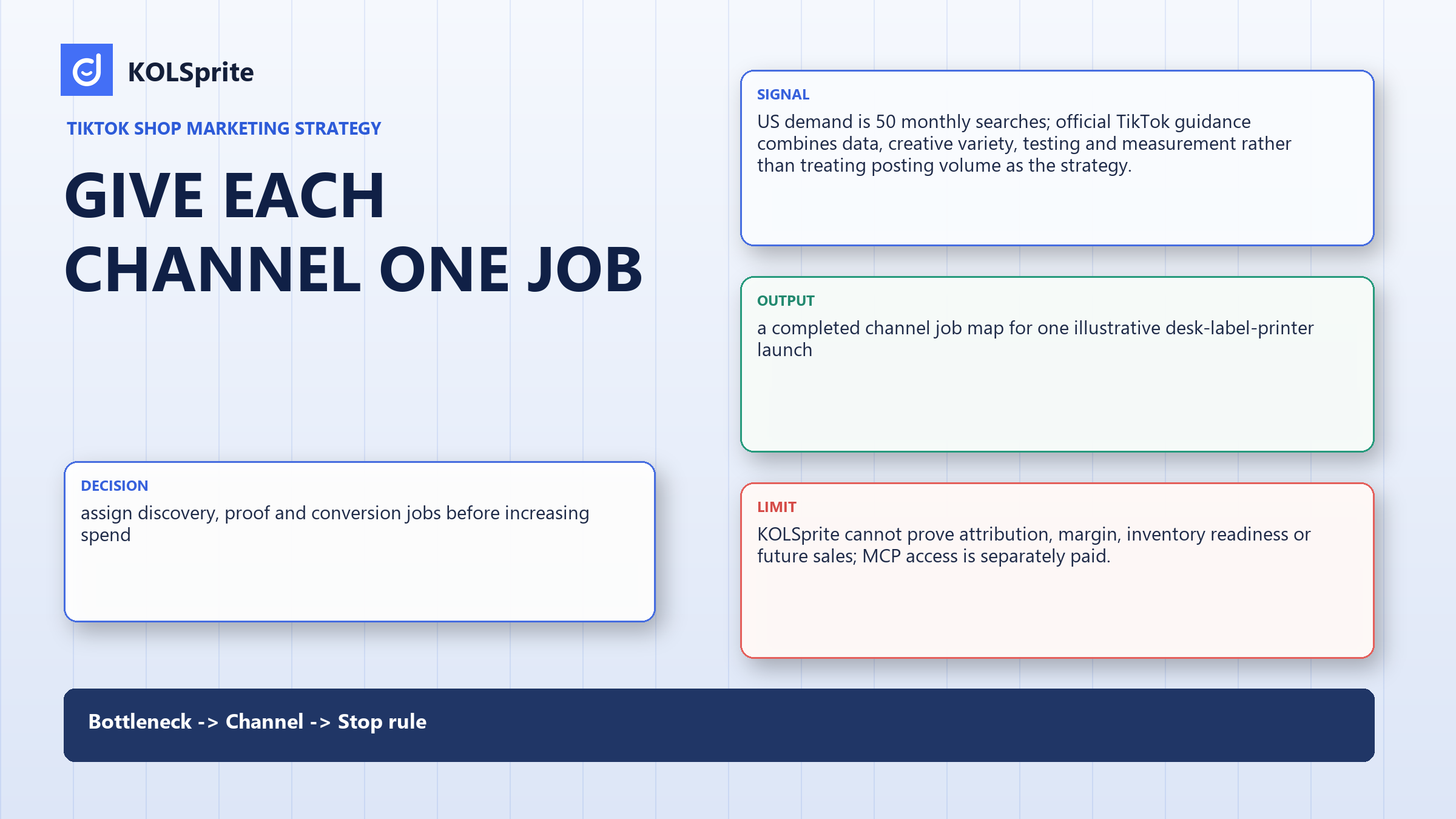
A TikTok Shop marketing strategy should assign one primary job to each channel: discovery, proof, or conversion. Increase spend only when that job matches the month’s bottleneck and the channel has a clear stop rule.
Most sellers can name three available levers: send products to affiliates, make more owned content, or buy ads. That list does not decide anything. The deciding question is what must change before the shop can make a better decision. A new desk-label printer, for example, may have a discovery problem if few relevant buyers see it. It may have a proof problem if buyers see it but do not understand why its labels are cleaner than handwritten ones. Or it may have a conversion problem if the product page and offer lose shoppers who already understand it.
Name only one bottleneck for the next month. That constraint is useful. It prevents a seller from treating every weak result as a reason to fund every channel.
| What the official source covers | What this channel map adds |
|---|---|
| Data connections and simpler campaign management | Name the shop bottleneck before choosing a channel. |
| Creative variety and structured testing | Give each channel one question and one stop rule. |
| Measurement as part of the system | Review whether the assigned job changed a decision. |
Scope: advertising fundamentals. Market: United States, English. Access date: 2026-09-04. Sample: a single official advertising framework. Cleaning: only decision-relevant principles retained. Limit: no shop-specific budget or result is implied. TikTok’s fundamentals guidance links data, campaign setup, creative variety, testing, and measurement.
The comparison matters because a framework and an allocation decision are different things. Official guidance can show which parts belong in a sound system. The seller still has to decide which part deserves attention now. If the shop cannot name that need, the channel map should stay blank.
For this memo, the desk-label printer is illustrative. No sales result below is a claim about a real launch. The reader’s job is to replace the example with one product and one current uncertainty.
Write the map on one page. A channel can support other work, but it should own only one decision this month. The map is not a forecast. It is a way to make later evidence interpretable.
| Channel | Primary job | Question it should answer | Stop rule |
|---|---|---|---|
| Affiliate creators | Discovery | Which buyer context brings the printer into view? | Pause new outreach when briefs repeat the same audience or product use. |
| Owned content | Proof | Which visible moment makes the printer’s use clear? | Stop adding formats when every video makes the same claim. |
| Shop Ads | Conversion | Can a buyer who already understands the product complete the offer? | Do not scale while the page, price, inventory, or landing proof is unresolved. |
Notice what the table leaves out. It does not call affiliates a conversion machine by default. It does not make ads responsible for inventing product proof. It does not ask owned content to reach every possible customer. A TikTok Shop marketing strategy gets more specific by taking jobs away, not by adding channel names.
Add two working fields beside the map: the evidence you expect to collect and the person who will review it. For discovery, the evidence may be repeated buyer contexts in creator content. For proof, it may be questions that remain after a demo. For conversion, it may be a page-level issue found in the seller’s own data. Naming an owner keeps the map from becoming a slide that nobody uses.
Also note the handoff condition. Discovery hands off when one buyer context is clear enough to brief. Proof hands off when the product claim is visible and bounded. Conversion work begins only when a prepared buyer has a fair chance to act. These conditions stop the team from moving money just because a calendar month ended.
Register for KOLSprite and claim a three-day trial of the web product. MCP access is sold separately.
Register and claim a three-day trial
Discovery work answers, “Who should notice this, in what situation?” For the hypothetical printer, affiliate outreach could focus on creators who show order packing or small inventory work. It could also look at market-shipment routines. The brief is not “make a viral video.” It is “show the moment a seller needs a shipping label and tell us whether this audience recognizes it.”
This is where public research can reduce preparation time without pretending to make the budget decision. After the channel job is defined, use KOLSprite web research to compare public product, creator, and video evidence and attach a bounded evidence note to one discovery decision. The note might record repeated public use cases, the visible proof style, and the source links reviewed.
KOLSprite reduces manual public-market research; it does not assign budget, read private ad results, prove attribution, margin, inventory readiness, or future sales. MCP access is separately paid.
Use the related TikTok Shop product research framework before treating a public example as a reason to recruit a creator. A public pattern can suggest a hypothesis. It cannot tell a seller whether that creator will accept, whether stock is ready, or whether the economics work.
Proof work starts after the buyer has a reason to look. For a label printer, the useful questions are concrete: Does the label come out at the needed size? Can a first-time user connect it? Does it solve a packing-table interruption? Owned content can show one question at a time. A packing scene, a setup scene, and a comparison with a handwritten label are not three cosmetic variations when each resolves a different hesitation.
Do not confuse a new camera angle with a new proof job. If five clips all say “fast and easy,” the shop has five versions of one argument. The relevant gap may be compatibility, label durability, or the first use. Link the content plan to your TikTok Shop analytics decision map so the evidence collected can be tied back to the assigned job rather than a general feeling about engagement.
Join the KOLSprite Discord to discuss the question behind your next test.
 +
+
Join the KOLSprite Discord community
Here is a worked, hypothetical allocation. A seller sees that viewers understand what the printer is but regularly ask whether it works for shipping labels. The bottleneck is proof, not raw reach. The next available effort goes to three owned demonstrations: an unboxing-to-first-label sequence, a size-and-compatibility check, and a packing-table use case. Affiliate invitations wait until the seller can explain the product’s proof point in one clear sentence. Ads wait until the shop can tell whether the product page carries that proof into checkout.
That choice can feel slower than sending invitations everywhere. It is faster in the only way that matters: the next observation has an owner. If the demonstrations fail to clarify compatibility, the seller revises the proof job. If they do clarify it but shoppers still leave, the bottleneck can move to conversion. The allocation changes because the question changed, not because a channel is fashionable.
Use a short review sentence after each week: “We funded [channel] to learn or change [job], and the next decision is [decision].” If the blank cannot be filled, the work is not ready for more spend.
A stop rule is not pessimism. It is the condition that keeps a channel from absorbing budget after its job is complete or impossible to judge. For discovery, stop when the creator list starts to duplicate the same audience and use case. For proof, stop when the team is making new treatments of an answer it already has. For conversion, stop when a product-level issue such as inventory, price, returns policy, or page clarity makes the result hard to interpret.
Stop rules also protect against false certainty. A creator video that attracts comments may be useful discovery evidence without proving sales. A clean product demo may be useful proof without establishing a paid-media return. Keep each observation beside the job it can actually support.
Write the stop rule in plain language before launch. “We stop creator outreach when the next ten names repeat the same use case” is clear. So is “we stop buying traffic while the product page still lacks the proof shown in the video.” A rule with an observable condition is easier to follow than a promise to review results later.
Channels should work in sequence when the buyer’s unanswered question changes. Once discovery identifies a promising context, owned content can make the proof stronger. Once proof is clear, Shop Ads can test whether the offer converts a prepared buyer. This does not mean every product follows one funnel. It means the seller has a reason for the handoff.
For affiliates, the handoff is especially important. The next step is not a larger list; it is a creator system built around a product story that has earned its place. The TikTok Shop affiliate program guide can help turn that defined discovery job into a focused outreach process.
At month end, turn the map into a budget decision. Read it from left to right. Name the bottleneck, the channel that owned it, and the observation that changed the next move. Cross out work that cannot answer those questions. A count of posts, invitations, or dollars is not enough.
Then mark each channel “fund,” “hold,” or “handoff.” Fund it when the same job still matters and the next test is clear. Hold it when an offer, page, or evidence gap blocks learning. Handoff when the buyer question has moved to another stage. Sign the map with the review date and the owner of the next decision. That is the final act of this memo: an allocation, not a general conclusion.
Do not fund a channel until you can name the job it owns. For the illustrative printer launch, the finished artifact is the table above, filled with the seller’s product, buyer context, and stop rules. It gives a small team a firm answer about where the next dollar belongs.
Latest Articles
As an essential, data-driven toolkit for TikTok influencers and marketers, KOLSprite provides powerful features for effortless creator discovery, trending content identification, and actionable real-time insights.
It empowers users to make smarter decisions and significantly boosts their TikTok business.

 Refer & Earn