 +
+
When a sales total looks healthy but the payout feels thin, the platform fee is not always wrong. Teams often group several costs together as "fees." Separate the platform deduction from discounts, shipping, product cost, and creator pay. Add refunds and the labor needed to fill the order. What does the sale leave after each cost is paid?
Start with one real settlement record. Label each line as actual, estimated, or still unknown. Then use that record to price the next order. Until you do, a headline fee rate is not a margin model.
For US TikTok Shop sellers, the official fee guidance describes a category-based referral rate of 5% to 6%. The rate applies to customer payment plus a platform discount, less tax. That is a fee-base rule, not a complete profit formula. Your category, current terms, and order details control the result, so check the current seller guidance rather than copying an old screenshot. TikTok Shop's US fee guidance is the primary source for that calculation.
What remains after the referral fee is not automatically your contribution margin. You still need the item cost, packaging, shipping or fulfillment charge, creator commission, payment adjustments if any, customer-service handling, and the likely cost of returns. Some costs occur on every order. Others appear only when an order is changed or refunded. A good worksheet keeps those cases apart.
That distinction is especially important for a new creator-led offer. A creator may generate orders at a price that looks attractive on a dashboard. If the promotion requires a deep seller-funded discount and fast shipping, the order can still be too weak to repeat. The question is not “What does TikTok charge?” It is “What does this exact order leave after the costs we chose to carry?”
Write the fee base as a small equation. Do not begin with gross merchandise value, because that label can hide tax and discount treatment.
Fee base = customer payment + platform discount - tax.
Then multiply that base by the referral rate that applies to your category and current terms. The official guidance does not authorize a universal rate. A seller who uses 5% for every product may understate the deduction for a category that is charged at 6%, and a seller who treats tax as revenue may overstate the base.
| Line | Role in the referral-fee calculation | What to verify |
|---|---|---|
| Customer payment | Included | Order amount paid by the buyer |
| Platform discount | Included | Whether the discount is funded by the platform |
| Tax | Excluded | Tax amount on the settlement record |
| Referral rate | Applied to the fee base | Current category rate and seller terms |
Source: TikTok Shop fee guidance. Scope: fee base and rates. Market: US. Access date: September 3, 2026. Sample: one official fee page. Cleaning: separated fee rules from our worked example. Limit: verify current category and account terms; rates and promotions may change.
Keep seller-funded promotions in a separate line in your worksheet. They can lower the money the buyer pays, but they are not the same thing as a platform-funded discount in the published fee-base formula. If you cannot identify who funded a promotion, mark it unknown until the settlement record resolves it.
Use a three-day KOLSprite web trial to research comparable product prices. Bring your own costs and settlement records; public listings cannot set your price floor. Register to start. MCP access is separate.
Register and claim a three-day trial
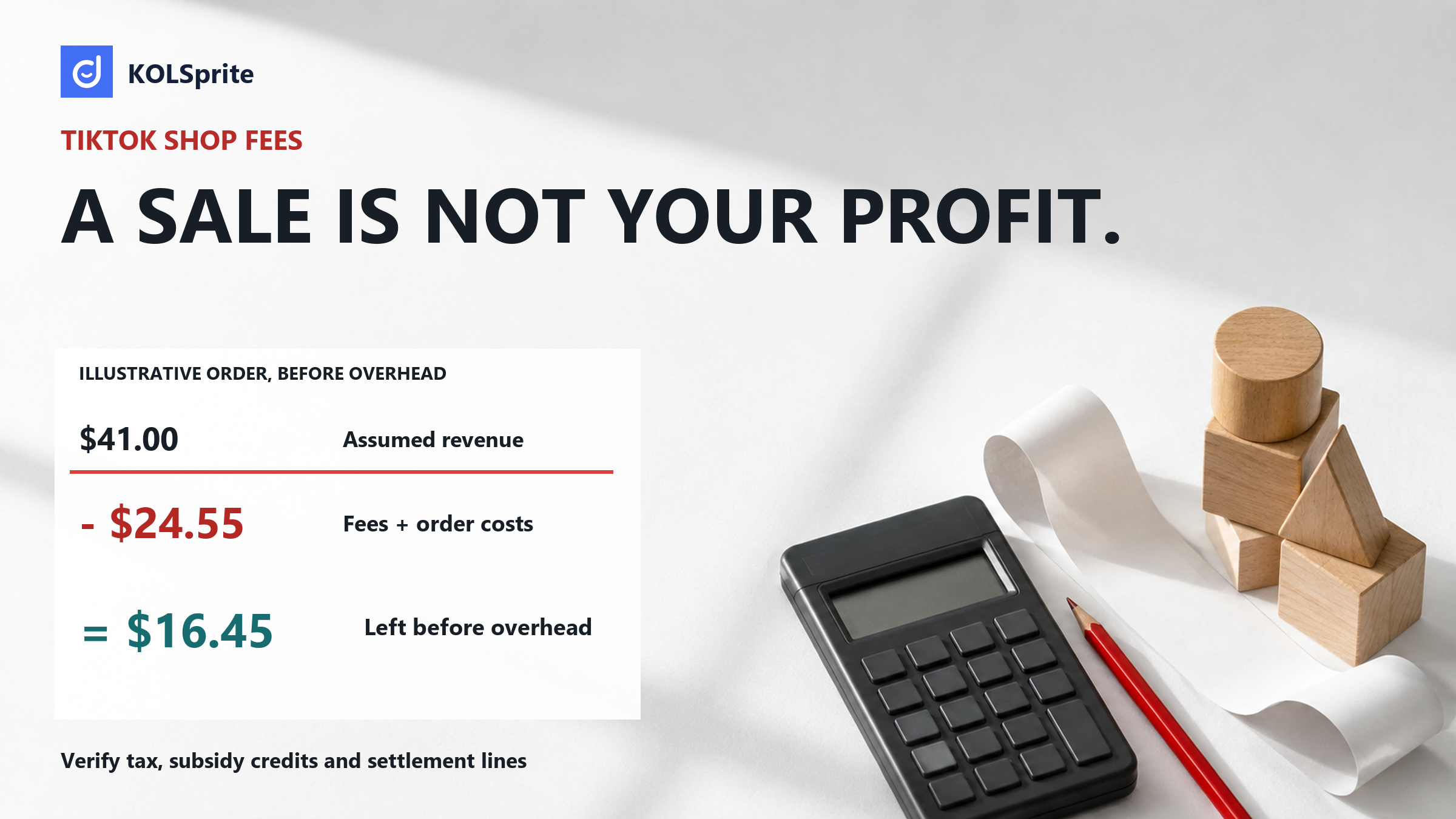
The arithmetic below is an example, not a promised payout. Assume a buyer places an order with a $40 customer payment. The platform supplied a $4 discount, tax was $3, and the applicable referral rate was 5%. The fee base would be $41: $40 plus $4 minus $3. The referral fee would be $2.05.
| Hypothetical order line | Amount | Why it is here |
|---|---|---|
| Customer payment | $40.00 | Starting payment in this example |
| Platform discount | +$4.00 | Included in the stated fee base |
| Tax | -$3.00 | Excluded from the stated fee base |
| Fee base | $41.00 | $40 + $4 - $3 |
| Referral fee at 5% | -$2.05 | $41 x 0.05 |
Now add costs that the fee formula does not settle. Suppose the product and packaging cost $13, fulfillment costs $5.50, and the creator earns $4. Also assume the settlement credits the full $4 platform subsidy to the seller and excludes the $3 tax. That leaves $41 before fees and costs, then $16.45 before overhead: $41 minus $2.05, $13, $5.50, and $4. This is a stated example, not a payout promise. Check the actual subsidy credit and tax lines. The buyer's $40 payment alone is not the seller's revenue, and a fee base is not proof of what was paid out.
Change one assumption and the outcome changes quickly. A 6% referral rate makes the fee $2.46. A seller-funded discount may already be reflected in the buyer's payment; subtracting it again would count the same cost twice. A heavier item may cost more to ship. The example shows which lines to check. Its $16.45 result is not a target for another business.
A refund deserves its own scenario. The official guidance states that the refund administration fee is 20% of the refunded referral fee, capped at $5 per SKU under that page's guidance. That does not mean every refund has the same operational cost. The product may return damaged, shipping may not be recoverable, and the creator commission arrangement may have its own rule.
For the hypothetical order above, a full refund would cause you to inspect at least five questions: Was the referral fee refunded? What is the applicable administration fee? Was the fulfillment charge recoverable? Did the item come back in sellable condition? Does the creator agreement reverse or retain commission? A single “refund rate” cannot answer these questions by itself.
Track refunds by reason as well as count. A damaged shipment suggests a fulfillment issue. “Not as expected” can reveal a creative or product-page promise problem. A size or fit pattern may point to a pre-purchase information gap. The margin worksheet should show the cost of the return, but the operating review should use the reason to decide what to fix.
Amazon also has selling-plan charges, category referral fees, and possible fulfillment costs, but its structure is not a shortcut for TikTok Shop pricing. Amazon publishes the Individual and Professional plan charges separately and notes that selling fees vary by category. Amazon pricing can help an operator compare the cost stacks, but it does not make one platform's rate transferable to another.
Use the comparison for a practical question: which line changes when the same product is sold through a different path? The product cost may not change. Packaging may change. Creator compensation may become a direct cost. A plan fee may be fixed while a referral deduction changes with each order. These distinctions are more useful than declaring one channel “cheaper.”
A brand that already knows Amazon contribution by SKU should copy the worksheet shape, not the numerical assumptions. Rebuild the TikTok version from a current settlement and current terms. That makes the comparison fair and keeps a past cost model from quietly setting a future price.
Comparable public listing prices can help frame an offer range before launch. They cannot tell you what your unit can afford to sell for. KOLSprite can provide a shortlist of public asking prices by product type, which is useful context for a creative hypothesis or offer review. It is not a settlement ledger, tax tool, or source of your unit cost.
First calculate the floor from your own record. Then compare KOLSprite listing prices for similar product types and pack sizes. Ask whether the buyer value supports a price above your floor. If comparable prices sit below it, the answer might be a different bundle, a different creator deal, or no pilot. A public price helps test the offer's positioning; it is not a reason to sell below your cost.
Complete one row for each test order. Use the settlement record where possible and mark assumptions in plain language.
Next, make a second row for a refund. Do not average it into the first row until you know the terms and actual outcome. This keeps a normal fulfilled order visible while still forcing the team to plan for the exception.
Join the KOLSprite Discord to discuss how you structure an offer-cost review. Keep account details and private settlement records out of a public conversation.
 +
+
Join the KOLSprite Discord community
When people disagree on a price, pull one completed order. Put the order screen and the settlement record side by side. Read each field aloud. This small act often finds the bad assumption. A team may have used the list price instead of the buyer payment. It may have counted tax as sales. It may have missed a creator charge that sits in a different report.
Make the review short. One person reads the source line. One person fills the worksheet. A third person asks what is assumed. Do not turn the meeting into a debate about a target margin. The goal is to make the first row true. Once the row is true, the team can test a new price, a new discount, or a new creator deal with less guesswork.
Save the source date with the row. Fee terms, carrier charges, and offer rules can change. A dated worksheet gives the next reviewer a fair starting point. It also prevents a past test from being used as proof of a current payout.
A sales number is the start of the calculation. The platform fee is one explicit line. Shipping, discount funding, product cost, creator pay, and refund handling decide whether the order can support another round of content. Once those lines are visible, a pricing discussion becomes less emotional and more useful.
For operating context, use the seller reporting guide to connect settlements to shop analytics. Review affiliate commission costs before treating creator pay as a casual percentage. Then place the final order economics beside the broader return on creator spending.
Before committing to the next price, build the fee base from the order. Add your business costs and run a separate refund case. The 5%-6% headline is not a price floor. Tie that floor to a real settlement record and clearly labeled assumptions so the next order has a cost check behind its price.
Latest Articles

As an essential, data-driven toolkit for TikTok influencers and marketers, KOLSprite provides powerful features for effortless creator discovery, trending content identification, and actionable real-time insights.
It empowers users to make smarter decisions and significantly boosts their TikTok business.

 Refer & Earn