 +
A small creator can be a good partner for a small brand, but a follower count is not a shortlist. You still need to find people who talk about a relevant problem, show products in a way your team can support, and are interested in working with you.
To find micro influencers, start with the product and buyer question, compare a few discovery routes, then review each creator's recent work before contacting them. Treat the follower range as a search filter, not proof of fit or future sales.
Knowing how to find micro influencers is only the start. This guide compares ways to find candidates and turn a broad list into a useful first conversation. Its examples are made up; they do not describe an actual brand campaign.
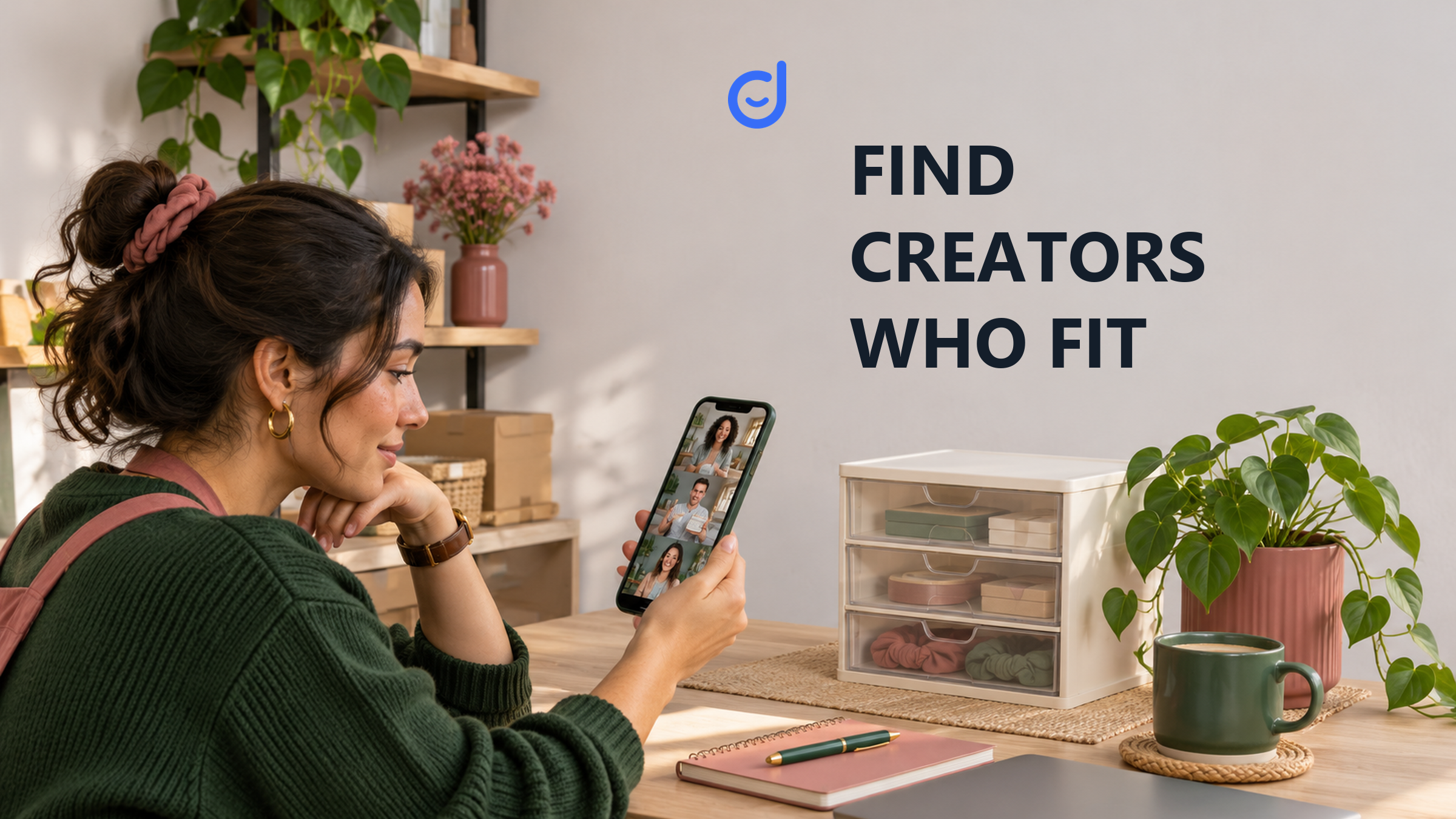
Imagine a small brand selling a drawer organizer. A creator who makes short videos about kitchen storage may be worth a closer look. So might a creator who shows compact apartment routines. The first signal is not that either person has a particular number of followers. It is that their public work may give them a reason to show the product in a setting their viewers recognize.
Write down the question the product needs to answer. For the organizer, it might be “Will this make a crowded drawer easier to use?” A useful demonstration could show the drawer before and after the organizer is placed inside, along with the actual dimensions. A creator who usually talks about an unrelated subject may have a large audience, but that alone does not make the product a natural fit.
You can use a follower range to keep the first search manageable. There is no single universal boundary that makes one creator a micro influencer and another something else. Set a range that fits the size of test you can support, and keep the range visible when comparing candidates. Do not infer a creator's rate, audience or willingness to participate from that number.
The creator program guide addresses the wider work of running a program. Here the immediate task is narrower: find a few people worth speaking to.
| Discovery route | Useful for | What to check next |
|---|---|---|
| Relevant public content | Finding creators who already show a real use case. | Review more than one recent post and confirm the work fits the product. |
| Platform creator marketplace | Searching participating creators using the platform's available tools. | Check your account access and the scope of each filter. |
| Customer or community recommendations | Finding names people already associate with the problem. | Review the creator's own content rather than relying only on the referral. |
| A previously suitable creator | Finding related topics or presentation styles to investigate. | Assess each new person independently; similarity is not an endorsement. |
Public content gives you a direct look at how someone presents a topic. Search for the use case, not only the product name. For a drawer organizer, a relevant term could describe a crowded kitchen drawer or a small-space routine. A candidate is worth review when the content itself helps you understand how the creator communicates about that problem.
Do not stop at one attractive video. Look at several recent posts when they are available. Does the creator regularly explain a similar task, or was the topic an isolated post? Can you tell what they actually showed? A review of public work is a starting point; it cannot establish whether the creator will accept your offer or whether their audience will buy.
TikTok describes tools for finding creators in TikTok One. Its search guide says users can search by name or topic, use available filters, and review creator profiles. The guide is dated November 2026. Check your account for access and current options.
Meta's 2024 Instagram marketplace announcement describes a place for brands to find creators. The announcement is dated. Check the current platform and terms to see what your account can use.
| Source | What it describes | What it does not establish |
|---|---|---|
| TikTok One guidance | Creator search, available filters and profile review inside the platform. | That a specific candidate will accept a deal or perform well. |
| Meta's 2024 announcement | An Instagram marketplace intended to help brands and creators find partnerships. | That all described features are available in every account today. |
Sources: TikTok and Meta, checked November 9, 2026. The guides describe discovery tools, not the results of a campaign.
A filter can save time, but it does not remove the need to inspect the content. A category label may be broad. A location field may describe the creator rather than the audience. A profile may look relevant while the creator is unavailable or does not work in your category. Treat each result as a candidate for review, not as an approved partner. If a search brings back mostly unrelated accounts, change one term and review the new results. Keep the original term in your notes so your team can compare which search was more useful.
Open the candidate's recent public posts and look for a useful match with the product question. A creator does not have to use your exact product already. They do need a credible way to show the kind of task your product helps with. For the hypothetical drawer organizer, that might be a clear look inside a drawer, an explanation of a small-space problem, or a demonstration of how the person sorts everyday items.
Watch for the difference between a polished shot and clear evidence. A fast montage can look appealing but leave the viewer unable to see the product in use. A plain video can be useful if it shows the setup, the action and the result without exaggerating what happened. The right choice depends on what your buyer needs to understand, not on one preferred production style.
Then consider what you would need to ask. Does the creator work with brands? Can they receive the product in time? What are their terms for a post or a delivered video? If you need an audience in a particular country, ask for appropriate information that relates to that audience. Do not assume a creator's location tells you where every viewer lives.
The creator-fit guide helps you decide whether to send a sample. It is most useful once you have real work to review.
You do not need a complicated scoring model to take the first step. For each candidate, write down the public work you reviewed, the product question it suggests they could address, and what remains to be checked. Include a link to the relevant post or profile so another team member can see the same evidence.
Imagine a shortlist with three people: one shows small kitchens, one explains how to sort drawers, and one films close product reviews. These roles are made up, not real people. Each person on a real list needs their own review before contact.
Write a different reason for each name. If every note says “good engagement,” you have not yet explained why that person fits the organizer. A stronger note names a visible behavior: the creator shows the contents of a drawer clearly, explains how they choose a storage layout, or films a close view that makes size easy to understand. These observations are still not proof of campaign success.
When two creators seem equally relevant, compare the work your team can support. One may need several product sizes for a demonstration; another may be able to show a single item clearly. Ask about their ideas before deciding which request fits your budget and schedule.
Leave space for facts you cannot check in public. These may include a creator's audience, fee, shipping address, schedule or terms for paid use. Ask about them directly instead of guessing.
When you have a few good candidates, make the first note about their work. Mention a relevant post you reviewed and explain the product in one sentence. Ask whether they are open to a specific project. A gift is not payment for work unless both sides agree to that arrangement.
The outreach template offers a structure for making that first contact specific. Customize it to the person and your real request. An honest, short message is easier to respond to than a long brief sent before the creator has expressed interest.
Talk about disclosure early. The FTC's guidance says a material connection can include a free or discounted product, not just cash. The facts of the endorsement matter. Discuss the right disclosure and platform rules before a post goes live.
A candidate can be well suited to the task and still be the wrong person for your next test. They may not have time, the product may not suit their usual work, or the price and rights may be outside your budget. Those are reasons to keep looking, not reasons to pressure them into a vague arrangement.
If none of your candidates can show the product's key use honestly, revisit the search terms and the demonstration itself. Perhaps the problem is too broad, or perhaps the product needs a clearer explanation before anyone can make a useful video. A smaller, well-reasoned list gives you a better starting point than a large list built only around follower counts.
Once someone is interested, agree on the deliverables, timing, payment and planned use before the work begins. Then both sides know what the first test is meant to produce and what they will need to decide next.
Latest Articles
As an essential, data-driven toolkit for TikTok influencers and marketers, KOLSprite provides powerful features for effortless creator discovery, trending content identification, and actionable real-time insights.
It empowers users to make smarter decisions and significantly boosts their TikTok business.

 Refer & Earn