 +
+
Before paying for a TikTok influencer platform pilot, name the decision that costs too much time or produces weak answers today. Build the pilot around that gap. Then test whether the platform improves the work. A long list of discovery, analytics, and outreach modules does not settle the purchase. This selection essay gives brand and agency leads a four-lane platform map and a paid-pilot scorecard. The goal is to buy evidence for one decision, without paying for an all-in-one promise the team cannot use.
Platform buying often starts with a polished creator search. The vendor finds a few impressive profiles, the room nods at the dashboard, and someone asks about outreach. By the end of the call, discovery, due diligence, creative research, and campaign operations have been folded into one imagined solution. The pilot then fails for a simple reason: the team never named the handoff it needed to fix.
That handoff may be a weak shortlist, a slow fit review, a missing creative rationale, or an unstructured campaign process. Each needs different evidence. A discovery tool can produce many names and still fail to help an agency decide which people fit a brief. A campaign system can organize work after approval and still be useless for judging the public content behind a recommendation.
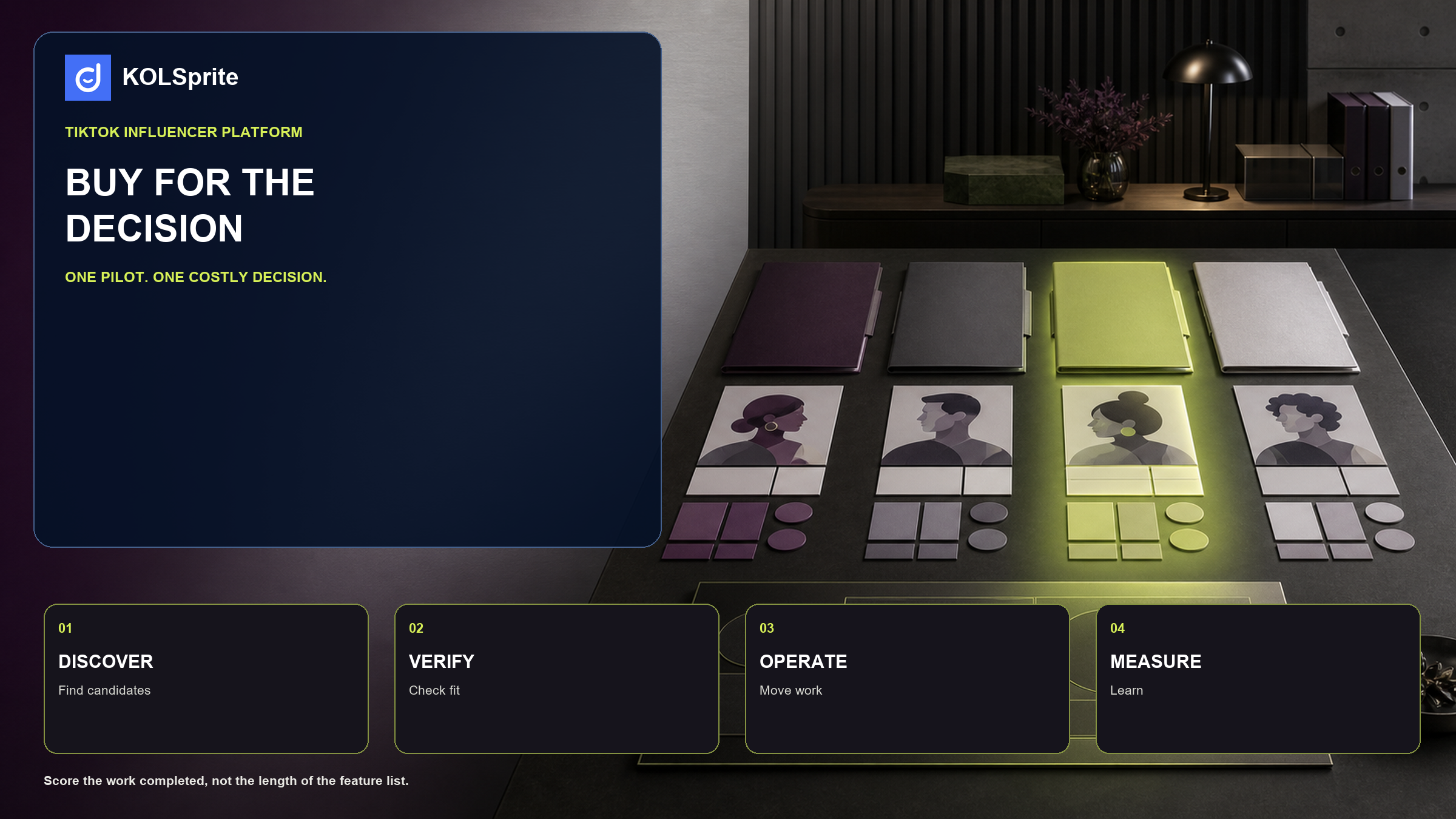
Discovery asks who should enter the first review. Due diligence checks which public facts support or weaken fit. Content research looks at the work viewers see. It finds patterns in the creative and in audience response. Campaign operations covers the steps after approval: outreach, contracts, delivery, and reports.
None of these lanes is lesser. They simply produce different artifacts. Discovery yields candidates. Due diligence yields a documented reason to advance or decline. Content research yields a creative brief or a pattern worth testing. Campaign operations yields a record of owned work and commercial coordination. A platform should be judged by the artifact your team cannot reliably produce today.
| Lane | Decision | Useful pilot output | Boundary to keep visible |
|---|---|---|---|
| Discovery | Who should enter review? | A short, explainable candidate set. | Names alone do not prove fit. |
| Due diligence | Who should advance? | A profile note with public evidence and open questions. | Public signals are not private audience data. |
| Content research | What should the brief test? | A public-content observation tied to a creative choice. | Observation does not grant content rights. |
| Campaign operations | How will approved work be run? | An owned workflow for outreach and delivery. | Commercial, legal, and attribution controls need their own review. |
Source and scope: the map is an editorial buying framework. TikTok’s materials on creator marketing, creator marketing projects, and finding creators in TikTok One describe platform context. They do not certify a vendor or promise results from a pilot.
KOLSprite can support public creator and content research where that evidence belongs in the pilot, while private CRM, payment, and legal processes stay in their own systems.
Register and claim a three-day trial
A paid pilot earns its budget when it has a narrow question, a defined population, a fixed owner, and an artifact to compare against the old method. “Can we find creators faster?” is too loose. “Can two researchers create a ten-person public-evidence shortlist for this brief, with documented reasons and fewer manual handoffs?” is testable. It also allows a fair comparison with the spreadsheet process the team uses now.
Set the pilot length around actual work, not a generic trial period. Give users a real brief. Preserve the source notes behind each advancement. Record where they left the tool to finish the job. That final detail is valuable. A platform may be worth keeping for one lane even when it does not cover the rest.
Ask the vendor the routine questions early. Which data is public or partner-provided? Which fields are estimates? Find out what the team can export and where its notes will live. Ask what a user can do when a record is missing. Clear answers are part of the product. A vague answer belongs in the pilot findings.
Give the scorecard five lines. Did the team reach the named decision faster? Could a second reviewer understand the evidence? Record whether the platform reduced copying and whether it raised new questions about data trust. Finally, check whether the output fit the next system in the workflow. Write one sentence beside each score. A numeric total can compare two pilots, but those sentences keep a prettier interface from winning on looks alone.
Migration should appear on the card as a cost, not a footnote. A team that must rebuild its past notes, change its approval process, or duplicate records across systems may still benefit, but the work needs an owner. Data trust belongs there too. If the platform’s explanation of a metric does not match the decision being made, treat that as a limitation instead of filling the gap with confidence.
Join the KOLSprite Discord to discuss discovery, due diligence, content research, and the practical scorecards teams use before a platform commitment.
 +
+
Join the KOLSprite Discord community
KOLSprite has a defined role in discovery, public-evidence review, and content research. A team can use it to name a decision gap and search or inspect creators. It can save public evidence of fit and organize context for a shortlist or outreach. These guides show the related work in more detail: a stable-ID creator discovery workflow, an influencer marketing operating plan, and creator-fit questions for analytics.
KOLSprite is not a CRM for every task. It is not a payment tool, legal review service, private audience database, or source of guaranteed campaign attribution. Keep private deal terms and attribution data in approved systems. This limit also makes the pilot fair. The team will not grade public research software against contract work the product never claimed to do.
Stop when the team cannot say what decision the platform improved. Stop when every user relies on a personal workaround to finish the task. Stop when a score looks persuasive but nobody can name its source or its limitation. Also stop when the purchase depends on a promise that one tool will settle creator fit, manage commercial work, and prove sales impact in one place. Those are separate operating questions.
Write a specific recommendation. You might keep the platform for public creator discovery and evidence notes. You might pilot another system for campaign operations while keeping the current contract process. Add a review date, such as next quarter if search volume rises. This may feel modest beside an all-in-one demo. It is still a better buying decision because the team knows which work will change on Monday and which work will stay put.
Before a pilot begins, decide what proof must remain readable outside the platform. A shortlist should retain the public URLs or identifiers allowed by the workflow, the selection reason, the review date, and the unresolved question. A research finding should retain its source and the limited conclusion it supports. This protects the team from treating a vendor interface as the only place where a decision can be explained.
Portability also makes the pilot fair. If the output can be read by the strategist, the legal reviewer, and the operations lead, the team can see whether the new platform improved communication or merely moved it into a different room. A platform does not need to replace every system to be useful. It does need to leave a clear handoff for the systems it does not replace.
Public evidence of fit can support a choice to contact a creator. It cannot tell you whether that creator is free, what they charge, or which usage rights they will grant. It also cannot settle exclusivity, legal review, brand safety review, or sales attribution. Put each open question on the paid-pilot scorecard. Give the work to an owner outside the public research tool. Buyers can then discuss the creator without making claims the evidence cannot support.
The team should be able to say, “This platform improved our public-evidence shortlist.” Stop there. Do not add, “therefore the campaign will perform.” The first claim is about research. The second is a sales forecast. A sound TikTok influencer platform pilot keeps the two claims apart.
There is another practical benefit to this restraint. It makes renewal meetings shorter. The buyer can show a before-and-after sample of the decision artifact, name the work still handled elsewhere, and choose whether the improvement is worth the cost. That is more durable than a deck filled with feature screenshots, because the team can revisit the same test when the vendor, process, or campaign mix changes.
Set a review date before the pilot ends. On that date, ask the original question again. Compare completed work with the old method, not just user enthusiasm. A pleasant platform may leave the costly handoff in place. A narrow tool may save hours on a decision that once depended on scattered tabs. The written pilot question keeps both results visible. Store the comparison materials with the memo so the next buyer can see how the team reached its recommendation. Include the old workflow, the test conditions, and the exact point where the new tool changed the decision.
Latest Articles
As an essential, data-driven toolkit for TikTok influencers and marketers, KOLSprite provides powerful features for effortless creator discovery, trending content identification, and actionable real-time insights.
It empowers users to make smarter decisions and significantly boosts their TikTok business.
 Refer & Earn