 +
+
If you manage influencer research, your first risk is often identity, not fit. Similar handles, copied names, inactive pages, and regional accounts can send a team into the wrong profile. This guide gives you a safer TikTok creator discovery workflow. Start from a relevant product video, capture the creator handle and stable account ID, then confirm the exact record before scoring content or sending outreach. You will leave with a verification card that a second teammate can repeat. Use one rule: a name match is a clue; an ID match is evidence.
A link in a chat is not a durable research record. Handles can change and search results can place close names together. Save the source video, visible handle, stable creator ID, country, date, and reason the account entered the queue.
Do not score a creator until you can prove which creator you scored.
A broad query can return thousands of accounts, but a large result count says little about relevance. We tested “home organization” in KOLSprite and saw profiles connected to many unrelated categories. A refined search using an organization term and a storage-bin category returned no records. That did not prove the market had no creators. It showed that the chosen filters were too narrow, mismatched, or unsupported for that path.
The correct response to a zero is not to relax every filter until something appears. Record the failed query, change the discovery route, and protect the meaning of the result. For product-led campaigns, a useful alternate route starts with an exact product and its linked videos. The creator has already shown some relationship to the product type, so the team begins with observed behavior instead of a profile claim.
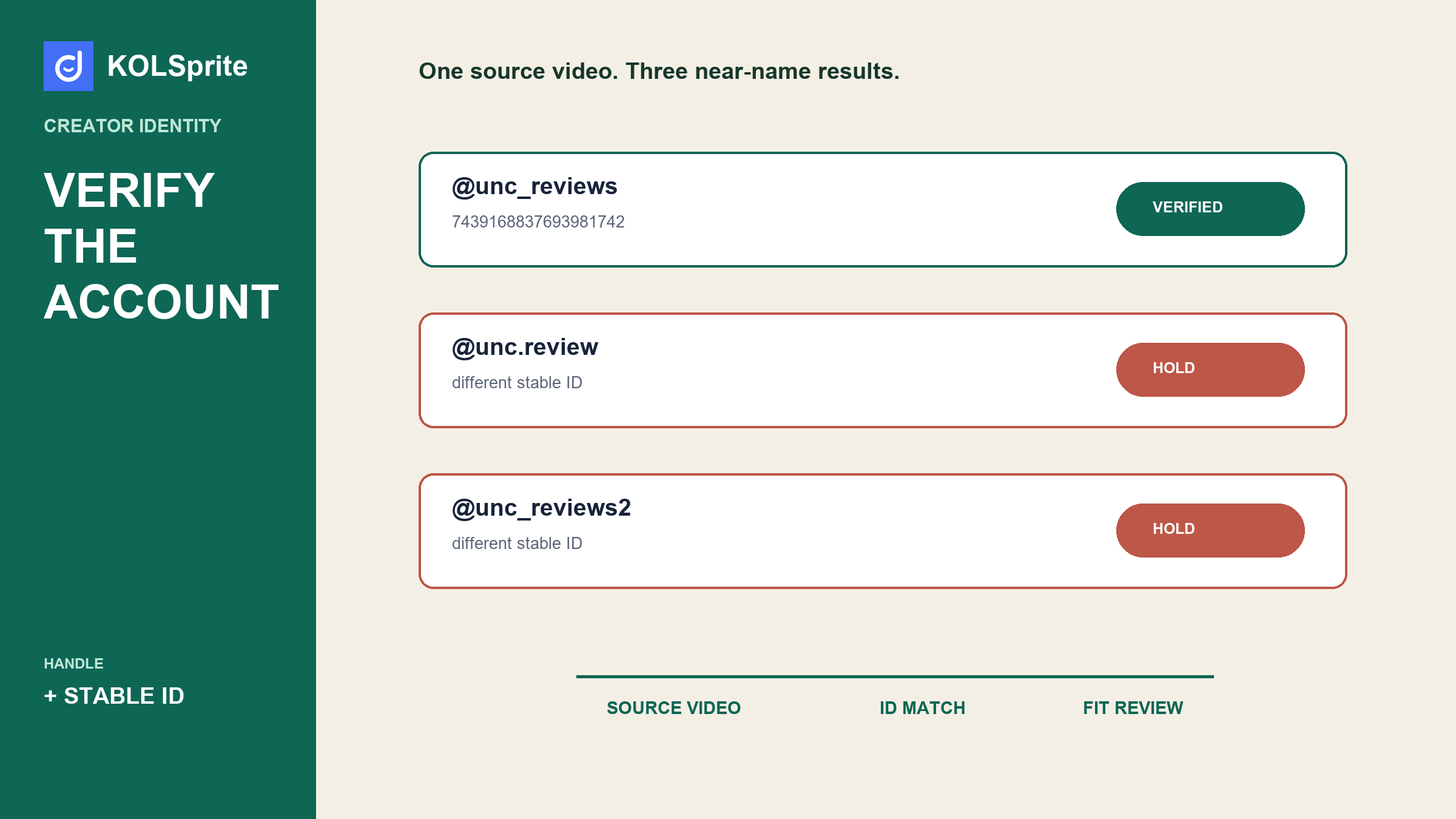
In the portable-blender case, one product-linked video showed about 6.8 million plays and 1,482 recorded 30-day units. Its visible creator handle was unc_reviews, and the video record carried creator ID 7439168837693981742. We then searched that exact handle. The result list included three similar names.
Only one row matched both the handle and the stable ID from the source video. That record showed about 110,095 followers, 681 videos, roughly 379,874 average views, and an interaction-rate field of 0.1298 at the time of access. Two near-name accounts had different IDs and much smaller visible scale. A researcher who chose the first familiar-looking name could have attached the video evidence to the wrong person.
Research note. KOLSprite product-linked video and creator search; US market; accessed July 28, 2026. The connected case requires the same stable creator ID across the video and creator records. Profile fields are directional snapshots and do not confirm commercial terms, audience authenticity, availability, or brand safety.
| Field | Source video | Creator result | Verdict |
|---|---|---|---|
| Visible handle | unc_reviews | unc_reviews | Match |
| Stable creator ID | 7439168837693981742 | 7439168837693981742 | Match |
| Market context | US product-linked video | US search result | Consistent |
| Commercial readiness | Not established | Not established | Still unknown |
The card should fit on one screen. Include the creator's current handle, stable ID, source video URL or ID, product or category, date found, and who verified it. Add a small thumbnail when your team works visually, but do not use the image as the identity key. Finish with one sentence: “This account entered the queue because…”
That final sentence prevents a second problem. Teams often verify the right account but forget why it mattered. “High views” is too broad. A stronger reason is “showed a leak test clearly in 37 seconds” or “answered a sizing objection without a spoken claim.” The reason becomes the first fit question later.
Identity asks whether the account is the account you intended. Observed fit asks what the creator has actually shown. Unknowns cover details that search data cannot settle. These are different stages and should never share one score.
| Stage | Question | Acceptable evidence | Output |
|---|---|---|---|
| Identity | Is this the same creator? | Handle plus stable ID match | Verified record |
| Observed fit | Can this person show our proof? | Relevant videos, format, tone, and audience context | Keep, hold, or reject |
| Commercial check | Can we work together safely? | Contact, rate, rights, disclosure, timing, and availability | Outreach-ready or pending |
A creator can pass identity and fail fit. A creator can pass observed fit and remain on hold because usage rights or timing are unknown. A creator may also have strong product-linked content but no interest in brand work. The workflow makes those limits visible instead of hiding them inside one “creator score.”
KOLSprite is most useful in this workflow when the team is browsing a real TikTok product or video and needs to keep the evidence attached. The researcher can use video search to narrow examples, then use creator search to confirm the exact account and compare visible profile fields. This is not a substitute for speaking with the creator. It reduces mistakes before the conversation begins.
The workflow also fits KOLSprite's browser-led advantage. A content lead can notice a strong demonstration while browsing, capture it, and send a verified record to the partnership team. The partnership team does not need to guess which account or rebuild the source context from a screenshot.
Stop the review and label the record “identity unresolved.” Do not average the fields from two accounts or choose the one with more followers. Return to the source video and open the profile from the platform if possible. Check whether the handle changed, whether the video was reposted, and whether the search result belongs to another region.
If you cannot resolve the mismatch, keep the content idea and remove the creator claim. A useful demo can still inform a brief even when the account cannot enter an outreach queue. This distinction protects the team from turning an uncertain identity into a confident recommendation.
After identity passes, review three to five recent videos. Ask whether the creator can repeat the relevant proof without copying the source clip. Check how the product appears in the story, whether comments show audience interest, and whether the tone fits your brand. Then list the commercial unknowns beside the observed fit.
TikTok's own TikTok One creator search guide explains that teams can use names, keywords, and creator filters in the official collaboration system. That route is useful for formal campaign discovery. Product-linked research adds a different clue: it starts with work the creator has already shown around an item or use case.
The creator engagement benchmark guide can help place visible performance in context, but it should not replace the demonstration review. Averages can screen; examples explain. When the account is ready, use the creator outreach SOP to mention the exact observed behavior instead of sending a generic compliment.
This method works beyond product affiliates. Agencies can use it when a client sends a screenshot. Market researchers can use it when tracking recurring voices in a category. Content teams can use it when an example moves from inspiration to a possible partnership. The key is to preserve identity before the record changes hands.
The unc_reviews record passes identity because the handle and stable ID match the product-linked video. It also provides enough observed activity for a deeper content review. It does not yet pass commercial readiness. Contact details, audience quality, rates, rights, disclosure practice, and availability still need checks. That is a sound result for TikTok creator discovery: the right account, the right source, and no invented certainty.
Store the verification card beside the campaign brief, not in a private browser folder. Add a review date because handles, content, and profile fields change. When someone updates the record, preserve the original source video and note what changed. This gives the team an audit trail without turning the process into paperwork.
Good TikTok creator discovery feels slower for the first five minutes and much faster for the next five people. It removes duplicate research, reduces wrong-profile outreach, and lets the creative and partnership teams discuss the same observed work.
Keep the handoff short. Write: “We found this creator through a portable-blender video. The handle and stable ID match. The clip shows a clear product demo. We have not checked rates, rights, audience quality, or timing.” Add the source link and the date. That is enough for the next person to start in the right place.
This note also makes a hold easy to explain. If the ID does not match, say so. If the creator looks useful but the source is weak, keep the idea and pause the outreach. If the match is clear, move to a small review of recent work. Each step has one job. No one has to guess what “approved creator” means.
At the end of the week, remove duplicate records and close old holds. Keep one owner for each open check. A clean queue is more helpful than a long list. It tells the team who is ready for a real fit review and who still needs proof.
A good record can be read in one minute. The team sees the clip, the exact account, and the reason it may fit. The team also sees what is not known. That last part matters. It stops a guess from turning into a fact as the card moves from one person to the next.
Think of the card as a label on a box. It tells you what is inside and where it came from. It does not tell you that the item is ready to ship. The next review still has to check the work, the brand fit, and the deal.
This small step saves time later. The content lead can talk about the demo. The brand lead can talk about tone. The deal owner can ask about rate and rights. All three people start with the same account and the same source. No one has to hunt for the clip in an old chat.
If the team says no, add the reason. A clear no can help the next search. It may show that the brand needs a calmer voice, a better demo, or a creator who can work in another market. The queue gets better as those reasons become clear.
Create a KOLSprite account and claim a three-day trial membership. Use the trial to research creators, compare content signals, and prepare a stronger shortlist or brief.
Register for a three-day KOLSprite trial
Share the public source video, handle, and verification steps without posting private contact details. Other partnership teams can help challenge a weak match or unclear handoff.
 +
+
Review the identity workflow on Discord
Latest Articles
As an essential, data-driven toolkit for TikTok influencers and marketers, KOLSprite provides powerful features for effortless creator discovery, trending content identification, and actionable real-time insights.
It empowers users to make smarter decisions and significantly boosts their TikTok business.
 Refer & Earn