 +
+
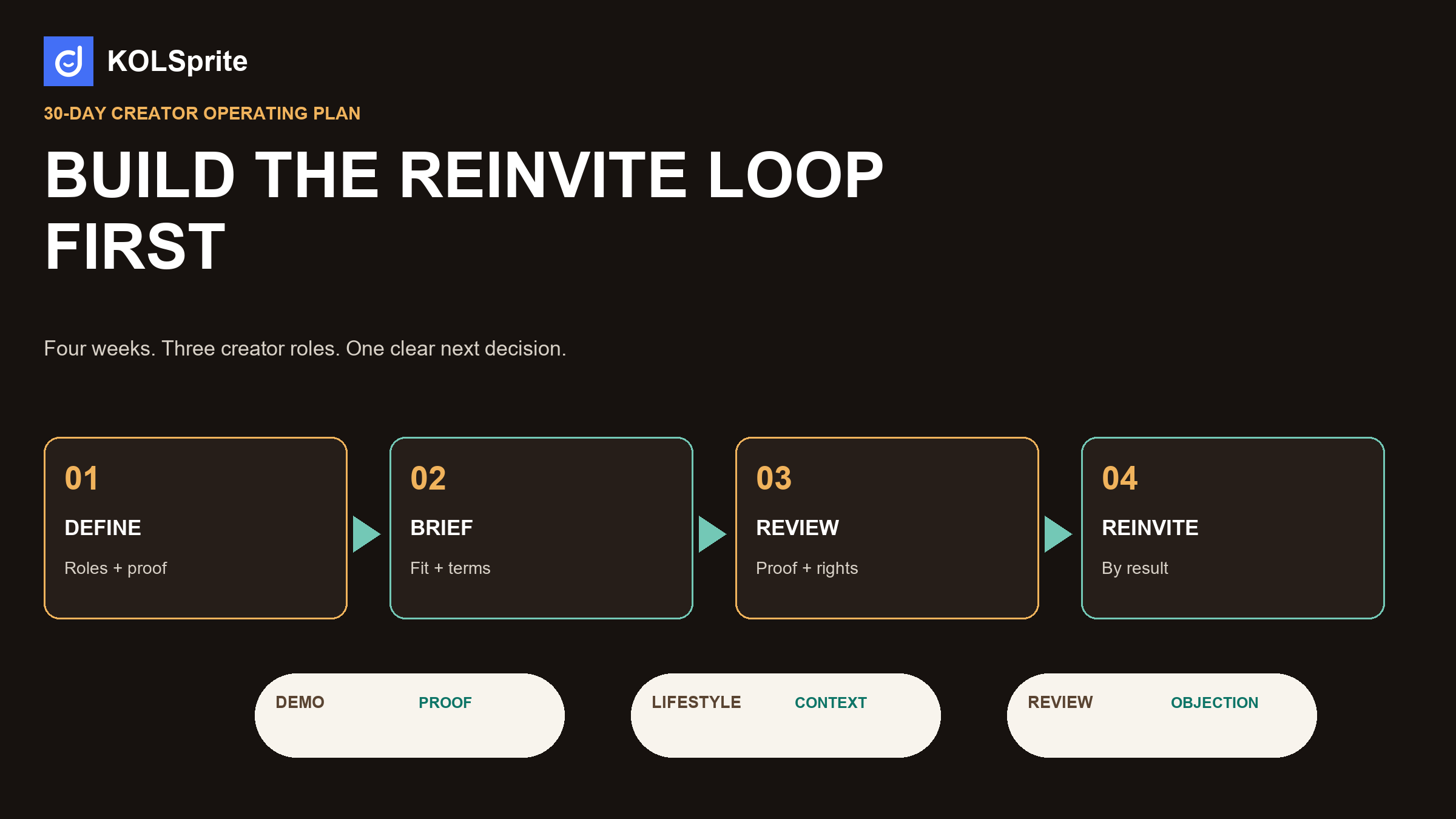
If you run partnerships for an ecommerce brand, recruiting more people will not fix a weak program. You need creator roles, a clear offer, content rules, disclosure checks, a review rhythm, and a reinvite decision. This guide turns TikTok influencer marketing into a 30-day operating plan. It separates open collaboration from targeted outreach and ties each creator to a job. You will leave with a weekly operating board, a first-test scorecard, and a stop rule. Begin with a small role-based group, learn what each role can prove, and expand only after a second creator repeats the result.
A list of creator names is not a program. A pile of posted videos is not a program. The system begins when the team can explain who enters, what they are asked to do, how work is reviewed, and why someone is invited again.
Recruiting fills the top of the funnel. Reinvite rules build the program.
Use roles based on the work the creator must do. A demonstrator makes the product easy to understand. An educator explains a hard choice or setup. A lifestyle translator places the item in a believable day. A conversion closer may handle an offer, live session, or direct shopping action. Your first cohort rarely needs every role.
For a portable blender, the first test could use a demonstrator for blend and cleanup proof, a commuter for the use moment, and a practical reviewer for leakage or charging questions. These roles are clearer than “micro influencer” or “high engagement.” Audience size may affect cost and reach, but it does not describe the creative job.
TikTok Shop's official affiliate materials describe open collaboration and target collaboration. Open collaboration allows eligible creators to discover products and request or promote them under the available terms. Target collaboration lets a seller invite selected creators directly. The two routes solve different problems.
Open collaboration can widen discovery and show who is naturally interested. Target collaboration gives the seller more control over fit and the brief. A practical program can use both: open collaboration for a measured discovery pool, then targeted outreach for creators whose observed work fits a role.
Review the current terms and features on TikTok Shop's official affiliate page. Platform availability and rules can change, so the operating board should name the market and review date.
The board needs seven columns: creator and stable ID, role, source evidence, collaboration route, current stage, next owner action, and reinvite decision. Add the product and market when the team handles more than one campaign. Keep commercial terms in the approved internal system rather than a public research sheet.
| Creator role | Source evidence | Route | First ask | Reinvite signal |
|---|---|---|---|---|
| Demonstrator | Clear product proof in prior videos | Target | Show one defined performance test | A second audience asks product-level questions |
| Lifestyle translator | Believable use in the target day | Open or target | Place one buyer moment in their own voice | Qualified viewers recognize the situation |
| Practical reviewer | Handles limits and objections well | Target | Answer one known doubt with proof | Trust questions fall or move deeper |
KOLSprite can help a team move from an exact product to linked videos and creators, then sort possible roles before outreach. In one July 28 case, a Fanttik car vacuum led to five product-linked videos from four creator accounts. The records included a 60-second car-detail story, a 98-second feature demo, two short car-detail clips from the same creator, and a 34-second product-focused post. Visible plays ranged from about 9.6 million to 40.9 million.
The point is not to crown the account with the largest reach. The set suggests different jobs. One creator may suit a longer feature demo. Another may fit a quick before-and-after. The repeated creator record also shows why the board should count creators, not only clips. None of these records settles rate, rights, availability, audience quality, or brand safety. KOLSprite improves the first conversation; it does not remove the checks.
Research note. KOLSprite product and product-linked video search for car vacuum product ID 1729390861839536961; US market; accessed July 28, 2026. Five videos from four creator accounts were reviewed for possible program roles. The sample is directional and does not establish commercial readiness or predict campaign performance.
The outreach message should state the product, role, deliverable, timing, compensation route, usage request, and why the creator's observed work fits. Avoid praise that could apply to anyone. A demonstrator needs to know the proof you need. A lifestyle creator needs room to make the situation believable.
For example: “Your portable-device reviews show setup and practical limits without turning them into a long lecture. We are testing whether commuters understand a blender's cleanup and leak proof. We would like one original video in your voice, with paid usage discussed separately. Are you open to reviewing the product and terms?” This message makes the job clear without promising a result.
TikTok says creators who post content that promotes a brand, product, or service must turn on the commercial content disclosure setting. The platform also notes that legal requirements can vary by country. Review TikTok's current commercial content disclosure guidance, and get market-specific legal advice when needed.
The program board should have separate fields for disclosure, organic posting rights, paid usage, editing, term, territory, and raw footage. A post going live does not grant every right. The brand and creator should understand the approved claim and the intended use before production.
| Week | Team job | Creator job | Decision at the end |
|---|---|---|---|
| 1 | Define roles, proof, offer, claims, and stop rules | Review fit and terms | Approve a small cohort |
| 2 | Confirm identity, product facts, and briefs | Develop concepts in their own voice | Approve concepts or release the fit |
| 3 | Review proof, disclosure, and landing-page match | Produce and revise within agreed scope | Publish, hold, or reshoot |
| 4 | Compare qualified signals and operating cost | Share context and learnings | Reinvite, change role, or stop |
The timeline is not a promise that every creator will publish in 30 days. It is an operating cycle. Late shipping, product issues, creative changes, or negotiations may extend the work. The board should show the delay and owner rather than making the creator look like a failed metric.
A demonstrator may be judged by clear product questions, useful watch behavior, and product-page actions. A lifestyle translator may be judged by whether the target situation is recognized and saved. A closer may be judged by qualified clicks, attributed orders, or live actions. Use guardrails for returns, claims, support issues, and content quality.
Do not compare every role on raw views. A practical review may reach fewer people and still remove a serious objection. A lifestyle post may create strong awareness but weak immediate sales. The program owner should know what each role was hired to learn.
Reinvite when the creator delivered the agreed proof, the audience response matched the role, the working process was sound, and the next brief has a clear learning goal. Hold when the content was useful but the offer, page, or product caused a mismatch. Stop when the proof cannot be repeated, claims create risk, rights are unclear, or the collaboration cost has no path to value.
The best result is not always “use the same creator again.” It may be “keep the creator but change the role,” “fix the landing page before another post,” or “the product needs a different proof.” The board should allow those outcomes.
In week one, use product research and linked videos to define the proof. In week two, use creator research to verify the account and review observed fit. In week three, use subtitle, script, and comment tools where they help check the message against buyer questions. In week four, return to the source evidence and decide whether the pattern repeated.
The creator outreach SOP provides the next detailed step for targeted contact. The guide to negotiating with TikTok creators helps the team carry deliverables, rates, and rights into the deal. Each resource supports a part of the operating cycle rather than sending the reader to a generic page.
If any of the first four items fail, do not rush to publication. If the metric or guardrail is missing, do not pretend the result will explain itself later. The scorecard is short so the team can use it every week.
Start with three creators in distinct roles, not 30 names with the same generic brief. Use open collaboration as a measured discovery route and targeted outreach for observed fit. Verify identity, approve disclosure and rights, review the product proof, and decide reinvites by role. That gives TikTok influencer marketing a learning loop before it gets a larger budget.
Add creators only when the program needs more reach for a proven role or a new role for an unanswered buyer question. Keep a small number of active experiments. Archive the briefs that did not produce useful proof, and write the reason. Over time, the program becomes a library of creator-product matches and tested buyer moments.
Durable TikTok influencer marketing is not built by removing human judgment. It is built by giving that judgment a shared record. Creators know the job, teams know the limits, and the next invitation follows evidence instead of excitement.
Set aside 20 minutes each Friday. Look at each active creator and ask four short questions. Did the right work get made? Did the viewer see the proof? Did the page and offer match the post? Is there a clear reason to work together again?
Use plain answers: yes, no, or not known yet. If the answer is not known, name the person who will check it. Do not hide a weak result in a large report. A small group learns faster when each open question has an owner and a due date.
Then choose one action. Reinvite the creator with a better next brief. Change the creator's role. Fix the page before asking for more content. Or stop. This meeting should end with work, not a new score. It keeps the program close to the buyer and fair to the creator.
Share the main learning with the product, content, and support teams. They may see a question that the partnership team missed. A common buyer doubt may need a page answer. A strong demo may belong in an ad test. A product limit may need to be clear before another sample goes out.
The board should make work feel clear, not heavy. A creator can see what the brand needs. The team can see what is due. The owner can see where a choice is stuck. Each row should point to one next step.
Keep the words short. Use “waiting for rate,” “brief sent,” “proof needs a new shot,” or “ready to post.” These notes are easy to scan. They also make it hard to hide a delay behind a vague tag.
A small team may run the board in a sheet. A larger team may use a project tool. The tool is less important than the shared habit. Every person should know who owns the next step and what fact will close it.
When a creator does good work, note why. It may be a clear demo, a strong match with the buyer, or a calm way to name a limit. That note makes the next brief better. It also gives the creator useful feedback.
When the work does not fit, stay fair and clear. A weak match does not mean the creator is weak. The role, item, or brief may be wrong. The board should help the team fix the cause instead of blaming the person.
Create a KOLSprite account and claim a three-day trial membership. Use the trial to research creators, compare content signals, and prepare a stronger shortlist or brief.
Register for a three-day KOLSprite trial
Share the creator roles, proof standard, and next-decision rule without exposing private deal terms. A second partnership lead may catch a weak metric or unclear owner.
 +
+
Compare the 30-day program on Discord
Latest Articles
As an essential, data-driven toolkit for TikTok influencers and marketers, KOLSprite provides powerful features for effortless creator discovery, trending content identification, and actionable real-time insights.
It empowers users to make smarter decisions and significantly boosts their TikTok business.

 Refer & Earn