 +
+
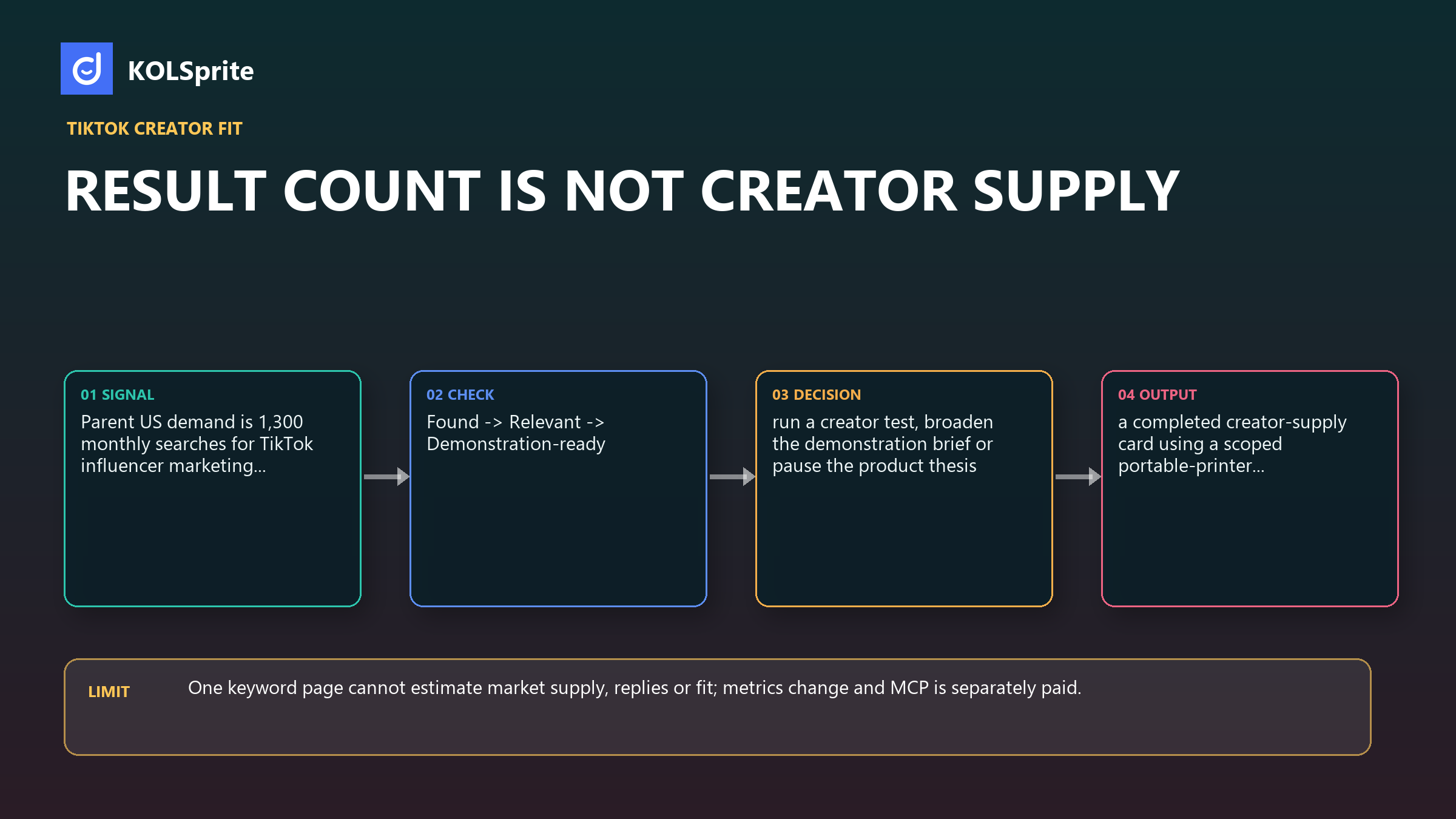
On September 7, 2026, one KOLSprite search for “portable printer” reported 10,000 results. The first page returned ten rows. A first clean kept zero. The profiles were not opened for video review. This small evidence note starts the question. That number says nothing about the size of the market.
Judge TikTok creator fit only after a relevance clean and a manual check for demonstration skill. A search result is only discoverable. It is not yet usable. Keep the returned count, the retained count, and the reviewed-candidate count separate.
Creator supply is not a single number. It is a series of stricter questions. Can a search find a profile? Does the profile fit the product or use case? Has the creator shown the action a buyer needs to see? Is the creator available, right for the brand, and willing to accept the proposed terms? Each question reduces doubt, but no broad result counter answers all of them.
For a portable printer, the key action may be showing the device make a useful print in a real setting. A creator who posts general office content may appear in search. A creator who discusses productivity may be a loose match. Neither is ready for the brief until public work shows that they can explain the product's physical use in a clear, believable way.
A result shows TikTok creator fit only after the person can do the product's job. That sentence keeps an early research review from pretending that visibility equals capacity. It also improves the brief. Instead of asking for “creators in tech,” the team can ask for people who can show setup, printing, output, and a believable use context.
TikTok also provides an official Creator Marketplace for creator and brand work. That platform fact leaves a broad search count unqualified. Search and partnership review are still different steps. A team must decide what a useful product demo looks like before it can judge the people it finds.
Here is the scoped MCP observation for this article. On September 7, 2026, one US KOLSprite creator search used the keyword “portable printer,” a page size of ten, and follower sorting. The search reported 10,000 and returned ten rows. None of the returned fields showed portable-printer or demonstration relevance, so the first relevance clean retained zero rows.
This is not a claim that portable-printer creator supply is zero. It is an example of why the broad counter cannot be used as the answer. The ten returned profiles were not opened for video review. One page cannot estimate market supply, creator quality, price, availability, response rate, or campaign performance. It does show that an initial keyword page can be a poor proxy for the work the brief requires.
Read the result as a failed broad-search sample. The lesson is operational: define a cleaning rule before the search result becomes a planning input. Without that rule, the team may carry “10,000” into a budget or launch discussion even though the returned sample did not establish usable fit.
The zero-retained result has one narrow meaning. None of the ten returned rows gave enough product signal in the returned fields to pass the stated first clean. It does not mean those creators have never used a printer. It does not mean a different query would return the same rows. It does not mean later pages are weak. Those points were not checked.
The reported 10,000 also needs a firm label. It is a search counter from that call, not a count of people who can show this product. Do not use it in a forecast. Do not divide it by an outreach rate. Do not present it as the top of a creator funnel. The only observed funnel in this notebook is ten returned and zero retained at the first clean.
That finding can still change a decision. It tells the team not to start outreach from this page. The next step must be a research choice. The team can revise the keyword, add a clear related-use term, or stop and improve the demo brief. Each choice should be logged as a new test. The first page should stay unchanged in the notebook.
One US follower-sorted search for “portable printer” reported 10,000 and returned ten records; zero were retained after a first product-relevance clean. KOLSprite MCP information: KOLSprite MCP.
Scope: a portable-printer relevance clean. Market: US. Access date: September 7, 2026. Sample: page 1, ten returned rows, follower sort. Cleaning: all ten were removed because returned fields showed no portable-printer or demonstration relevance. Limit: profiles were not opened for video review, and one page cannot estimate supply, quality, availability, price, replies, fit, or performance.
Register for KOLSprite and claim a three-day trial of the web product. MCP access is sold separately.
Register and claim a three-day trial
Use three levels in the research note. Discoverable profiles are returned by the chosen search. Relevant profiles have public signals that match the product's category, use setting, or audience question. Demonstration-ready candidates have public work suggesting they can show the essential action in a way a buyer could understand. Keep the levels separate even when the counts are small.
Define relevance before you look at names. For the portable-printer example, a first-pass rule could require an explicit portable-printer signal, a printing demonstration signal, or a closely related mobile-workflow use case in the returned public fields. A later video review can use a stricter rule: the creator has demonstrated a physical product with setup and output, or has a content format that can plausibly make that action clear.
The rule need not pretend to be perfect. It needs to be written. A written rule lets another reviewer challenge a borderline decision and lets the team compare searches without changing the definition halfway through. It is better to say “we found three relevant profiles under this rule” than “we have plenty of options” without a traceable basis.
Manual review starts only after a row passes the first clean. Open the public profile. Check whether the recent public work includes a physical product in use. Look for a full action, not just a product held near the camera. For this case, setup without a visible print is incomplete. A print without a clear use setting may still need review. Record what is visible. Do not guess at skill from a bio alone.
Use three manual-review outcomes. Pass means the public work shows enough of the needed demo form to merit partnership review. Hold means the signal is close but a second reviewer should decide. Reject means the public work does not show the needed action. None of these outcomes proves interest or availability. They only clean the research set for the next owner.
If a later search retains profiles, report the work done. Say how many profiles were opened and what public videos were checked. A retained row without that review remains relevant, not demonstration-ready. This keeps a small manual sample from sounding broader than it is.
Required demonstration: show setup, a print action, output, and one real-use context.
Discoverable: ten records returned from one scoped US keyword page.
Relevant: zero retained from returned fields using the first product-relevance clean.
Demonstration-ready: not assessed; no profiles were opened for video review.
Decision: do not estimate supply from this page. Refine the brief or broaden the research design before committing to a creator test.
Join the KOLSprite Discord to discuss the question behind your next test.
 +
+
Join the KOLSprite Discord community
A zero-retained first page does not force one response. It gives the team a choice. Run a creator test when a more precise query or a different route can reasonably surface candidates. Broaden the demonstration brief only when the product can still be shown honestly with a different format. Pause the product thesis when the essential action has no credible creator path within the team's constraints.
Do not broaden the requirement silently. “Must demonstrate portable printing” and “can mention productivity tools” are different briefs. The second may increase apparent supply while making the content less useful for a buyer who needs to see the product work. Record the tradeoff so the launch owner chooses it deliberately.
Supply research is most valuable when it can stop a weak assumption early. A small, cleaned sample may tell you that the problem is not creator volume but an unclear product job. The next action can then be a better brief, a different product angle, or a pause. That is a more useful outcome than a large number with no operational meaning.
Start with a precise demonstration requirement, a US market, and a product keyword. Use KOLSprite creator search to build an initial public universe, clean broad matches against the written rule, and manually inspect the remaining creators' public product and video behavior. Report the three levels: discoverable, relevant, and demonstration-ready. The output is a conditional supply estimate, not an outreach list disguised as certainty.
One keyword page cannot estimate supply, replies, quality, availability, price, fit, or performance. Public metrics change. KOLSprite does not guarantee partnership results, and MCP is separately paid rather than included in Plus, Pro, or a free trial.
The handoff should say what was searched, what the cleaning rule removed, what was actually reviewed, and what remains unknown. That is enough for a partnership team to decide whether to spend more research time. It is also enough for a skeptical colleague to understand why a broad search result count was not used as the plan.
Even a demonstration-ready public profile is not a confirmed partner. Public videos can suggest a format fit. They cannot prove rates, rights, timing, responsiveness, exclusivity, audience response, or the creator's willingness to use the product. Those are later outreach and negotiation questions.
Keeping this boundary visible improves communication with stakeholders. The research team can say, “We found candidates worth a manual review,” rather than implying a campaign is staffed. The partnership team can say, “These are public-fit signals,” rather than treating them as availability data. The product team can keep its focus on the action the content must demonstrate.
That division also protects small tests. A team can validate whether creators can explain the difficult part before investing in a broad campaign. The test may still fail, but it fails against a stated product job rather than a vague belief that thousands of results meant the channel was ready.
On the next search, keep the same three-level card and change only the research choice you are testing: query language, product term, relevant public signal, or review depth. Then compare the cards without pretending they are a census. A stronger result is not simply more profiles. It is more profiles that survive the same useful definition of fit.
TikTok creator fit becomes a planning input only after cleaning. Start with TikTok creator discovery, evaluate likely fit with influencer audience analysis, and move only reviewed candidates toward contacting TikTok creators. The result counter can start research; it cannot finish the decision.
Latest Articles

As an essential, data-driven toolkit for TikTok influencers and marketers, KOLSprite provides powerful features for effortless creator discovery, trending content identification, and actionable real-time insights.
It empowers users to make smarter decisions and significantly boosts their TikTok business.

 Refer & Earn