 +
+
For ecommerce research leads choosing a comment collection method, the hard choice is not how to get more rows. It is whether the rows will still tell you what they mean when someone asks where they came from. A TikTok comment scraper can make collection look effortless while stripping away the source, sample limit, and review trail that make a finding usable. The direct answer: treat collection as a proof-preservation problem first. This guide gives you a five-part Comment Collection Quality Test, a fast choice path, and a way to decide whether to use an approved export, analyze a narrower set, or stop.
Keep a comment only when you can reconnect it to the public post, the set scope, and a human-readable review choice. If a tool cannot preserve those basics, its larger export is a weaker research input.
Comment research gets messy when the request is phrased as a quantity. “Get every comment” sounds decisive, but it does not say what choice the team is trying to support. A product marketer may need recurring objections before a landing-page revision. A creator manager may need a small set of questions that reveal whether a product claim is confusing. Those are other jobs, and they produce other acceptable samples.
Write the choice at the top of the request in one sentence: “We need to learn whether buyers question device fit on these five public videos,” for example. Then name what could change because of the answer. A gathering plan is easier to judge when its purpose is visible. You can ask whether the chosen posts are useful, whether the time period matters, and whether a reviewer can see the original wording in context.
Policy matters. TikTok's current US terms limit unapproved automatic extraction. Set needs approved access and review of applicable terms. Do not assume public material is fair game for any workflow. Read the useful TikTok Terms of Service before choosing an access route.
One operator-level warning sign is familiar: a spreadsheet arrives with thousands of comments and no one can answer which posts were included. The file looks substantial, yet the first challenge from a stakeholder turns it into an untraceable pile of text. More rows did not make the research stronger.
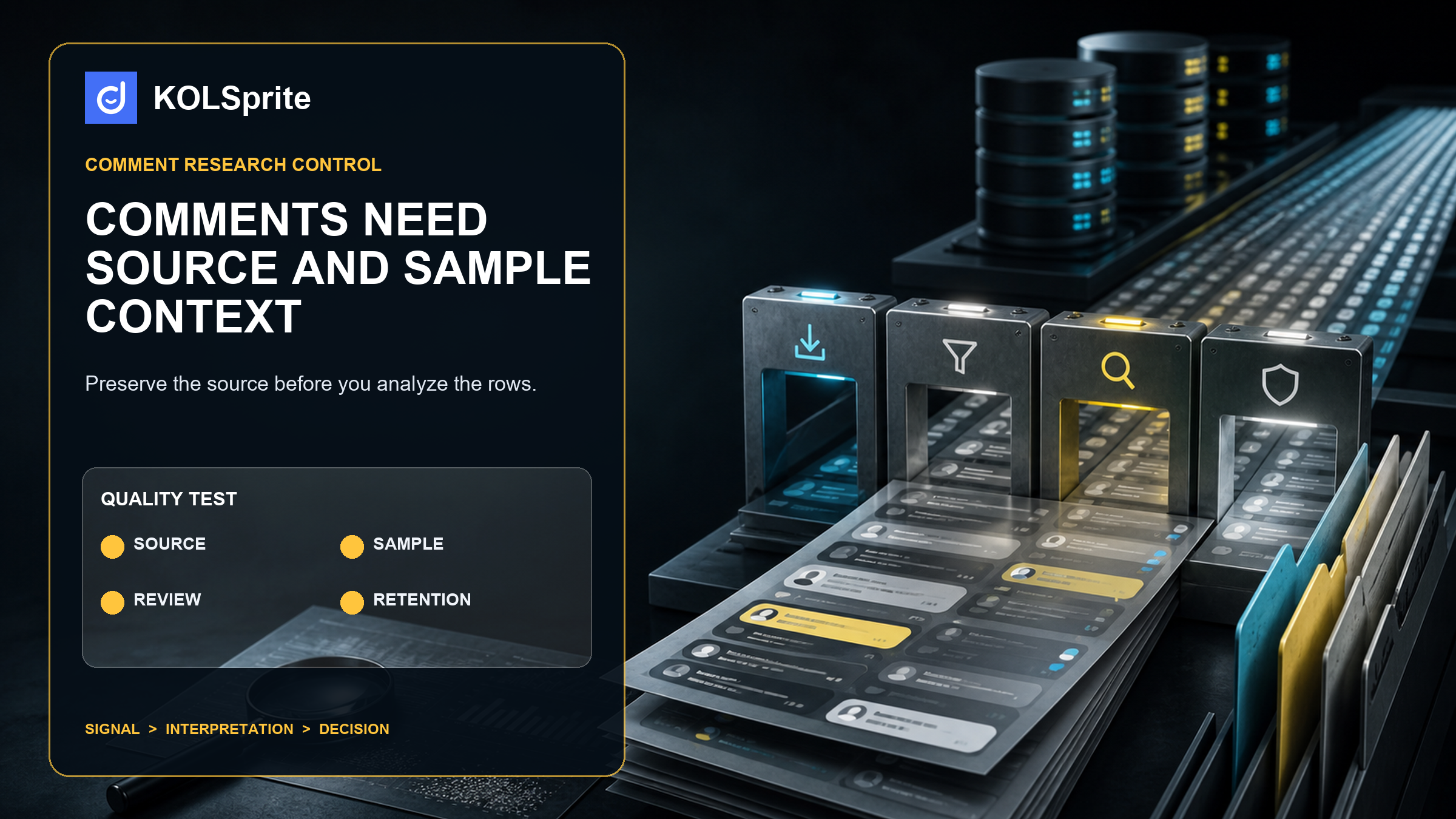
The useful test has five parts. It is deliberately plain. A workflow that passes it gives a reviewer enough context to trust a bounded finding. a workflow that fails it may still be useful for exploration. But it should not drive a product or campaign choice without repair.
A passing result does not mean the comments are sample of every buyer. It means the team has not hidden the conditions under which it learned something. That distinction protects the next person who reads the summary, especially when the answer is inconvenient or ambiguous.
| Gate | What to retain | Choice when missing |
|---|---|---|
| Access | The approved access or export route used | Pause and confirm the plan |
| Source trail | Source post reference for retained comments | Do not treat the row as proof |
| Sample scope | Posts, choice rule, and sample limit | Narrow or relabel the claim |
| Review check | Sample original comments for human inspection | Check before acting |
| Keep-or-delete rule | Deletion and keep-or-delete rule choice | Set the rule before distribution |
Scope: comment collection quality workflow. Market: United States comment-research policy review. Access date: 2026-08-31. Sample: a five-part quality test defined for this research brief. Cleaning: decision-useful collection controls only. Limit: this is not a legal determination, a completeness guarantee, or a substitute for platform terms and approved access methods.
Register for KOLSprite and claim a three-day trial to organize supported public comment discussions while keeping the source and sample limit visible.
Register and claim a three-day trial
The sample limit is where teams most often overstate what comments can prove. A post with a large comment thread may be useful because it contains detailed questions. It may also be a poor stand-in for a category if it was boosted, unusually old, or centered on a creator-specific joke. Preserve the reason a post entered the set, not only the comments that came out.
Keep a set note. Record the public post, why and when you checked it, comments reviewed or exported through an approved route, and any gap. Say if you sampled instead of collecting the full visible comment thread. “First 100 visible comments” and “all comments on five chosen posts” differ. Neither is always better. Each supports another claim.
For a supported TikTok comment area, KOLSprite can help structure comment comment threads and translate supported comments, then support a human review of sample original text. That is useful after the access and scope choices are made. It does not make automatic set lawful, and it does not turn a narrow sample into a complete measure of intent. The product limit is part of the workflow, not a footnote.
When the research goal is a new product page, a small, source-preserving sample is often enough. Link the retained findings to the team that will use them. This guide to AI comment analysis for TikTok research provides the upstream review context, while turning one objection into a video test helps move a verified question into a concrete creative hypothesis.
Comments become weak proof when labels replace original words too soon. “Does this work with mine?” could mean device fit, missing setup detail, a joke, or a reply that depends on its parent. Reviewers must be able to open sample source comments and decide what the words support.
Make review deliberately small. Select a handful of comments from each emerging theme and include examples that seem to contradict the label. Ask three questions: What is the person actually responding to? Is the wording direct enough to support the proposed interpretation? Would a product or creative owner make the same call after seeing the source? If not, record the ambiguity rather than forcing a tidy category.
This is why a TikTok comment scraper should be evaluated by its review trail, not its speed alone. Fast capture can be valuable for finding a place to look. It cannot remove the need for a person to distinguish a recurring question from a copied phrase, a sarcastic reply, or a comment thread attached to an unrelated moment in the video.
Join the KOLSprite Discord to discuss comment samples, review limits, and responsible research decisions.
 +
+
Join the KOLSprite Discord community
Minute one: name the choice and list the public posts that could reasonably inform it. Confirm that the planned access is approved and compatible with the useful platform rules. If the plan depends on unapproved automatic extraction, stop there and change the route.
Minute two: inspect a small visible set in context. Record the post reference, choice reason, and sample rule. If the material is too broad, narrow it to the posts that actually relate to the choice. A smaller set with known limits is easier to defend than an unknown bulk export.
Minute three: decide among four outcomes. Use an approved export workflow when the source trail and scope can be retained. Use KOLSprite AI Comment Analysis when the supported area and a human review will help organize a bounded comment thread. Narrow the sample when the question is specific. Stop the gathering plan when access, source trail, or keep-or-delete rule cannot be explained.
The output should be a choice note, not a pile of labels. A clear note might say: “We reviewed public comments from these chosen posts for setup questions. The sample is bounded and does not measure all buyers. Three original comments repeatedly ask about device fit; product will verify the answer before changing copy.” That language leaves room for uncertainty without making the work vague.
Once comment text is copied into a working document, it tends to spread. A strategist forwards it to a writer, a researcher uses it in a deck, and a later project inherits a file whose purpose is no longer clear. The keep-or-delete rule choice should therefore happen before the set, not after the first useful insight appears.
Keep only what is needed for the stated choice and review trail. Separate a short research note from any larger working set. Name who can access it, when it will be revisited, and when it should be deleted. If an insight can be expressed with a summary and a few reviewable references, that may be enough. The goal is not to build a permanent archive of public comment thread; it is to support a bounded choice responsibly.
When a finding is ready to move downstream, use it with the same restraint. This guide on turning reviewed feedback into a Shopify page choice can help translate a verified finding into a page choice. Keep the sample limit attached so the next team does not mistake a focused review for a universal customer survey.
If comments feed a wider listening system, add the collection-quality boundary to the current review and link source-preserving comment collection to the support workflow. The same source and sample limits should follow the finding downstream.
The best result from a TikTok comment scraper is not the biggest file. It is a set a skeptical teammate can inspect in five minutes: here is the question, here are the public sources, here is what we reviewed, here is what we left out, and here is what remains uncertain. That is the difference between a convenient export and research another team can actually use.
Before the next request, ask the person proposing the workflow to fill in the five test fields. If they cannot name the access route, source references, sample rule, review step, and keep-or-delete rule choice, the plan is not ready. The right response may be to narrow the request or stop it. That is not lost momentum; it is how research avoids creating a confident-looking answer with no reliable path back to the proof.
Add a set-quality limit to comment analysis. In wider listening, link comments to source-preserving set. Set is complete when the choice can be reviewed, not when row counts stop growing.
Latest Articles

As an essential, data-driven toolkit for TikTok influencers and marketers, KOLSprite provides powerful features for effortless creator discovery, trending content identification, and actionable real-time insights.
It empowers users to make smarter decisions and significantly boosts their TikTok business.

 Refer & Earn