 +
+
If your TikTok comments say “how does this work?” while support tickets say “I cannot make it work,” the team may be looking at the same gap at two stages. Most companies never join those signals because social, support, product, and content use different labels. This guide gives ecommerce operators a practical social listening system that connects TikTok questions with tickets, reviews, and returns without pretending they are one sample. You will get a shared issue ID, a stage map, an owner table, and a weekly review that ends in an action.
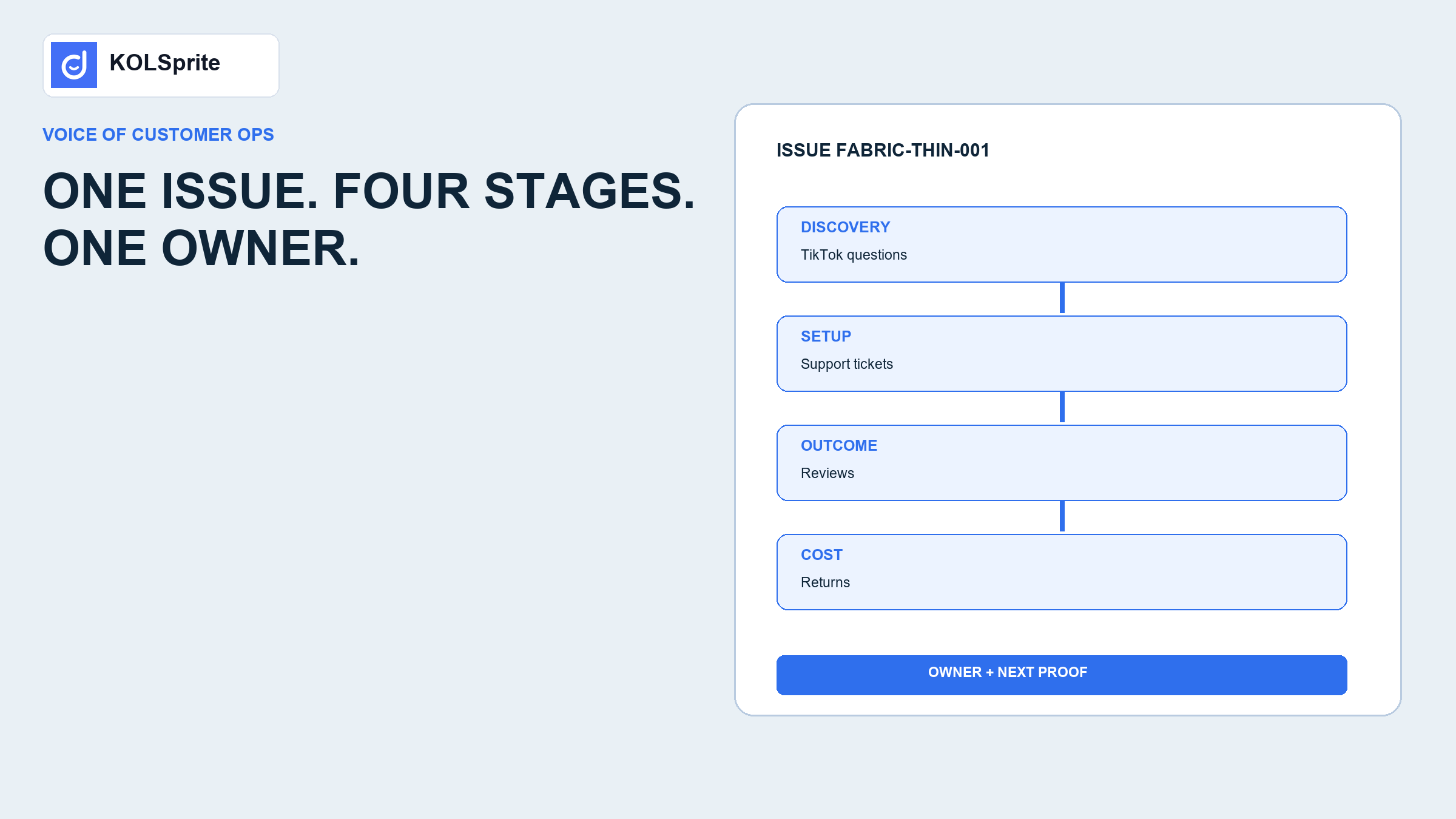
Create one plain-language issue statement, then keep each source in its source stage: pre-purchase question, first-use problem, post-purchase outcome, or costly failure. Join records only when the product, variant, meaning, and time match. Rank themes that move across stages or make material buyer cost.
One issue can appear in four systems. It should still have one owner.
Positive and negative labels are easy to chart. They often hide the work. A TikTok comment asking whether a fabric shaver is safe on leggings may be neutral in tone and high in purchase intent. A cheerful support message may still describe a repeated setup failure. A one-star review can combine product, delivery, and expectation problems.
Source stage changes the meaning. TikTok questions often happen before purchase. Support tickets happen after a buyer is blocked. Reviews happen after some use. Returns show that the issue became expensive enough to reverse the transaction. The same words should not carry the same weight across those stages.
TikTok's official Comment Insights guidance describes AI summaries, frequent topics, positive sentiment and viewer questions. Those groups can speed review, but an operator should still inspect sample comments and the source video before assigning a product issue.
Write the issue as product plus situation plus outcome. “Lint remover” is a topic. “Fabric shaver catches on thin leggings at the highest setting” is an issue. “Battery” is a topic. “Device loses charge before one sofa section is full” is an issue.
Add the exact product, variant, market, date window, and source. Keep the buyer's words in a separate field. The shared issue statement is for routing. The source wording is for proof.
| Field | Example | Rule |
|---|---|---|
| Issue ID. | FABRIC-THIN-001. | Stable across systems and revisions. |
| Issue statement. | Shaver may catch on thin fabric at high speed. | Describe situation and outcome. |
| Stage. | Pre-purchase, first use, ongoing use, return. | Do not merge stages into sentiment. |
| proof. | Source text, video, ticket, review, or test. | Keep sample examples. |
| Owner. | item, content, support, listing, or logistics. | One primary owner. Others can support. |
We reviewed KOLSprite US Video Search records for rechargeable lint removers. The retained content showed before-and-after demos, leggings, sweaters, furniture, pet hair, several speed settings, LED displays, and replacement blades. One accessed record showed 1.3 million visible plays for a 35-second product demo. Another showed 875,200 plays for a 102-second video. A 31-second record showed 6,977 plays and 308 comments, a reminder that comment volume and play volume do not move together in a simple way.
The content makes several questions a feedback system should be ready to recognize: Which fabrics are suitable? Which speed should a buyer use? How often should the blade be cleaned or replaced? Can it handle pet hair as well as pilling? What happens if it catches loose threads? Those are examples of choice areas suggested by the visible product claims and formats, not quoted comments from the MCP call.
Research note. KOLSprite US Video Search for “rechargeable lint remover,” accessed August 4, 2026. choice-useful records were reviewed for product format, public content, and visible engagement fields. Public data can change. The MCP call did not return comment text, support tickets, reviews, returns, or item-test results. Example issues must be verified in the brand's own sources.
Build one source-linked issue trail from TikTok research to your internal owner. Create a KOLSprite account to claim a three-day trial membership.
Register for a three-day KOLSprite trial
A theme that appears only in discovery may need content. A theme that moves from discovery to support may need both content and instructions. A theme that reaches returns may need product or quality action. The stage path is more useful than an overall mention count.
Keep the label set small enough for humans to use: compatibility, setup, how it works, performance, durability, safety, care, delivery, offer, and support. Add a product-clear subtheme only when it changes an owner or choice.
For a fabric shaver, “compatibility: thin fabric” is useful. “Concern” is not. “Negative product issue” is not. The detailed theme can tell the content team to show the correct speed and the product team to test snag risk.
Store the source language and translation. If AI clusters the text, label that output as a draft. Review sample records before counting, especially when slang, sarcasm, short replies, or several products appear in one thread.
| Pattern | Likely first owner | Required proof | Possible action |
|---|---|---|---|
| Many pre-purchase compatibility questions; few post-purchase failures. | Content and listing. | Exact product test and approved surface list. | Create a compatibility demo and check block. |
| Questions become setup tickets. | product education and support. | First-use observation and ticket examples. | Rewrite the quick-start guide. Film the missed step. |
| Tickets become reviews or returns. | item and quality. | Reproduced failure by batch or variant. | Correct product, packaging, or quality process. |
| Questions come from a claim the product cannot support. | Claims and content. | Source video, brief, and product facts. | Remove or narrow the claim and update creators. |
In KOLSprite Video Search, isolate exact product-linked videos and note the promise, scene, setup, and visible result. Use product and creator context to avoid assigning a question to the wrong product, while browsing TikTok, KOLSprite's AI comment-analysis feature can help summarize topics and surface questions for review.
Do not paste a summary into the issue log as if it were raw buyer proof. Save the source URL, access date, sample comments, and checker note. Exclude private details. KOLSprite does not connect to your help desk or decide whether two records describe the same defect. Your support export and product IDs complete the join.
Add the issue ID to the social-research note, support tag, review-analysis sheet, return-reason review, and product task. Do not move all data into one tool on day one. A stable ID and shared definition can make the connection before a full link exists.
Include the product and variant in every source. If support uses internal SKU while social uses a TikTok product ID, maintain a small crosswalk. Mark uncertain matches. A broad “lint remover” row should not be joined with a clear rechargeable six-blade product until the team confirms the product.
Share an anonymized stage map and owner table without buyer details. Other teams can help test whether the label set is clear enough to use.
 +
+
Review the feedback system on Discord
Frequency matters, but it is not enough. Add stage depth, business cost, buyer harm, and proof confidence. A rare safety problem may outrank a common color question. A frequent TikTok joke may deserve no product action. A repeated support problem that causes replacements deserves attention even if it is not discussed publicly.
Use words such as low, medium, and high with definitions. Avoid a universal score that hides assumptions. The owner should be able to see why an issue was selected and which proof could change the priority.
Bring the top five open issues, not every comment. For each issue, show one sample public example, one support or review example when available, stage path, cost signal, current proof, owner, and next action. Spend most of the meeting on choices.
A useful choice sounds like: “Product will test thin polyester at all three speeds by Friday. Content will pause the universal fabric claim. Support will add the approved-fabric note.” A weak choice sounds like: “Monitor sentiment.” A review without a threshold or owner delays the same conversation.
When the product test is full, update the creator brief, product page, quick-start guide, support macro, and future comment response. Record which change addressed the issue. Watch whether the theme moves backward in the stage map: fewer setup tickets, fewer return mentions, clearer pre-purchase questions.
Do not claim success from one quiet week. Product seasonality, content volume, and traffic mix can change the count. Use a reasonable window and compare like with like.
Remove personal facts from shared reports. Limit access to ticket text and order details. Quote only what is necessary. The team can follow the platform, marketplace, and company policies that apply to data use and retention.
Document the sample and limits below tables, not throughout the article or executive summary. The public output needs enough setting to trust the finding, while raw cleaning steps and sensitive records remain internal.
Choose one product with active content and support volume. Review five to eight exact TikTok videos and sample questions. Export the last four weeks of tickets for the same SKU. Write three detailed issue statements. Give each a stage, proof level, and owner. Pick one issue that can be tested this week.
The TikTok comments product-research guide helps separate buyer questions from broad engagement labels. The product-demo expectation-gap workflow is useful when post-purchase outcomes need a deeper check. The content proof-test guide can turn the chosen issue into an original demo.
The team should be able to name the top issues in plain English. Social and support should use the same IDs. Product should know which issues are reproduced. Content should know which claims and scenes changed. Leaders should see cost and buyer impact without reading raw comments.
More importantly, the next buyer should have an easier path. The page answers the real question. The creator shows the missing step. Support receives fewer preventable tickets. Product work is based on reproduced outcomes rather than a vague dashboard.
Imagine TikTok viewers ask if a fabric shaver is safe on thin leggings. Support also sees tickets about pulled fabric. The team links both sources to one issue ID, but it does not count them as the same event. The social signal shows doubt before purchase. The ticket shows a problem after use.
The next step is a product test on the approved fabrics and speed settings. Content pauses any broad “safe on all fabric” claim. Support adds a short fabric check to its reply. When the test is done, the owner updates the brief, page, and help text. That is a closed loop: one issue, clear proof, named owners, and a visible change for the next buyer.
Strong social listening keeps where a signal came from and what stage it represents. Use KOLSprite to organize the public TikTok product, video, creator, and comment context. Connect it to your own tickets, reviews, returns, and tests with a stable issue ID. Then give every key theme one owner and one next proof.
Latest Articles

As an essential, data-driven toolkit for TikTok influencers and marketers, KOLSprite provides powerful features for effortless creator discovery, trending content identification, and actionable real-time insights.
It empowers users to make smarter decisions and significantly boosts their TikTok business.

 Refer & Earn