 +
+
The request often arrives late in the day: a creator or social lead says the devil trend is moving fast and asks whether the brand can join. The category team hears “viral,” but nobody has defined the version in question, how viewers are reading it, or what it means for this product. Pause long enough to write a Context-Risk-Fit memo based on current public examples, comment interpretation, product fit, and sensitive-category limits. The memo should end with one decision: participate, reinterpret, monitor, or decline. That gives the creator a bounded brief or a clear reason to stop.
Trend labels are efficient shorthand inside a busy team. They are poor instructions. The same label can cover a sound, a visual device, a joke, a costume reference, a response format, or several related clips that viewers interpret differently. A team that approves the label without inspecting current examples may approve the wrong thing.
Begin with the actual public materials in front of the team. Save a small, current sample. Note what happens in each clip, what the caption says, what the comments seem to clarify or contest, and whether the format has already split into different versions. This is a context review, not a search for a universal meaning.
TikTok’s trend guidance advises advertisers to use current trend context, and TikTok Next is the platform’s published trends resource. Those sources provide platform framing rather than a fixed definition for any one cultural label. See TikTok’s How to Use Trends guidance and TikTok Next.
Use this response: “We can consider the devil trend after we define the current format, the audience reading, the product fit, and the category boundary.” It gives the team a path without creating a false sense of safety.
The devil trend on TikTok is not a stable creative asset with one set of instructions. Public examples may show a playful pattern the brand can use. They may also reveal context the brand should avoid. In some cases, the format has become too unclear for the category. The decision belongs to the current evidence, not the label alone.
A cultural format changes as people reuse it. One group may make it playful. Another may use the same visual cues to signal criticism, irony, or a private in-joke that is not visible from the first clip. Captions and comments can show whether viewers are reading the content as intended, but they can also introduce their own local meanings.
That is why a brief should describe the version the team saw, not a generic trend name. “A light, self-aware reveal where the product solves an ordinary temptation” is more useful than “do the devil trend.” It tells the creator what the brand wants to say. The creator still has room to decide if the format fits their voice.
Do not copy a successful clip shot for shot. Public research can inform a new treatment, but it does not grant reuse rights. It also cannot prove that the same idea will work in another category. The creator’s own context remains part of the review.
KOLSprite can support bounded public video, comment, and creator-context research. The brand still owns category fit, claims, legal review, and the final brief.
Register and claim a three-day trial
Context asks what the sample actually contains. Identify the visible format, words, symbols, music use where relevant, and the dates of the examples. Risk asks what could be misunderstood, who may be affected, and whether the category introduces a higher standard. Fit asks whether the product has a truthful role in this specific treatment.
Keeping these lenses separate stops a familiar error. A format can be current and still be a poor fit. A product can fit the joke and still need a different approach because the audience reading is uncertain. A low-risk category can still decline when the only workable version requires an unsupported claim.
The three-minute review should end with a written uncertainty. “We saw two visible meanings and cannot tell which will dominate the audience response” is a decision-relevant finding. It may lead to monitoring rather than a rushed post.
| Lens | Public evidence to review | Decision question | Boundary |
|---|---|---|---|
| Context. | Recent videos, captions, visible format changes. | Which version of the trend are we discussing? | Public samples do not fix a universal meaning. |
| Risk. | Comment interpretation, category concerns, visible confusion. | What could the brand or creator misstate or mishandle? | Research is not legal clearance or a brand-safety guarantee. |
| Fit. | Product role, creator context, truthful proof available. | Can the product belong here without distortion? | Fit does not predict audience response or sales. |
| Decision. | Named evidence and unresolved questions. | Participate, reinterpret, monitor, or decline? | A human owner makes the final call. |
Source date: 2026-08-20. Scope: an illustrative Context-Risk-Fit decision framework for reviewing current public TikTok examples and comments. Limitations: it does not measure the trend, infer private beliefs, guarantee brand safety, provide legal clearance, or establish a fixed cultural meaning.
The table should make disagreement easier. One reviewer may see strong product fit while another sees a context problem. Put both judgments in the memo with the supporting examples. A disagreement that is visible can be escalated; an assumption hidden behind a trend label cannot.
For products connected to health, finance, children, safety, religion, politics, or other sensitive contexts, the standard changes. A playful format can still create an unsuitable association, invite an unsupported promise, or make a serious subject appear casual. The category owner should determine whether participation is permitted before creative work advances.
Public comments may help identify where viewers are confused or uncomfortable. They cannot resolve a compliance issue or provide a complete view of the audience. When the category needs legal, policy, or specialist review, record that escalation in the memo and wait for it. Fast cultural timing does not erase the responsibility to make a sound claim.
For creator-level suitability questions, the TikTok creator vetting suitability check can keep the review tied to a real person and a real brief rather than to a generic trend category.
Join the KOLSprite Discord to compare trend interpretations, creator guardrails, and reasons to participate, reframe, watch, or decline.
 +
+
Join the KOLSprite Discord community
The memo has a simple job: preserve why the team chose its path. State the observed format, the public examples reviewed, the audience reading the team can support, the category boundary, and the selected option. Then name the owner and the next action.
Participate means the current format, product role, and boundaries are clear enough for a bounded brief. Reinterpret means the underlying audience tension is useful but the visible format needs a safer or more truthful treatment. Monitor means the signal is too new, split, or unclear for a decision. Decline means the risk or lack of product fit is strong enough to stop the work.
Keep the language specific. “Monitor until we have a clearer reading of the caption and comment pattern” is usable. “Monitor the trend” is not. A team can pair the memo with the TikTok trend analysis decision framework so the observation gets a review date rather than disappearing into a channel.
KOLSprite can help reviewers inspect current public examples, group visible formats and meanings, read comments for interpretation or confusion, review creator context, and document guardrails. That work supports the memo because it gives the team a record of what it looked at and what it could not establish.
KOLSprite cannot make a moral judgment, access hidden audience data, guarantee brand safety, clear legal risk, or declare one meaning permanent. It should remain a bounded research layer. The brand and category owners still decide which creative direction, if any, earns approval.
For a closer public-comment workflow, see TikTok comment analysis for ecommerce. Keep the source examples attached to any interpretation so another reviewer can inspect the same context.
When the memo says participate or reinterpret, the brief should describe the approved audience tension and product role. State the claim limits and visual boundaries. Explain why a creator may decline the format. Never say “make it viral” or rely on a label with several meanings. Give the creator enough context to make a fitting version.
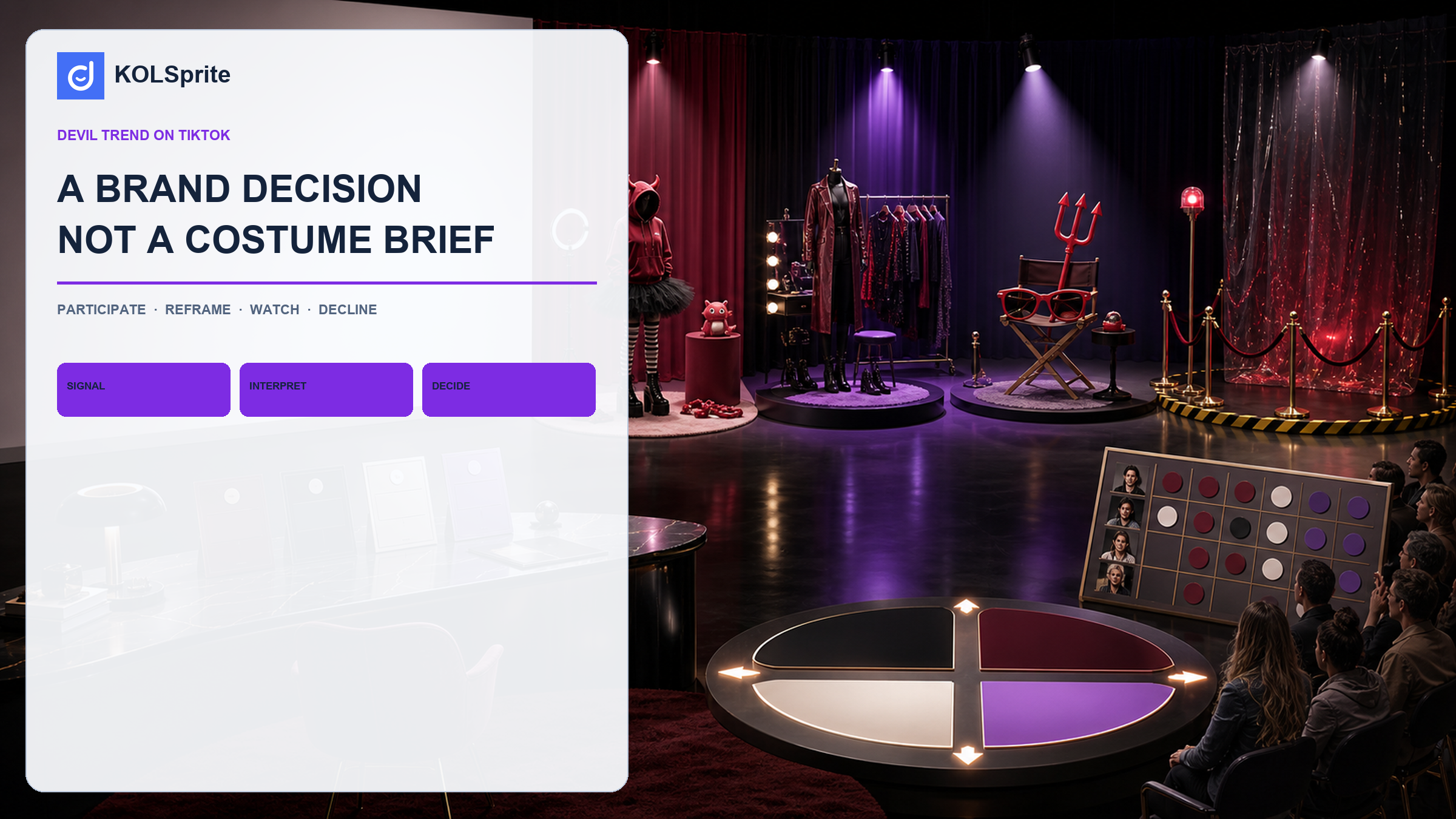
When the memo says monitor or decline, save that decision with the current sample and date. The label may look different next month, or it may not return. The team has still done useful work because it avoided treating the devil trend on TikTok as a costume brief when it was really a brand decision.
A usable brief includes a stop rule. State which claim the creator may not make. State which visual cue should be avoided. State who reviews a change to the concept. A creator should not have to guess whether a late twist will put the work outside the approved context.
Give the creator room to bring a real point of view. The memo should name the audience tension and the product role. It should not force the creator to copy a clip the team found in research. The public examples are context for the decision, not a set of shots to reproduce.
Review the finished concept against the memo before production. Check the current format again. Check the product claim. Check whether the category boundary still applies. A trend can move during the time between research and posting. The same evidence should be fresh enough for the final approval.
For a monitor decision, schedule one clear return point. The team might inspect a new sample after several days, or it might wait for a specific creator format to become clearer. A monitor decision without a return point is only a delayed yes or no. Write down what new evidence would change the choice.
For a decline decision, close the request with a reason that people can use. “The current format does not give the product a truthful role” is clear. “The comments show mixed readings that are too risky for this category” is clear. That language keeps the team from reopening the same debate every time the label appears.
Keep the decision with its date and reviewed sample. A later request should reopen the evidence, not inherit an old approval.
The first approval should cover one treatment rather than every use of the label. That narrow scope leaves room to review a new version when public context changes.
If the creator sees a shift in comments or peer context, ask them to flag it for the team. This adds a reason to pause without making the creator responsible for every risk.
Use the memo in the approval call in a fixed order: current context, truthful product role, then category and claim limits. Creative pace and style come after those checks.
Some trends need no brand response. Monitoring or doing nothing may be the sound choice when the product fit is weak or the cultural cue is too loose.
State in one line why the format fits or why it does not. The next reviewer needs the judgment and its evidence, not another vague trend label.
A dated, bounded decision lets the team move on one clear treatment or decline it without pretending the cultural signal is a ready-made brief.
Before final approval, inspect a small current sample again: the clip, caption, relevant comments, and any unresolved meaning. Save only what bears on the choice.
The product still needs a truthful role. A larger joke does not justify a claim the team cannot support.
Name the final owner and give that person the memo, source examples, and review date. That owner must be able to pause the work when context shifts.
Apply the same test to the creator’s proposed treatment. If it misses the observed format, distorts the product role, or crosses a category boundary, revise it or stop.
A fast trend creates no duty to post. The team can wait, choose another format, or spend the creative time on a stronger product story.
The final brief should name the idea, its limits, and the reviewer. That is enough for a creator to judge whether the work fits.
Latest Articles
As an essential, data-driven toolkit for TikTok influencers and marketers, KOLSprite provides powerful features for effortless creator discovery, trending content identification, and actionable real-time insights.
It empowers users to make smarter decisions and significantly boosts their TikTok business.

 Refer & Earn