 +
+
When a creator test goes well, it is easy to remember. When the team moves on, it is just as easy to misread. A hook gets praised, a creator is labeled “strong,” and a later campaign tries to repeat the result with different product stock, a different offer, a different audience, and a different objective. The conclusion travels, but the conditions do not. This field note is for ecommerce marketing teams that need to keep the conditions attached to what they learned.
Ten-second answer: Treat a creator test as a small record of conditions, not a verdict on a creator. Capture the job, offer, audience situation, creative choice, outcome, and what changed. Then decide whether the next campaign should repeat, adapt, or retire that one idea.
Most teams have more numbers than they have usable learning. A campaign dashboard can show spend, views, clicks, conversions, or affiliate activity. Those numbers matter, but they rarely explain what was actually tested. Without a record of conditions, a good outcome becomes a story: “That creator works.” A bad outcome becomes another story: “This format does not work.” Neither statement gives the next person a clear decision.
Campaign learning gets lost at the handoff points. The researcher may know why a creator entered the shortlist. The partnership manager may know what was agreed. The content lead may know which line was changed before filming. The person reviewing performance may only see the final asset and the date. Each person holds a piece of the test. The learning disappears because no record joins those pieces.
Google's guidance on campaign learning periods is a useful reminder that results need context and time before they become reliable conclusions. The exact setting differs by platform and campaign, but the operating lesson is simple: do not treat an early number as a universal rule. Google's learning-period guidance describes why change and observation windows matter. Creator work needs the same discipline, even when the measurement stack is different.
“August creator video” is a file label. It is not a test. A useful job sounds more like this: help first-time buyers see how a product fits into a weekday routine without promising an outcome the product cannot guarantee. That sentence tells the team what success should mean. It also tells the reviewer which parts of the asset matter: the situation, the demonstration, the wording, and the audience response.
The job should be small enough that a later team can compare it to another test. A creator may be testing an objection answer, a product setup, a comparison, a category framing, or a reason to believe. When a video tries to test all of them, the record should say so. That is not an ideal test, but it is still a fact worth preserving.
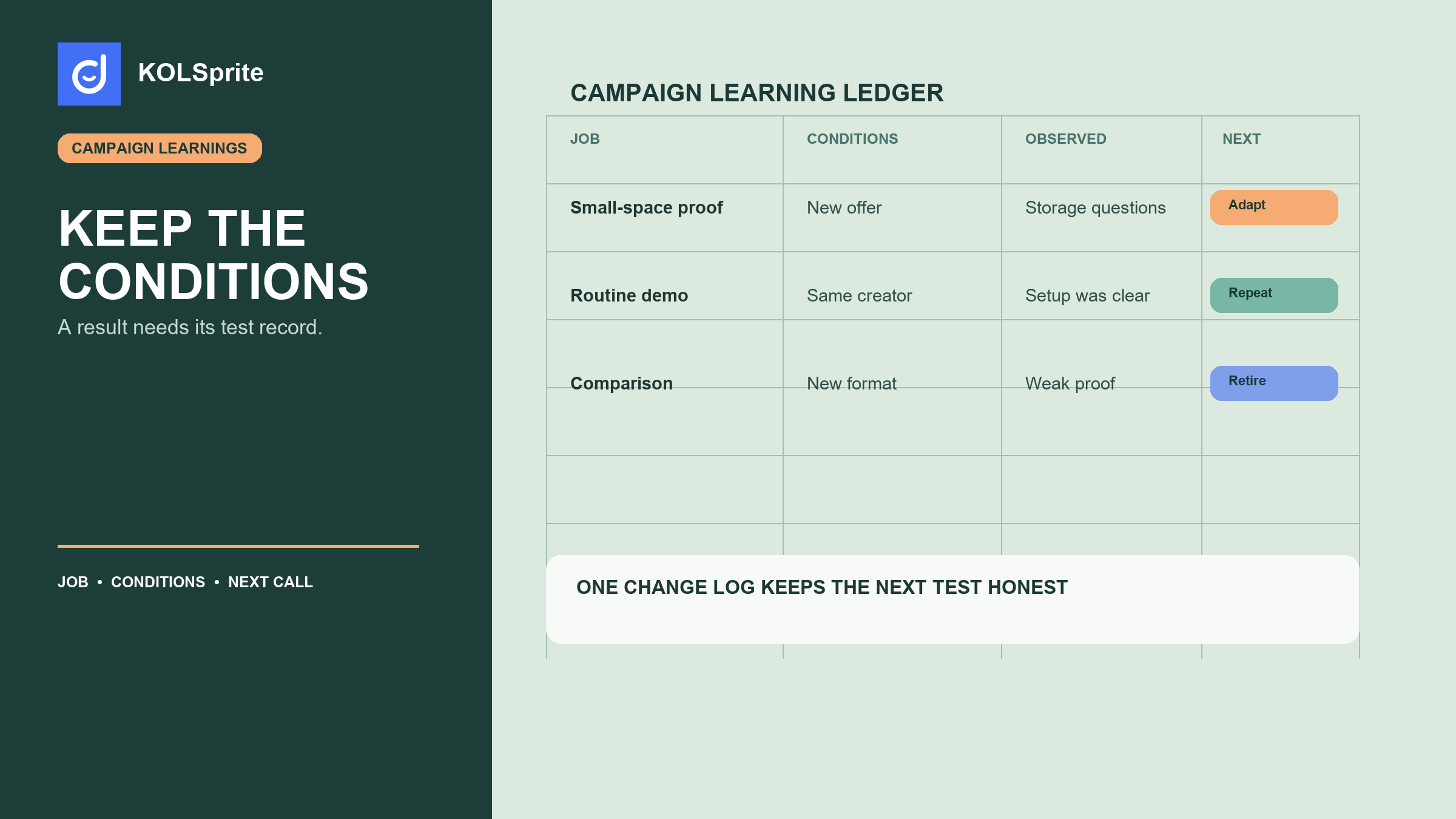
| Record field | Example of a useful entry | Why it protects the learning |
|---|---|---|
| Job | Make the small-space setup easy to picture | Keeps the result tied to a buyer decision |
| Conditions | New offer, late-summer timing, creator chose a bedroom scene | Shows what was not held constant |
| Observed output | Viewer questions focused on storage, not setup | Preserves a public response without claiming a survey |
| Business result | Use the team's measured result from the source system | Keeps reported numbers in the system that owns them |
| Next call | Repeat the space proof; rewrite the storage explanation | Turns a result into a bounded next test |
Evidence asset: Campaign Learning Ledger. Scope: the ledger records what the team observed and measured in its own systems; it does not make causal claims from one creator asset.
Use KOLSprite to retain supported public creator and content context while your team owns campaign facts, measurement, and the next test call.
Register and claim a three-day trial
A learning record becomes more useful when it separates public evidence from internal facts. Public evidence can include the creator's prior content patterns, the language used in a public comment thread, or the visible way a product use case is explained. Internal facts may include the offer, paid usage terms, creator brief, publishing date, tracking setup, and campaign result. Mixing those sources without labels creates confusion later.
KOLSprite can help at the public-research layer. It can keep supported public creator and content context close to the TikTok browsing flow, so a researcher can retain a reference, note an observed pattern, and share it with the people who own the campaign record. It does not replace your analytics source, contract file, or attribution method. The value is the bridge: a public observation does not get separated from the test it informed.
This boundary also makes a poor result easier to use. If a post underperformed, you can ask whether the public research was weak, the offer changed, the creative did not deliver the intended proof, or the measurement was incomplete. That is more useful than declaring that a creator or category “failed.”
When a new campaign borrows a past learning, record what changed. Perhaps the same creator is now talking to a different buyer group. Perhaps the product price changed. Perhaps the earlier video used a comparison and the new one uses a before-and-after. The old learning might still be useful, but it has become an adaptation, not a repeat.
This is where teams often save time by being precise. A one-sentence change log prevents a long retrospective. “Same proof job, different offer and a new creator” gives the next reviewer enough information to avoid a false comparison. “Different category, same creator” tells the team to reconsider whether the creator's public credibility travels with the new product.
The job and key conditions remain similar, so the team can check whether the learning holds.
The underlying question remains, but one meaningful condition changed and should be named.
The result no longer fits the offer, audience situation, or available evidence.
A claim, rights, safety, or attribution question needs an owner outside the learning ledger.
A ledger is not useful if everyone can add notes but no one decides what happens next. Give the record a named owner and a review date. The owner does not need to run every campaign. They need to close the loop: choose repeat, adapt, retire, or escalate. That small responsibility prevents the document from becoming another archive.
For the research side of this workflow, the creator brief template can hold the original proof job, while the content analytics guide helps a team describe a public content observation without converting it into a performance promise. The handoff is deliberate: research informs a test; it does not certify one.
Do not write “this creator converts” when the record only contains one campaign outcome. Do not write “the audience loved it” when the evidence is a handful of comments. Do not write “the hook caused the result” when the offer, timing, distribution, and creator relationship all changed. These phrases feel decisive, but they make later learning less trustworthy.
Instead, write what the team actually knows. A sentence such as “The storage question appeared more often than the setup question in the public comments reviewed” is modest, readable, and actionable. It suggests a next creative change without pretending to settle every reason for the outcome.
Join the KOLSprite Discord to discuss campaign conditions, creator learning notes, and the questions that make a result useful in the next test.
 +
+
Join the KOLSprite Discord community
The best review rhythm is usually shorter than a monthly retrospective and calmer than a daily dashboard chase. Choose a weekly or campaign-close review that lets the owner reopen the brief, the public references, and the measured outcome together. The discussion should end with one updated ledger entry and one decision, not a request for every person to defend their work.
Over time, the ledger also helps new teammates understand why a current practice exists. They can see the original condition, the later adaptation, and the point at which the team stopped treating an old result as universal. That history is more useful than a collection of screenshots because it preserves the reasoning as well as the result.
When the record is thin, say so. A small, honest learning is safer to build on than a confident conclusion with missing conditions.
Not every campaign review needs one interpretation. If the content lead believes the demonstration worked while the partnership lead thinks the offer was the main factor, record both views and the evidence each person used. The next test can be designed to separate them. A ledger that hides disagreement often creates more false certainty than it removes.
The goal is not a perfect history. It is a fair starting point for the next decision, with enough context that the team does not have to reconstruct the campaign from memory.
For how to track creator test learnings across campaigns, a short review works better than a long slide deck. Open the brief, the final post, and the result in the same meeting. Ask three plain questions. What job did we set? What changed while the work was made? What one choice should change next time?
Write the answers in the ledger while the people who know the work are there. A content lead may recall a line that changed. A partner lead may know that the offer was late. The person who owns results may see a gap in the tracking. Each note has value when it stays tied to the same test.
KOLSprite can keep the public reference, creator context, and saved clip close to that ledger entry. It does not explain why a result happened. It gives the team a stable way to reopen the public work before it decides what to repeat or change.
The next campaign should then state whether it is a repeat or an adaptation. If it is an adaptation, name the one key change. This simple habit makes how to track creator test learnings across campaigns a real team practice, not a phrase used only after a result is hard to explain. That is the practical value of how to track creator test learnings across campaigns.
Here is a simple example. The job is to show that a lamp can work on a small desk. The creator uses a home office scene. The offer is new. The post gets many questions about the cord, not the light. The next test keeps the desk scene and shows the cord in the first few seconds. That is a useful lesson. It does not say that the creator will always work, or that one post caused a sale.
The note is short, but it gives the next team a real place to start. They know what was shown. They know what changed. They know what the public talk was about. They know the one thing to test next. A good record does not need a long theory. It needs facts that stay with the work.
The purpose of tracking creator test learnings is not to make every campaign report longer. It is to make the next decision smaller and clearer. A good ledger keeps the useful conditions, marks what changed, and gives the team one next call. That is enough to turn a creator campaign from a one-off asset into a source of practical learning.
At the end of the week, review the records that produced no decision. Those are often the ones with an unclear job, a missing condition, or no named owner. Fixing that gap usually improves the next campaign more than adding another report column.
Continue the research: job-first influencer strategy · creator brief proof criteria · use learning for the next creative choice.
Newer Article
<<Evaluate TikTok Creator Category Fit With Evidence
Latest Articles
As an essential, data-driven toolkit for TikTok influencers and marketers, KOLSprite provides powerful features for effortless creator discovery, trending content identification, and actionable real-time insights.
It empowers users to make smarter decisions and significantly boosts their TikTok business.

 Refer & Earn