 +
+
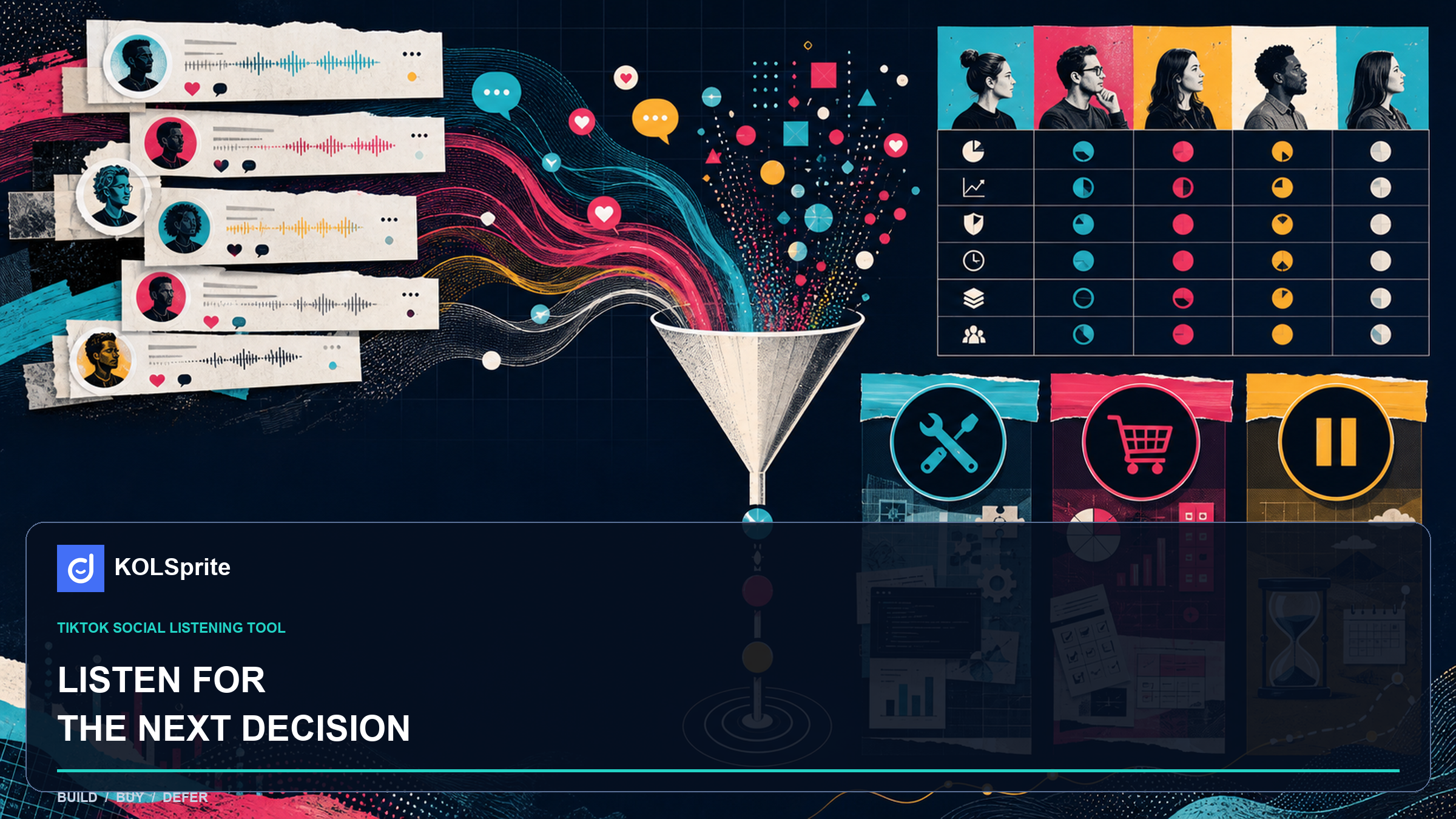
A lean ecommerce team does not need a wall of sentiment charts. It needs to know which buyer question should change the next product page, video, or creator brief, and who owns that change. Define the action, evidence boundary, and owner before comparing software. Those requirements produce a Small-Team Listening Requirements Card and a build-buy-defer choice, while keeping useful comments from disappearing into another dashboard.
“We need social listening” often means several different things. A product marketer may want recurring buyer objections. A content lead may want language for the next video. A creator manager may need public context before writing a brief. These jobs use some of the same posts and comments, yet they require different outputs and different review habits.
Start with the decision that has been stuck. Perhaps product-page copy keeps making a claim customers question. Perhaps the social team cannot tell which comment theme deserves a reply video. Perhaps a creator brief is missing the words buyers actually use. The right listening workflow makes that one decision easier. Everything else is optional until it proves useful.
TikTok’s Market Scope materials describe audience and market research contexts, and TikTok Next presents current platform trend perspectives. They are useful references for platform context, not a substitute for a team’s own scoped question. See TikTok’s Market Scope overview and TikTok Next.
Use this as the buying rule: “Choose a listening workflow only when a public signal has an owner, a stated limit, and a next decision.” It is a stricter standard than “can this tool collect more data?”
A TikTok social listening tool may be worth paying for when it removes a real manual burden and reliably routes evidence into work the team already owns. It may be unnecessary when one weekly comment review, recorded with care, answers the present question. The decision should follow the volume and complexity of the work, not the anxiety created by a competitor’s dashboard.
Write the action in a form someone can complete. “Revise the product-page answer about sizing” is an action. “Learn what customers think” is too broad. “Draft a reply-video angle for the recurring installation question” is an action. “Improve social insight” is not a useful assignment.
Then name the signal. It might be repeated public questions on a defined group of posts, a recurring term in captions, or visible confusion around a product claim. Keep the sample bounded by topic, date range, and post type. A small sample that the owner can inspect is often more valuable than a sweeping label that nobody can trace back to the original comments.
This sequence changes the software conversation. First ask if the platform can collect evidence for the planned action. Then check whether people can inspect the examples. The workflow should also record why the team chose that action.
KOLSprite AI Comment Analysis can summarize public comment themes and questions where supported, while your team verifies examples and decides what should change.
Register and claim a three-day trial
Public comments and videos can reveal questions, language, and visible points of confusion. They do not reveal every buyer’s view, private messages, complete purchase context, or a representative measure of sentiment. An AI summary may speed the first pass, but it can group language imperfectly and should send the reviewer back to examples.
Write the limitation next to each output. “These are recurring questions in the reviewed public comments” is honest. “This is what the market thinks” is not supported by the same evidence. The distinction is especially important when a comment theme could affect health, safety, compliance, or a promise made on a product page.
Teams that need verified platform data integrations should review the relevant TikTok Business API documentation rather than assume that a listening tool has the same access or permissions. TikTok publishes its developer material at the Business API documentation.
The card is the deliverable. It should fit on one page and answer five practical questions: What decision needs help? Which public evidence is in scope? Who checks the original examples? Who owns the next action? When will the team decide whether the workflow was worth repeating?
| Requirement | Observed workflow output | Owner | Limit to record |
|---|---|---|---|
| Buyer-question review. | A grouped set of visible questions with linked examples. | Product-page owner. | Public commenters are not a representative sample. |
| Reply-video input. | A recurring question with the source posts and dates. | Content lead. | Question frequency does not prove demand. |
| Creator brief context. | Visible wording and examples around a product problem. | Creator manager. | Public context does not clear claims or compliance. |
| Escalation. | A theme marked for specialist review. | Named reviewer. | Tool output cannot make the final judgment. |
Source date: 2026-08-20. Scope: an illustrative requirements card for public TikTok video and comment workflows. Limitations: it does not represent full-web monitoring, private sentiment, market research, complete API coverage, or guaranteed AI classification accuracy.
A card with blank owners is a warning sign. A team may have found an interesting theme without deciding what happens next. Assigning ownership also reveals when the answer is to defer: there is no value in collecting a signal that no one can act on this quarter.
Build a bounded workflow when the question is narrow, the post volume is manageable, and a person can inspect the original examples. A shared research record, a weekly review time, and a clear owner may be enough.
Buy a fuller platform when the work repeats across products, regions, or teams. A larger system may also make sense when the team needs clear routing or software links. Name the decisions that system must support. The purchase case should cover the review work, not only data collection.
Defer when the team has no decision owner or the question is still too vague. Deferral is a valid outcome. It prevents a large tool from replacing the harder work of deciding what counts as evidence.
For a narrow question-led workflow, the guide to TikTok comment analysis for ecommerce is a useful companion. A content owner building from those questions can also use UGC scripts from TikTok comment questions without treating public comments as a script mandate.
Join the KOLSprite Discord to discuss comment evidence, buyer questions, tool boundaries, and build-buy-defer choices.
 +
+
Join the KOLSprite Discord community
KOLSprite can support a bounded public workflow. It can collect supported public videos and comments, while AI Comment Analysis can group themes and questions. The reviewer can still inspect the source examples and their limits. The team can then carry those observations into content, product, or creator research without losing context.
That role is useful when the team needs a research layer around a defined decision. KOLSprite is not a full-web monitoring system, private-sentiment database, representative market study, or guarantee that a classification is correct. A person should still verify examples and choose the product, content, or creator action.
When the work concerns broad audience context rather than a specific comment question, use the TikTok audience insights public signal workflow to keep the scope visible.
The test for a listening workflow arrives after the card is complete. Did the team revise a real answer, write a more grounded video brief, or decide that the evidence was too thin to act on? Those outcomes are more useful than a rising count of themes or mentions.
Keep the chosen action attached to its source examples and stated limitation. When a similar question returns, the team can inspect what it saw, what it changed, and whether the workflow deserves another week of attention. That is the level of proof a small team needs from a TikTok social listening tool.
Set a short review date when the workflow starts. A two-week window may be enough for a narrow question. The exact length depends on posting volume and the decision at hand. What matters is that the team agrees on when it will stop collecting and start deciding.
At that review, look at the original examples before looking at the summary. Check whether the chosen theme still describes the comments. Check whether the owner used it. A summary that was never turned into a product, content, or creator decision has not earned another cycle.
Keep the record small. Store the question, the sample boundary, the examples, the decision, and the limitation. That is enough for a later reviewer to understand the work. A long archive of loose themes often makes the next decision slower, because no one knows which theme led to an action.
Escalate when the question moves beyond public context. A claim about product safety, an issue involving a regulated category, or a pattern that may require legal review belongs with the right specialist. The listening record can show what was observed. It cannot settle the issue alone.
The best test is practical. After a month, can the team point to one page change, one useful reply video, or one stronger creator brief that came from a documented public signal? If it can, keep the workflow. If it cannot, narrow it, change the owner, or defer the tool until there is a decision worth supporting.
Before using the record, confirm that each example is still public and supports the note attached to it. Remove any claim that has drifted beyond its source.
Keep the sample tied to the current choice. A narrow question needs the relevant posts and comments, not a broad search that ends in a vague report.
Ownership should follow the action. The content lead may own a reply video, the product lead a page edit, and the creator manager a brief.
Set a stop point before collection begins. The review can end when the team has enough evidence to decide, when examples conflict, or when no owner can use the answer.
Four plain labels make the record easy to inspect: question, proof, limit, and next action. A missing field exposes a note that is not ready to use.
Public comments support bounded observations, not market claims. Link each point to its post and report a count only after someone has checked it.
The value test is practical: did a buyer question get answered, a page line change, or a creator receive better context? With no trace of real work, the workflow is probably too wide or too loose.
Start with one small set and make one decision from it before extending the process.
A short record is enough when it preserves the source, limitation, owner, and action for the next reviewer.
At the stop point, check the dates and scope once more, then let the owner act. If the workflow did not support a decision, narrow the question or defer the tool.
Latest Articles
As an essential, data-driven toolkit for TikTok influencers and marketers, KOLSprite provides powerful features for effortless creator discovery, trending content identification, and actionable real-time insights.
It empowers users to make smarter decisions and significantly boosts their TikTok business.

 Refer & Earn