 +
+
A strong rating and a large review count can make a TikTok Shop product record feel settled before anyone has checked whether it matches the buyer question. US sellers need a narrower standard. What can a rating actually prove?
A rating can justify a closer look at a relevant public record. It cannot prove a product claim, buyer use case, quality outcome, or market opportunity. Check the result set first, identify the claim you want to make, and write down the evidence the rating does not provide.
Ratings feel persuasive because they reduce a messy buyer experience to one visible number. That reduction is useful for scanning. It is dangerous when the number starts doing jobs it cannot do. A rating does not explain what buyers liked, which variant they bought, when they purchased, what they expected, or whether the record belongs in the comparison you are making.
The first question is therefore not “Is this rating good?” It is “What claim am I asking this rating to prove?” A team might want it to prove that a product is durable, that a buyer problem exists, that a price is acceptable, or that a category has room. Those are different claims. None follows automatically from a public rating field.
Make the claim visible before you search. “We want evidence that buyers value a portable printer for travel” is a claim about a use case. “We want a relevant public product record to inspect” is a research goal. The first needs buyer evidence beyond a score. The second may begin with a rating, provided the returned products are actually relevant.
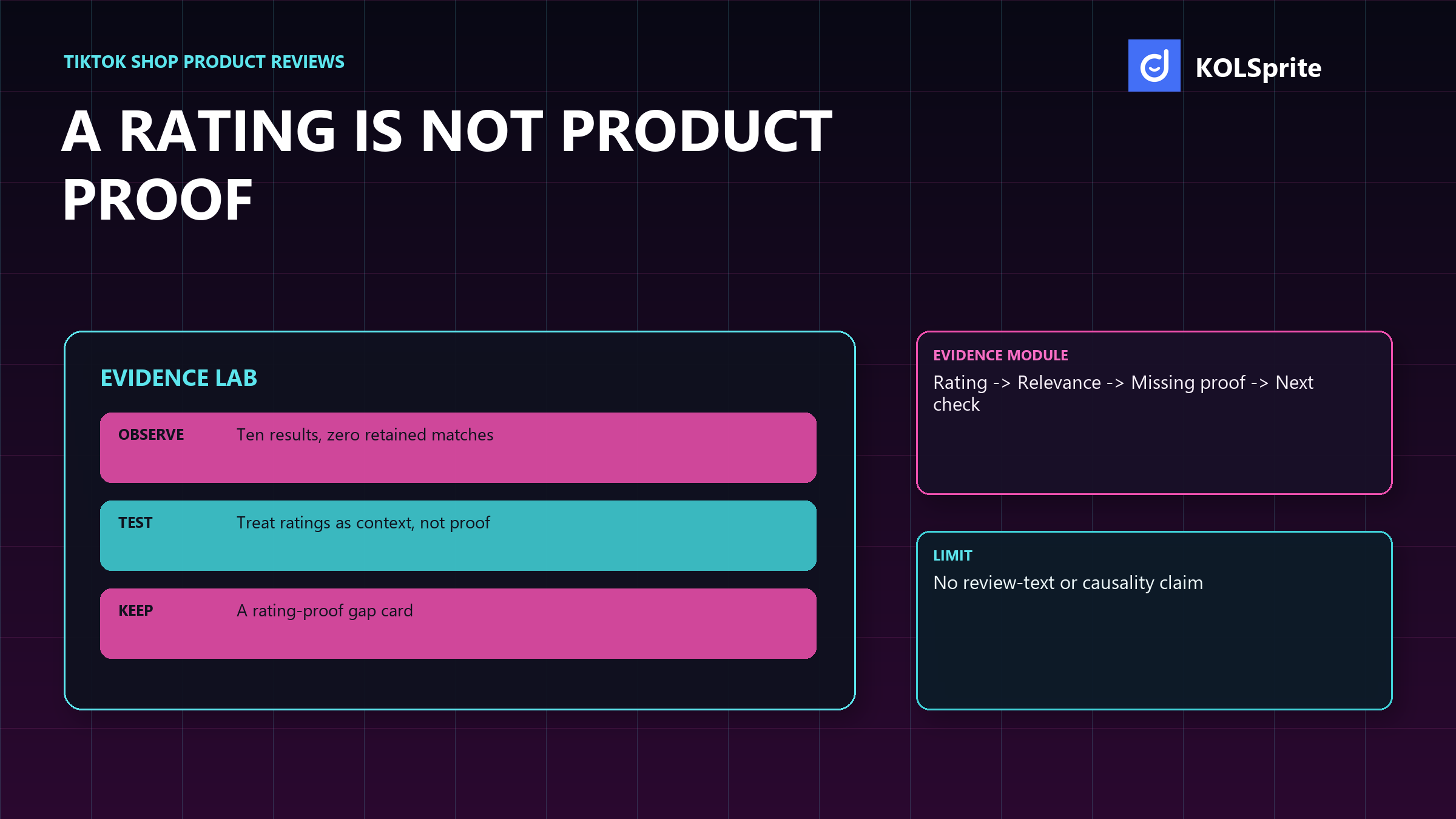
A September 8, 2026 KOLSprite MCP product search for “portable printer” returned ten public records. None was a portable printer, even though the returned records carried rating and review fields. That observation is more valuable than it may sound. It shows how easy it is to see populated data and assume the comparison is valid.
In that result page, a rating would have described a record that did not match the stated product question. Adding the ratings together, sorting them, or calling the highest one a competitor would not improve the search. The failure happened earlier: the result set was not relevant enough to retain.
Use a three-part relevance check. Does the item match the product type? Does it address the buyer use case you are studying? Does the offer belong in the same price, package, and market conversation? A record that fails one of those checks may still be interesting for another question. It should not be used as proof for this one.
| Field on the card | What you may record | What remains unproven |
|---|---|---|
| Visible rating and review count | The fields shown on a retained public record | Why buyers rated it that way |
| Relevance check | Product type, buyer job, package, price, and market fit | That a keyword match is automatically comparable |
| Claim under review | The exact product or buyer claim the team wants to test | That the rating validates the claim |
| Missing proof | Original buyer evidence, product facts, and timing context | Quality, demand, or causality |
| Next action | Inspect a relevant record, find buyer evidence, or stop | A recommendation to copy the product |
Scope: record a visible rating only after the product set passes a relevance check. Market: US. Access date: September 8, 2026. Sample: one ten-record MCP keyword result page. Cleaning: retain only records that match the buyer question. Limit: the observed mismatch does not explain buyer ratings or show market demand.
The FTC’s advertising guidance is the relevant external boundary for buyer-facing claims: a rating field is context for research, while a new objective product claim needs its own support.
The card turns a vague caution into a concrete gap. You can show the rating, state why the item is relevant, name the claim under review, and list what is still missing. If the relevance line is blank, do not complete the rest of the card. The correct next action is to reject the record and improve the search question.
Register for KOLSprite and claim a three-day trial of the web product. MCP access is sold separately.
Register and claim a three-day trial
Suppose a team wants to say a product is “trusted by buyers.” A rating and review count may show that a public record has visible buyer feedback. They do not show what buyers trusted, whether the feedback applies to the same variant, or whether the claim is permitted for your own product. The proof gap remains open.
Suppose the team wants to copy a product offer because the rating looks high. Ask whether the retained record has the same buyer job, price structure, package, and market conditions. If the answer is incomplete, the rating does not make the offer transferable. A score cannot repair a weak comparison set.
Suppose the goal is a category decision. One product rating can be a lead for a closer review. It cannot estimate the size of an opportunity or establish the reasons buyers select a category. That work needs a broader and still carefully comparable evidence set. The rating card is useful precisely because it makes the next proof request visible.
KOLSprite MCP can surface public product fields for a scoped research lead. Use a specific product search query, inspect the returned records, and reject results that do not meet the relevance rule. If a record is retained, treat the rating as context for a separate proof review. That sequence is more valuable than collecting a long list of scores.
TikTok Shop product reviews are most useful after the product set passes the relevance check. Keep the rating beside the buyer question and the evidence request it cannot answer on its own.
Input: a public product search query, returned records, and one product claim under consideration. Action: use KOLSprite MCP product search, reject irrelevant results, and treat any retained rating as context for a separate proof review. Output: a rating-proof gap card with the visible field, relevance check, missing buyer evidence, and next action.
KOLSprite does not provide review-text sentiment proof, private quality data, product causality, or a guarantee that keyword matches form a comparable market set. A public field must not become a claim about buyer outcomes on its own.
The stop rule is simple: stop using the rating when the record no longer matches the question. You may keep the search observation in a research log, but do not retain it as a competitor, benchmark, or buyer proof. A visible number should not outlast the relevance that made it meaningful.
A public product record tells you about that record. Your product promise has to be supported by your product facts, compliant claims, and buyer evidence. Those can overlap, but they are not the same thing. The distinction matters most when teams are tempted to borrow language from a high-rated listing and treat the rating as permission.
Before a listing or creative brief uses any buyer-facing conclusion, open a buyer expectation review. Name what the buyer expects, what the product can document, and what the public record merely suggests. That work can lead to a better claim, a clearer limitation, or a decision to leave the promise alone.
The card also helps content teams. A creator may want to mention that a product is popular or well reviewed. The team should first decide whether the retained record is relevant and whether that statement describes the correct product. Public metrics are easy to repeat. They are harder to defend after the fact.
Join the KOLSprite Discord to discuss the question behind your next test.
 +
+
Join the KOLSprite Discord community
A well-matched product record can still be useful even when it proves very little by itself. It can prompt a specific question: What buyer problem does this product appear to address? What evidence would show that our offer addresses the same problem? What review or product information do we need before using that language? These are research questions, not verdicts.
For a broader comparison, use comparison relevance to keep the product job and package promise in view. The rating belongs inside that comparison as one field among several. It should never become the shortcut that decides the result.
For a structured public-record review, use the KOLSprite MCP workflow with one query and one relevance rule. TikTok Shop product reviews then become a bounded field in the review, rather than a stand-alone recommendation.
Keep the search log honest
Record rejected results as rejected. The portable-printer observation is useful because it shows that a query produced records with populated fields but no retained matches. A clean research log can say exactly that. It should not turn the returned products into competitors simply because their ratings were visible.
For every retained record, write why it passed the relevance check. For every rejected record, write the reason in a few words: wrong product type, wrong buyer job, wrong market, or unclear package. These notes help a team improve the next query and stop the same loose match from returning in a later presentation as if it had been validated.
The log is also a useful guard against selective evidence. A high score can create pressure to keep a record that fails the product question. The rejection note keeps the choice tied to relevance rather than to the appeal of the number. It makes a smaller, cleaner comparison set possible.
Use the same record structure when the result is relevant. Save the product type, buyer job, market, package, checked date, visible rating, and reason it passed. This does not make the score proof. It makes the next review more accountable, because the team can see which part is an observation and which part is still a hypothesis.
A useful search log can therefore include both a retained record and a rejected one. The contrast teaches the team more than a list of the highest ratings, because it shows how relevance was protected before the evidence was allowed into the decision.
That record also gives reviewers a way to challenge the search without pretending the rating itself settled the argument. They can improve the query, change the comparison rule, or ask for buyer evidence before a product promise moves forward.
Use it before copying a claim.
Take one rating you have been tempted to cite and complete the gap card. If the relevance check fails, discard it from the current decision. If the record is relevant, write the buyer proof that remains missing. TikTok Shop product reviews can provide context, but they do not replace that proof. Then choose a next action that can produce it, such as inspecting original buyer context or reviewing the product claim.
Use the card to keep the rating, product match, and open proof request in one decision note. A teammate can then see the record that earned attention, the buyer question under review, and the evidence request that should guide the next piece of work.
Latest Articles

As an essential, data-driven toolkit for TikTok influencers and marketers, KOLSprite provides powerful features for effortless creator discovery, trending content identification, and actionable real-time insights.
It empowers users to make smarter decisions and significantly boosts their TikTok business.

 Refer & Earn