 +
+
A TikTok Shop product listing is often treated as the last publishing task. The team gathers a title, uploads images, sets a price, and turns on traffic. That puts pressure on the page before the seller has agreed on the basic facts. Different people may prepare the title, photos, options, and proof. Shoppers see any conflict first.
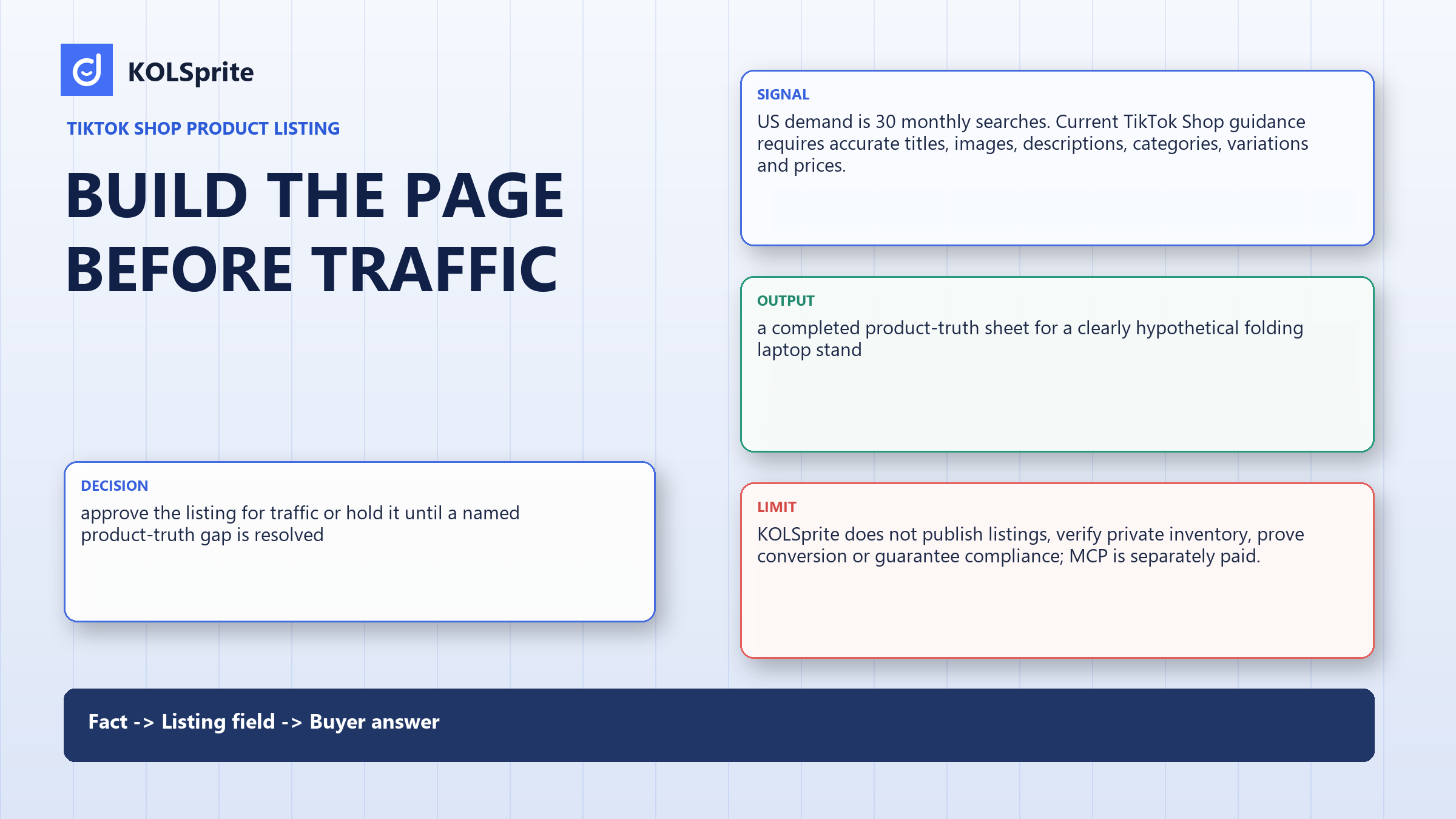
Build the TikTok Shop product listing as a product-truth model before you send paid traffic or creators to it. Every visible element should answer a buyer question with a fact you can support. When a needed fact is missing, hold the listing and resolve that gap instead of covering it with more copy.
Imagine a shopper who arrives from a short video, knows the broad product type, and wants to decide in a minute whether the item is for them. They are not looking for your internal launch plan. They want to know what the item is, what arrives, whether the pictured version is the purchasable version, which option to choose, and what claim the page is asking them to believe.
That is why traffic cannot repair a page that has not decided what is true. Extra impressions may make an unclear page more expensive. A creator can demonstrate a feature, but the listing still needs to make the offer legible after the video ends. Treat the page as the place where the product team makes its promises checkable.
TikTok Shop's current US guidance requires accurate titles, descriptions, images, categories, variations, and prices. Each part must represent the item. This is a useful sales standard as well as a publishing rule. A strong page agrees with itself. The title must not suggest a bundle that is not in the box. An image must not show an unavailable color. An option label must not hide a real difference.
Begin with the least promotional description you can make. Write what arrives in the box and what the product does without adjectives that need interpretation. For a hypothetical folding laptop stand, that might read: “One adjustable folding stand, one storage sleeve, and one setup card. The stand holds a laptop above the work surface at several height and angle positions.” That sentence is not a listing yet. It is a shared starting point.
Next, separate facts into four piles. The first pile is physical: materials, dimensions, included items, colors, and configuration. The second is use: what action the product enables. The third is choice: what changes between variations and what a buyer must select. The fourth is proof: photos, instructions, demonstrations, measurements, or approved documentation that support the first three piles.
This work feels slower than opening a listing form, but it prevents a familiar failure. A seller may write “portable workstation” because it sounds useful, then discover that shoppers read it as a desk, a bag, or an included keyboard. The truth model gives the phrase a test: can the rest of the page answer the expectation it creates? If not, use plainer language or add the missing explanation.
Give every fact a status before the copy review. Mark it confirmed, needs proof, or remove. A confirmed fact can move into the page when the offer and image match it. A fact that needs proof stays in the working sheet. It does not become public copy because launch day is close. A removed fact should also leave the photo notes and creator brief. This small status check keeps one weak idea from appearing in several places.
Also name the source of each fact. The box list may come from the approved pack plan. A size may come from a product record. A use step may come from the current setup guide. If two sources disagree, stop and ask the product owner. Do not choose the version that sounds better. The listing should reflect the item a buyer will receive, not the version that makes the easiest headline.
Register for KOLSprite and claim a three-day trial of the web product. MCP access is sold separately.
Register and claim a three-day trial
A useful TikTok Shop product listing gives each element a job. The title should identify the item and its meaningful form. The lead image should show the purchasable item clearly. Supporting images should answer questions that cannot fit in the title: scale, included parts, use position, and option differences. The description should connect facts in a readable order rather than repeat every label. Variations should make selection easy. Price should match the selected offer.
For the hypothetical laptop stand, a title such as “Adjustable Folding Laptop Stand with Storage Sleeve” makes a specific offer. A first image can show the stand and sleeve together. A second can show the folded and open positions. A third can name what is included. A variation table can distinguish color only if color is the only difference. If one option changes the stand's size or included parts, the variation name needs to say so plainly.
What arrives: adjustable folding stand, storage sleeve, setup card.
What it does: raises a laptop above the work surface at adjustable height and angle positions.
Buyer questions: Is the sleeve included? What does folded look like? Which color is selected? What changes if I choose a different option?
Page evidence: boxed-items photo, open-and-folded photo, variation labels, product dimensions only when verified.
Launch hold: do not publish until every pictured item, selected option, and included item has a matching product fact.
The product-truth sheet is most useful when it makes a launch hold precise. “The page needs work” is not actionable. “The main image shows a sleeve but the offer does not state whether it is included” is actionable. A named gap has an owner, an evidence need, and a decision. It can be fixed, removed from the page, or kept out of the launch until the seller can support it.
Use a simple hold test. Read the title, images, description, variation names, category, and price as if they were separate sources. Then ask whether a cautious buyer could reach two different conclusions about the product. Look especially for bundled accessories, before-and-after imagery, capability language, size assumptions, and option names. These are common places where a page can be technically complete but still create doubt.
A hold is not a verdict on the product. It is a decision to keep attention from reaching a page before the page can explain itself. For a team under launch pressure, that distinction matters. The target is not perfect prose. It is an offer that a shopper can understand and a seller can defend.
Set a clear release condition for each hold. The sleeve question may close when the approved box list and a new included-items image agree. A color question may close when the option name and stock record match. A size question may close when the product owner supplies the verified measure. These are small decisions. They are much easier to manage than a broad request to “improve the listing.” They also show the traffic owner exactly why the page is waiting.
Join the KOLSprite Discord to discuss the question behind your next test.
 +
+
Join the KOLSprite Discord community
Once you know the proof you need, public market research can help you see the comparison points shoppers may encounter. KOLSprite can support web research into relevant public products and videos, producing a short observation note about useful comparison points. That can reduce manual searching when you are deciding what questions to address on the page.
A bounded KOLSprite workflow starts with verified product facts and a question such as “What included-item and folding-position comparisons are visible in public examples?” Review relevant public products and videos, record observations without copying their claims, then bring the note back to the product-truth sheet. The seller decides which facts belong on the listing and supplies the evidence for them.
KOLSprite does not publish listings, verify private inventory, prove conversion, or guarantee compliance. Public examples are context, not product evidence. Its MCP offering is separately paid and is not a Plus or Pro benefit or a free-trial benefit.
That boundary keeps the research useful. A competitor's image may reveal that shoppers expect to see the folded form. It does not prove your product folds the same way. A popular phrase may point to a question worth answering. It does not authorize a claim. Bring only the question forward until your own facts and evidence answer it.
Current US guidance calls for accurate titles, descriptions, images, categories, variations, and prices that represent the item. Read the source before publishing: TikTok Shop product listing guidance.
Scope: listing accuracy requirements. Market: US. Access date: September 7, 2026. Sample: one current Seller Center University page. Cleaning: only explicit listing fields and accuracy guidance were retained. Limit: the source does not promise sales, approve claims, or make the hypothetical truth sheet an official form.
Keep the distinction in the approval record. The source tells you to represent the item accurately. Your product files tell you what the item is. The page connects the two. That order is more durable than borrowing a claim from a product that happens to look similar.
Before you chase traffic, ask one person who did not assemble the listing to complete the buyer-question map. Their job is not to polish wording. Their job is to identify a conclusion they could draw that the page cannot support. Have them choose a variation, list the included items, describe the product in one noun phrase, and point to the image or text that proves each answer.
Then choose one of three outcomes. Approve when the facts, evidence, and offer agree. Hold when a named product-truth gap remains. Simplify when the product is clear but the page has introduced unnecessary language. The last outcome is often missed. Removing an unsupported or fuzzy promise can make the listing stronger without adding a single asset.
Picture the final handoff. The traffic owner receives a page, a short truth sheet, and no hidden caveat. The product owner can trace each claim. The creative team knows which facts it may show. Questions that remain are named, not buried. For related discovery work, review TikTok Shop product research, compare alternatives with TikTok Shop product comparison, and turn confirmed proof points into TikTok video ideas.
Latest Articles

As an essential, data-driven toolkit for TikTok influencers and marketers, KOLSprite provides powerful features for effortless creator discovery, trending content identification, and actionable real-time insights.
It empowers users to make smarter decisions and significantly boosts their TikTok business.

 Refer & Earn