 +
+
If you are comparing research software for an Amazon or Shopify team, the longest feature list is a poor buying guide. A trend page, ad library, product database, browser extension, and creator platform can all be useful, but they answer different questions. A TikTok product research tool earns its place only after the team names the evidence gap it must close. This guide gives you a question-to-evidence matrix and a 30-minute trial that ends with a product decision, not another dashboard tour.
Ten-second answer: use trend tools to find candidates, videos and comments to understand the product story, creator research to test content fit, and your own records to check margin, stock, shipping, returns, and compliance. Buy the tool that makes one of those handoffs faster and clearer.
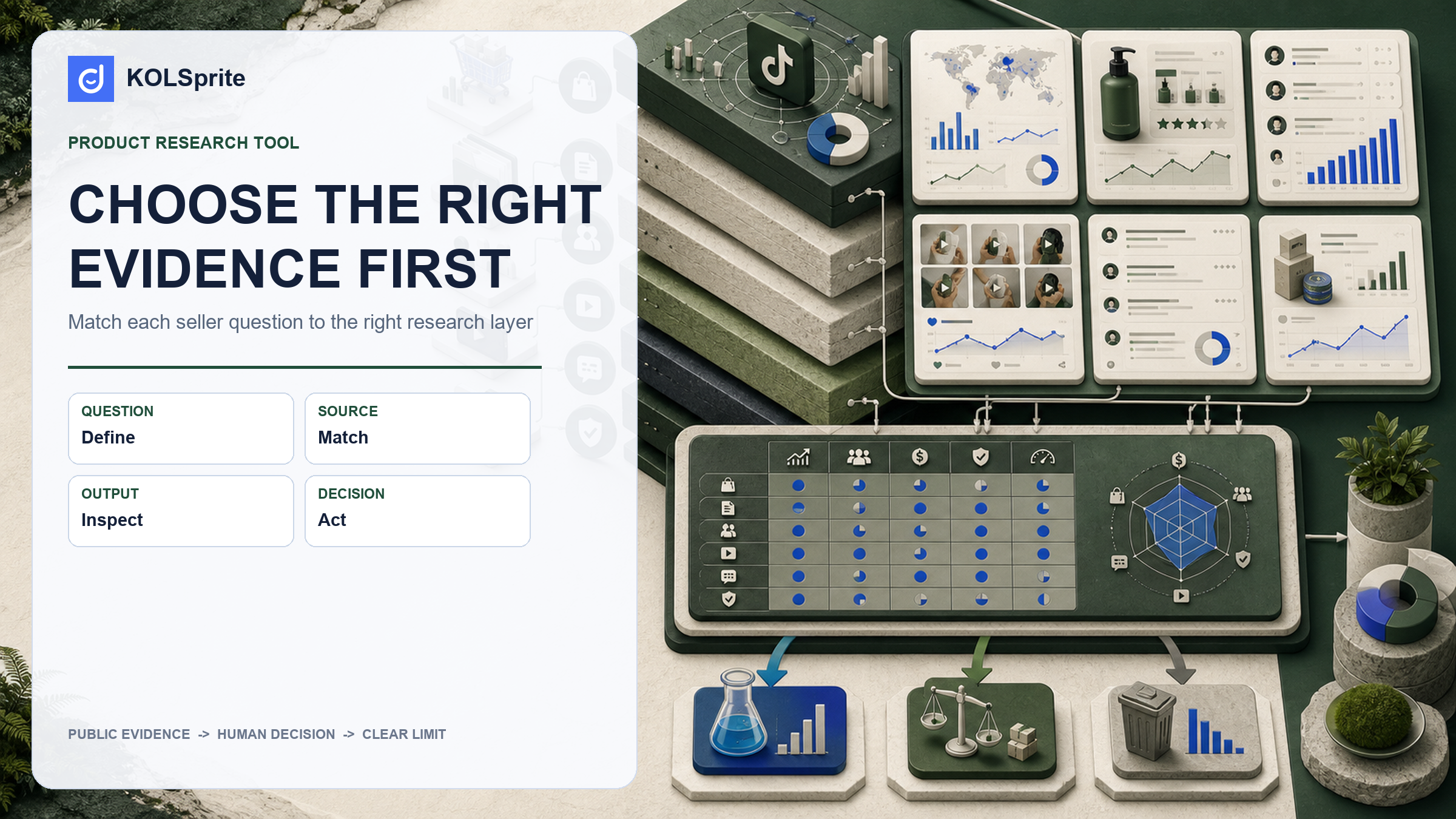
Start with four lines: What do we need to know? Which source can show it? What will we save? What choice will that record change? A tool earns a place in the stack only when the team can answer all four.
"Research portable blenders" is not a decision. It is a topic. A better question is: "Can a portable blender earn a small creator test for office smoothie use?" First, check whether that setting appears in real content. Then inspect the demo and recurring objections. Ask whether creators can show the use case naturally. Finally, confirm that your commercial limits can support a test.
Official source: TikTok Shop describes Product Opportunities as a way to surface trending products, searches, and content signals. Treat it as discovery input and recheck the live page before acting.
Different tools help with different parts. TikTok Shop Product Opportunities and Creative Center can surface a topic or content pattern. Public video research can show the hook, demo, comments, and setting. Creator research can show who makes clear content for that use. Your own systems must still answer margin, stock, safety, returns, and shipping questions.
A product research stack becomes useful when it makes these handoffs explicit. It becomes misleading when a platform calls one public signal "winning" and leaves the buyer to discover the missing commercial work later.
| Decision question | Best evidence surface | Useful output | Limit to state |
|---|---|---|---|
| Is this worth investigating? | Trend pages, Product Opportunities, current content patterns | Dated category candidate | Not a demand forecast |
| What does the buyer want to see? | Public videos, captions, scripts, comments | Proof task and objection list | Comments are not a representative survey |
| Who can demonstrate it? | Creator and similar-account research | Shortlist with format reasons | Public data does not confirm availability or fees |
| Can we sell it responsibly? | Supplier, finance, policy, operations records | Margin and risk check | External tools cannot replace internal facts |
| What should we do next? | Combined evidence record | Test, hold, reject, or collect more data | Decision still needs an owner |
This matrix is useful during a software trial. Do not start with AI, exports, or database size. Ask whether the tool gives you a usable output for one row. A focused tool may answer one important question cleanly. That can be worth more than a wide platform that returns vague signals for every question.
In a small public check of four portable-blender videos, reported views ranged from about 26,600 to 73,700. Reported video-linked sales ranged from 2 to 221. These numbers do not prove that one clip was better. The creators, offers, dates, products, and audiences differed. The range shows one useful fact: views and sales are separate fields. They answer different questions.
If you need to study the hook, a video surface may be enough. If you need to understand why people hesitate, comments and scripts can be more useful. If you need to judge the product's economics, neither field is enough. You need your own price, cost, shipping, return, and inventory data. A tool should make the boundary visible, not hide it under one score.
Source note: The portable-blender figures are public-market snapshots used to illustrate evidence selection. They are not complete category data, causal proof, or a forecast. Check the market, date, product version, and current seller information before acting.
A three-day KOLSprite trial works best with one narrow question, such as whether a product has a repeatable desk-use demonstration or a creator pool that can explain it. Save the public evidence and its limitation, then ask whether the result made the next handoff easier.
Register and claim a three-day trial
These are good at surfacing candidates and broad movement. Use them to decide what deserves a closer look. They are weak when a team mistakes an upward chart for a product decision.
These are useful for seeing how products are framed, what visual proof is common, and how offers are presented. They cannot verify whether a creative pattern fits your product, margin, or buyer trust.
These can help compare public product activity and price patterns. Their value depends on scope, freshness, and how clearly they define a metric. Treat incomplete or delayed data as a research clue, not a private business ledger.
KOLSprite fits here. It helps teams inspect public product, video, creator, caption, and comment context while they are already browsing TikTok. It can support downloads and exports when a research record needs to move to another owner. It also offers MCP access for structured research. It does not replace supplier validation, landed cost, safety checks, private marketplace analytics, or operational approval.
This trial also helps prevent subscription overlap. Two tools may produce the same candidate list. If one keeps creator and video context beside the decision, that may matter more than a wider feature grid. If neither can answer the commercial question, do not buy a third research tool. Take the gap to the person who owns cost and operations.
A simple path keeps the work clear: signal, interpretation, workflow, output, decision, limitation. For example: "Several public videos show office smoothie use. The repeated setting suggests a content angle, not proven demand. We will use KOLSprite to collect five relevant demonstrations and comments, then ask the buyer to price a ten-unit test. We will not claim the category is validated until margin and return risk are checked."
This language is more useful than a generic report because it tells each owner what they are responsible for. It also preserves the limitation. A future reader can see why the team tested the idea without assuming the first data point proved everything.
Share the product question, the record your trial produced, and the business fact the tool could not answer. The KOLSprite community can help you decide whether you need different software, a better research question, or an answer from operations instead.
 +
+
Join the KOLSprite Discord community
A discovery tool helps a team notice a category, phrase, creator, or creative pattern. A decision tool helps the team document why it should test, hold, or reject that candidate. The same product can appear in both places, but the output should change. Discovery output is a queue. Decision output is a bounded record with source, date, interpretation, next action, and limitation.
This distinction prevents research theater. A team can collect screenshots for hours and still have no idea what it would do differently on Monday. Ask a simple question at the end of each session: what decision did this evidence make easier? If the answer is "none," the output may be interesting but it does not yet justify another subscription or another week of browsing.
The record can stay compact. Include the exact question, the public sources checked, the observation, the interpretation, the proposed action, and the limitation. For a product with a strong visual hook, the observation might be that creators repeatedly show a quick setup. The interpretation might be that the setup deserves a script test. The limitation might be that none of the public examples answer the product's cleanup question. The next action is then a focused creator or supplier check, not a generic claim that the product is trending.
When the record is clear, a buyer, marketer, and creator manager can each add their part without rewriting the whole analysis. That is the real handoff value of a research stack. It gives people a common object to inspect instead of a pile of disconnected charts, saved posts, and comments.
Do not fold landed cost, return risk, compliance, safety, or inventory capacity into a score that came from public videos. They are not the same kind of evidence. A product may have an excellent content fit and still be commercially unworkable. A product with moderate public attention may be a strong test because you already have the supplier, margin, and fulfillment capability.
The commercial owner then gives a direct answer: can we support a limited test under these conditions? If the answer is unknown, the correct research outcome is a hold with a named task. This is more useful than giving a product a high score that hides the fact that no one has priced it.
At the end of a trial, finish this sentence: "Because we found this, we will do this next." If the team cannot finish it, the tool may have created information without improving a decision. The test should leave a practical next action. That action may be to stop research and ask operations for a missing commercial answer.
The trial sheet should stay short. Write the question at the top. Add two or three links. Write what you saw in plain words. Then write the next step. A good note can be: "Three clips show desk use. Two comment threads ask about cleanup. We need a supplier answer before a creator test." That is enough for a real handoff.
The sheet should not become a score maze. A high score can hide a weak fact. A clear label works better: test, hold, reject, or ask for more data. Give each label one reason. This keeps the tool review tied to a real move the team can make.
The renewal question is simple: "What decision did this tool improve in the last month?" If no one can name one, pause the renewal. The tool may still be useful for ideas. But ideas alone are not proof that it belongs in the paid stack.
One page is enough for a first test. The product question goes at the top. The source links sit below it. Three facts are enough. One limit follows. The page ends with one action. A buyer can read that page fast. A creator lead can see what kind of proof is needed. An operator can see what still needs a cost check.
Short labels help. "Trend signal" means a topic is worth a look. "Video proof" means the clip shows the product job. "Buyer question" means people ask for a fact. "Cost check" means someone inside the firm must answer. These labels do not make the work less careful. They make it easier to share.
The final call can stay plain too. Test means run a small, named test. Hold means get one missing fact. Reject means stop for a clear reason. A good tool helps the team make one of those calls with less guesswork. It does not need to make a bold claim to be useful.
A good stack does not need to be large. It needs to cover the questions your team asks repeatedly. For product discovery, connect your Amazon-to-TikTok validation process with a rejection test. For items with real delivery constraints, add the high-shipping-cost review. When the research question requires public evidence, use KOLSprite product and video research to keep the examples attached to the decision.
A quarterly stack review keeps the tools useful. Remove a tool when it no longer changes a decision or when its output is duplicated elsewhere. Add a tool only when a repeated, important evidence gap has no better owner. This keeps research software from becoming a collection of dashboards nobody can explain.
A TikTok product research tool is valuable when it makes the next product decision clearer. Choose evidence first, then choose the software that helps you collect, interpret, and hand off that evidence without hiding the limits.
Latest Articles
As an essential, data-driven toolkit for TikTok influencers and marketers, KOLSprite provides powerful features for effortless creator discovery, trending content identification, and actionable real-time insights.
It empowers users to make smarter decisions and significantly boosts their TikTok business.

 Refer & Earn