 +
+
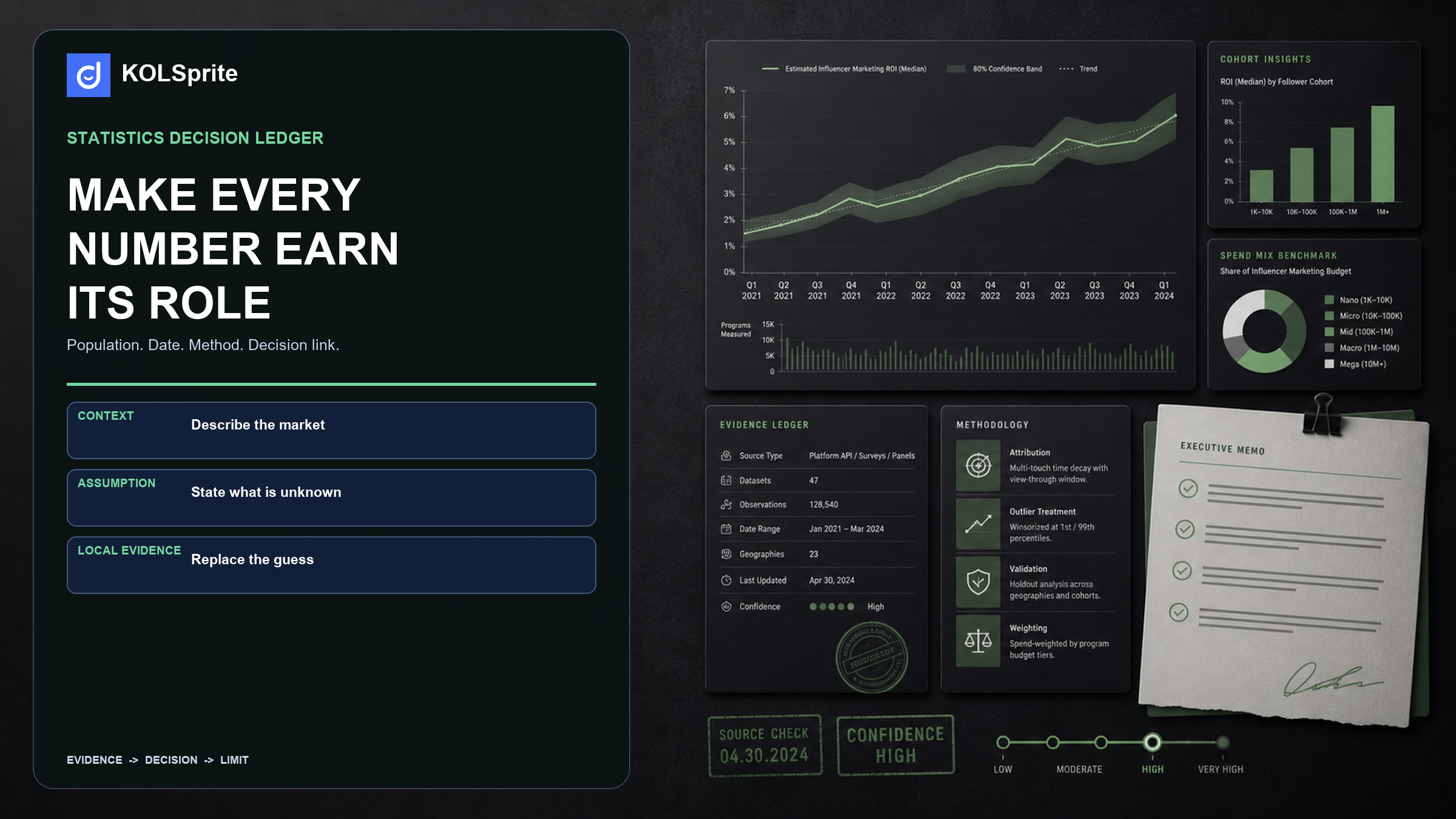
You lead growth or write budget notes for senior leaders. Your slides hold many percentages, but few change a real decision. The issue is not a lack of information; it is knowing which TikTok influencer marketing statistics can guide your plan and which only describe another population. Give each statistic one of four labels: context, assumption, threshold, or local evidence. Then show who was studied, when, how, and why the statistic matters. The result is a budget note that keeps external evidence separate from your forecast. This guide gives you the complete statistic ledger, a source review, a local example, a compliance review, a memo, and an update schedule. Public TikTok data cannot create population-level market statistics or prove private ROI. It can help you define and learn from a local test.
If the last answer is "none," move the statistic to background or cut it; if the first four answers are missing, do not use it in the forecast.
A strong memo does not win by adding more links; each statistic needs a specific job; the reader should see the gap between the source and your decision.
Context describes the world outside your plan; it can show why a channel is worth a look; it can also show what one study found. It should not become your own forecast.
Record: "This external finding gives us a reason to study the channel; it does not predict our outcome."
An assumption fills a gap before your own statistics exist. Make it specific, cautious, and easy to replace; it might cover a likely rate, cost, reply share, or time need.
Write: "We use this value for the base case until quotes or actual results replace it."
A threshold is a requirement set by your team; it is not a market statistic; you may set a top cost per approved clip or a stop-loss line. A threshold can guide a decision even when no external norm exists.
Record: "This is our operating threshold based on cost and risk."
Local evidence comes from your own population or campaign; it is relevant to your decision, but it still needs a count, date, time span, and method; twelve replies may improve your next plan. They do not describe the full creator market.
Record: "This outcome applies to this population and period; we will update it as the population grows."
Register for KOLSprite and claim a three-day trial to define a bounded creator cohort and test the assumption behind your planning memo.
Register and claim a three-day trial
A 2026 paper on arXiv gives a practical source lesson; it describes 13,215 videos and 104,097 comments tied to 71 U.K. finance creators; those are large counts. They still come from one topic, place, population, time, and research method.
Do not take a rate from that study and apply it to U.S. beauty creators. Use the example to show why every statistic needs a frame.
| Source field | Question | Research example |
|---|---|---|
| Population | Who or what could enter? | 71 U.K. finance creators and linked posts. |
| Unit | Are we counting creators, clips, or comments? | The study counts all three as distinct units. |
| Size | What base count sits under the outcome? | 13,215 clips and 104,097 comments are not the same base. |
| Place and topic | Where and in what field? | U.K. finance creator content. |
| Date | When was the study and its information created? | The paper is from 2026. Review the paper for the information span. |
| Method | How did records enter and get coded? | Review the full paper before using an outcome. |
| Use | What decision can it change for us? | It can improve source care, not forecast a campaign. |
Do not cite these dataset counts as evidence that creator marketing is effective; they demonstrate the size of one research set. Review the paper before you use any of its detailed findings.
Use one row for each statistic; do not blend several sources in one row; these examples show how the four roles stay apart.
| Statistic or claim | Label | Population, date, and method | Use | Threshold | Next step |
|---|---|---|---|---|---|
| 13,215 clips and 104,097 comments linked to 71 U.K. finance creators. | Context | 2026 research set. U.K. finance topic. Paper method. | Needs a specific source frame in the memo. | Not a U.S. shop outcome norm. | Keep as a source lesson. |
| Expected creator reply share: [team assumption]. | Assumption | No first-party outcome yet. Owner and date shown. | Sizes the first outreach plan. | Unknown until the team records it. | Replace after the first cohort. |
| Top approved cost per usable clip: [$ internal]. | Threshold | Based on the team's unit cost and rights needs. | Sets deal and stop rules. | Not a market rate. | Review with finance and legal teams. |
| Fit-pass share in the first twelve names: [outcome/12]. | Local evidence | Named population, market, rules, and review dates. | Changes the next search plan. | Bounded local population. | Update after each additional cohort. |
| Source and statistic | Label | Population | Date | Method | Use | Threshold | Owner and update |
|---|---|---|---|---|---|---|---|
| [record source.] | [Context, assumption, threshold, or local evidence.] | [record population.] | [record date.] | [record method.] | [Name decision.] | [record gap.] | [Name and date.] |
A row is not done until it has a next step; "Interesting" is not a step; "use in the low case," "set a stop line," "replace after ten quotes," and "cut from the plan" are steps.
On August 12, 2026, a bounded KOLSprite MCP search identified five public U.S. skincare creators; the filter used a band of about 10,000 to 100,000 followers; followers ranged from 11,945 to 86,517. Average views ranged from 35,388 to 210,209. Public rates ranged from 0.90% to 3.10%.
These public statistics vary within one query; follower count, views, and rate do not rise in one order; this can change one local step: do not build the list from follower count alone. Review the topic and video context first.
It cannot support a claim such as "skincare micro creators average X." The five profiles do not stand for the market; the search was sorted by public interaction; it does not prove audience quality, fraud, rates, availability, rights, replies, or ROI. The products and sales-volume fields are not audited private income.
Put this in the ledger as local evidence; record the August 12, 2026, date and the exact query; if the team needs a closer rate review, build a defined TikTok rate peer cohort. A peer cohort is still local unless its sampling method supports a wider claim.
KOLSprite can help move from an external statistic to a bounded public population. Set the market and topic; pull relevant public creator or video statistics. Review the source context. Set a local threshold; then test and replace assumptions with your own results.
That is a practical part of a plan built around TikTok influencer marketing statistics. It creates local evidence for a named decision, but it does not create broad market statistics, reveal private ROI, prove cause, or validate a budget forecast. Keep those thresholds in the same ledger row.
Join the KOLSprite Discord community to compare measurement frameworks and the limits of public creator data.
 +
+
Join the KOLSprite Discord community
For U.S.-facing brand deals, the scope and budget need a disclosure step; the U.S. Federal Trade Commission's Disclosures 101 guide says a material link with a brand should be disclosed. It also says the disclosure should be hard to miss and placed with the message.
This is a planning boundary, not legal advice. Review current requirements and seek the right legal support for your plan; do not treat a vague database field as evidence that a post met the requirement. Review the post and the terms that apply.
Compliance reviews take time and money; leaving them out does not make a lean plan; it creates an incomplete plan.
Use this short form; replace each bracket; never use a rate without its base count.
Decision: Approve [amount or range] for [defined creator test] in [market and topic] during [period].
Why now: External context from [source, date, and population] supports a closer look at [question]; it does not forecast our result.
Base assumptions: We use [rate, cost, time, reply, or output] for now. [Owner] will replace it with [quotes, signed terms, or results] by [date].
Operating thresholds: We will not pass [cost or risk line]; we will pause when [stop requirement]; these are our requirements, not market norms.
Local evidence: Our population has [count] creators picked by [requirement] and checked on [dates]. [result/base count] passed [specific review]; this applies only to that population.
Measure: We will record [first-party activity and results] with [time span or method]; public views and rates stay apart from sales.
Requirements and rights: The budget includes [review, disclosure, edits, reuse, and paid-use terms].
Known gaps: [population size, reach, time, cause, information, or sales-tracking gaps.]
Next decision: On [date], continue, change, or stop based on [named evidence].
This form makes debate useful. A leader can challenge an assumption, threshold, or method without treating it as an external statistic.
| When | Review or replace | Owner | Decision |
|---|---|---|---|
| Before contact | External context, current requirements, budget thresholds, and population requirements. | Growth lead. | Approve the test. |
| After first quotes | Rate, rights cost, time, and reply assumptions. | Deal lead. | Revise the primary and low cases. |
| After signed terms | Scope, disclosure review, and reuse terms. | Program owner. | Release committed spend. |
| After posts | Public output and first-party results. | Analyst. | Review work and data. |
| After sales window | Campaign results with base count and method. | Measure lead. | Keep, change, or stop. |
| Each quarter | External context and old benchmark slides. | Growth lead. | Cut statistics with no job. |
Do not update only the headline; save the old assumption and state what replaced it; that record demonstrates whether the plan got better or just changed after the statistic.
Use a wider TikTok social commerce operating model to place the memo within team roles; use an evidence-based influencer contract scope when the test moves to signed terms.
A strong plan is clear about the distance between evidence and decision. External statistics set context. Assumptions make a case possible. Thresholds guard cost and risk; local evidence improves the next decision. Keep those roles clear, and a leader can fund a test without mistaking a published statistic for a promise.
Frame the commercial system with the TikTok social commerce operating model, define local comparison rules with the engagement benchmark cohort guide, and carry approved assumptions into the influencer scope evidence checklist. After publication, add persistent inbound links from the first two maintained pages.
Latest Articles

As an essential, data-driven toolkit for TikTok influencers and marketers, KOLSprite provides powerful features for effortless creator discovery, trending content identification, and actionable real-time insights.
It empowers users to make smarter decisions and significantly boosts their TikTok business.

 Refer & Earn