 +
+
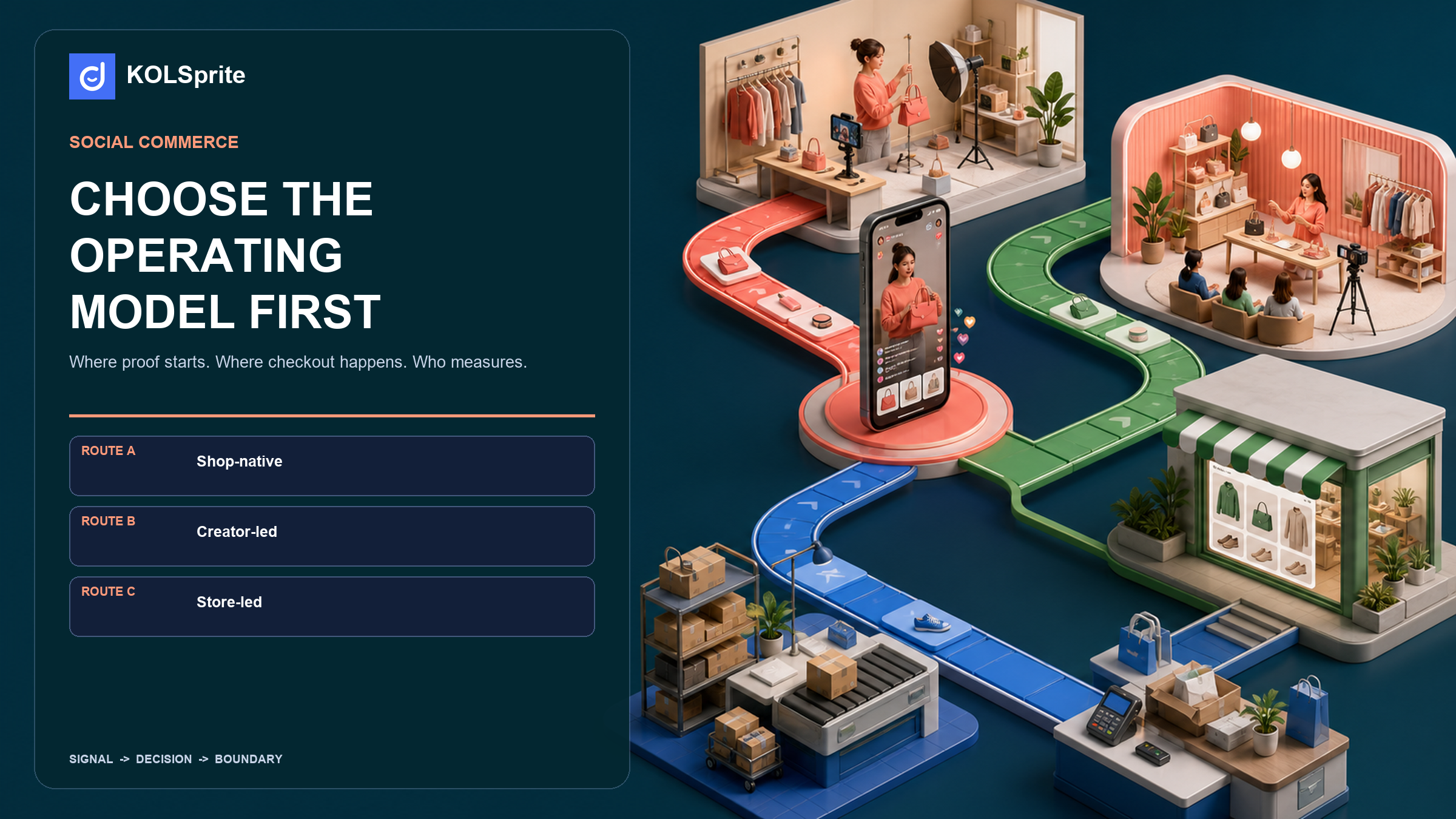
Direct response: Select your route by asking where the buyer gets evidence, where it is easiest to buy, and where your team will learn what to fix next. A creator video, a Shop page, and a store link can work together, but they are not the same operating strategy.
Here is the 10-second response: draw the path from initial view to evidence to checkout, then select one main route for 30 days: Shop-led, creator-evidence-led, or store-led. Each route can work, but the wrong route is one your team cannot support with stock, content, checkout, and useful data.
For many Shopify and DTC teams, TikTok social commerce sounds like a channel choice, yet it is really an operating choice. A buyer may discover a product in a creator video, learn why it fits from a demo, then buy in TikTok Shop or return to your store. Each path asks different things of product, creator, support, and data teams.
Put the real path on one page and start with the first honest reason a buyer would stop scrolling. They may see a product solve a specific problem, watch a creator use it in a believable routine, or find a shoppable video. Next comes evidence: what must they see or know before they feel ready? Then comes checkout, followed by the system that tells your team what to improve.
TikTok has Shop, Showcase, shoppable video, and LIVE tools. Check the current requirements and setup in the TikTok Shop Academy and TikTok Shop support. Requirements and access can change, so use the official help pages when you set up a live test.
Your map should expose breaks instead of simply looking neat. A creator may make a strong demo while the product page misses the same key detail; a Shop page may make buying easy while stock runs out; and your own store may have a strong bundle while you cannot tell which content sent the buyer. Write every handoff down.
| Handoff | Question to ask | Likely owner |
|---|---|---|
| Initial view to evidence | What shown fact earns the next few seconds? | Content or creator lead |
| Evidence to product page | Where can the buyer get the main response? | Merch lead |
| Product page to buy | Which path has the fewest needless steps? | Commerce lead |
| Buy to learn | Which first-party system guides the next fix? | Growth or data lead |
Method note: This map is a work tool. It does not prove what caused a sale. Use your own store, Shop, and data tools to judge results.
The next table is a decision aid, not a ranking. A brand can use all three routes over time, but choosing one main route for one product test makes clear what the team is trying to improve.
| Route | Use it when | Main work | Initial question |
|---|---|---|---|
| Shop-led | Your listing, stock, offer, and in-app buy path are ready | Improve the page, creator work, and Shop tasks | Can this product and deal make a sound order? |
| Creator-evidence-led | Buyers need to see true use before they shop | Give creators one specific evidence job | Which evidence helps the appropriate buyer most? |
| Store-led | Your store has key bundles, help, or repeat-buy work | Send the content to one specific store path | Does the visit reach the appropriate next step? |
Method note: The best route depends on the product, your team, and what you need to learn. Do not assume Shop or your own store is always best.
Use Shop-led when you can maintain stock, product facts, shipping, and customer help in line with demand. Use creator-evidence-led when the main block is buyer trust rather than checkout. Use store-led when the buyer needs a bundle, guide, strategy choice, or more detail than one product page can provide.
Use KOLSprite to inspect the public content and creator evidence behind the route you are considering. New accounts can claim a three-day trial.
Register and claim a three-day trial
Before you ask a creator to make a video, review the kind of evidence that already appears in the category. A public KOLSprite snapshot, checked on August 12, 2026, looked at five US commerce videos tied to heatless curls. Public plays ranged from about 265,000 to 3.5 million, while visible interaction ranged from about 0.71% to 8.77%.
The snapshot did not reveal one magic content style. The videos used different evidence, including sleep comfort, workout use, hair care, and a busy family routine. That is the useful lesson: buyers may need different types of evidence at different points in the path.
| Evidence seen | Buyer worry | What the team must do |
|---|---|---|
| Sleep comfort | Will this work at night? | Demonstrate time, feel, and removal in a credible way |
| Workout use | Will it hold up through a normal day? | State the use limits with care |
| Hair care | Which common tradeoff might I avoid? | Show the steps and avoid broad claims |
| Family routine | Can this fit a busy home? | Use a real setting and avoid broad promises |
Sample note: KOLSprite public-data snapshot, accessed 2026-08-12. The five videos came from a set query. They are not a market-share sample. Plays, interaction, and sales-linked fields do not prove an angle caused sales or will work for a new product.
Use research to define the evidence job. If a buyer needs to see what sleep comfort looks like, a Shop listing alone may not resolve the doubt. If the buyer already understands the use case and wants a specific offer, Shop-led may be the appropriate initial evaluation. If the product needs a guide, comparison, or bundle choice, your store may need to do more of the work.
KOLSprite helps you compare public content, creators, and product context while keeping those notes close to the brief. It does not run checkout, replace Seller Center or Shopify data, or decide which channel deserves credit for a sale. Those decisions still belong in your first-party systems.
Make the evidence job easy to check. Write down the one fact the content must show, the setting where it should appear, the buyer doubt it should answer, and what it must not imply. This gives creators room to speak in their own voice while keeping the work tied to the route you chose.
Check the handoff as a buyer would: open the content, follow the link or Shop path, and read the product details. Then confirm that the destination answers the question raised by the content. Test the entire path on a phone. If the answer is missing, repair that break before deciding the creator evidence failed. The route works only when each step tells the same, accurate story.
A useful 30-day evaluation has one route, one evidence job, one owner, and one question to answer. Keep it limited rather than starting a new creator strategy, rebuilding the store, changing every product page, and adding a Shop deal in the same month.
Week 1: Select one main product. Name the buyer worry. Check stock and the live platform criteria for the route.
Week 2: Save a limited set of public content pieces that fit. Write one brief around the evidence you need.
Week 3: Publish the video or start the test. Check the page and purchase path before people arrive.
Operating check: Confirm that product information, promotional terms, shipping expectations, and customer-support guidance tell the same story across the selected route. A persuasive creator video cannot compensate for an incomplete product page or an unavailable product, and a clean checkout path cannot repair a claim that the brand cannot support.
Week 4: Read the first-party data for that route. Keep it, adjust the evidence, fix a handoff, or end the test.
Bring your proposed proof path, checkout owner, and measurement handoff to the KOLSprite community before committing to a 30-day test.
 +
+
Join the KOLSprite Discord community
Write a one-line criterion before the evaluation starts. You might keep the Shop-led route only if stock, product facts, and order profit stay sound, or revise the evidence if people watch but the product page does not answer their question. A criterion written before launch is more useful than a story created afterward.
Also list what will stay the same during the test. If you are testing creator evidence, avoid changing the offer and landing path at the same time. If a change is necessary, put it in the test note so the result remains useful instead of becoming harder to interpret.
Document the route decision in the same place as the creative brief. Include the buyer problem, selected handoff, product-page state, offer conditions, creator instructions, and the initial metric the team will review. This operating record reduces accidental changes during the evaluation and makes it easier to separate a content issue from a checkout or inventory issue after the evaluation ends.
Teams lose the lesson when they judge a route with every number they can identify, so start with one main question. For Shop-led, ask whether the product, page, deal, and shipping work can make a sound order. For creator-evidence-led, ask whether one strong demo answers the buyer's main doubt. For store-led, ask whether the page gives the detail the content made people want.
Use other data to explain that main question. High views may explain why a page received visits, but they do not demonstrate whether the page was ready. A low buy rate may point to friction, so check the page, deal, stock, and tracking before blaming the creator.
At the end of 30 days, make one of four calls: the route is ready to repeat, the evidence needs work, a handoff needs repair, or the product is not appropriate for that route yet. Give the next task to one owner and set a date, because a route with no owner becomes a slide instead of a working model.
Save the content pieces, brief, product page state, deal facts, and evaluation note in one place. That helps the next person understand why you chose the route and stops the team from treating a result from one product or price point as a criterion for every product.
Before expanding the model, document the operational assumptions behind the result, including inventory reliability, fulfillment responsibility, product-page ownership, promotional conditions, attribution boundaries, and the exact evidence expected from creator content. This shared record helps the team distinguish a repeatable route from a temporary outcome created by one offer, product, or reporting window.
TikTok social commerce is not a requirement to use every tool. It is an operating model that connects discovery, product evidence, purchase, and measurement with fewer gaps between teams. The strongest route is usually the one with clear responsibilities, reliable inventory information, consistent product claims, and a measurement process that helps the team distinguish creative performance from checkout friction. That operational distinction prevents teams from misdiagnosing a merchandising, fulfillment, or attribution problem as a creative failure. Select the route your current systems and staff can support, define each commercial handoff, and use the measured outcome to decide which part of the model deserves the next investment.
Keep commerce tied to evidence. Start with the TikTok product selection guide. Shape the proof plan with the TikTok content strategy workflow, then connect creators to the route with the influencer marketing operating guide.
Latest Articles
As an essential, data-driven toolkit for TikTok influencers and marketers, KOLSprite provides powerful features for effortless creator discovery, trending content identification, and actionable real-time insights.
It empowers users to make smarter decisions and significantly boosts their TikTok business.

 Refer & Earn