 +
+
TikTok hashtag research can look like a fast way to find ideas. A tag is trending, a generator offers related phrases, and a content team feels it has direction. The problem is that a tag is only a label around a set of posts. It is not proof that a product should be made, a script should be copied, or a buyer will care. This guide shows how ecommerce content teams can turn a tag cluster into one small content test instead of a loose collection of ideas.
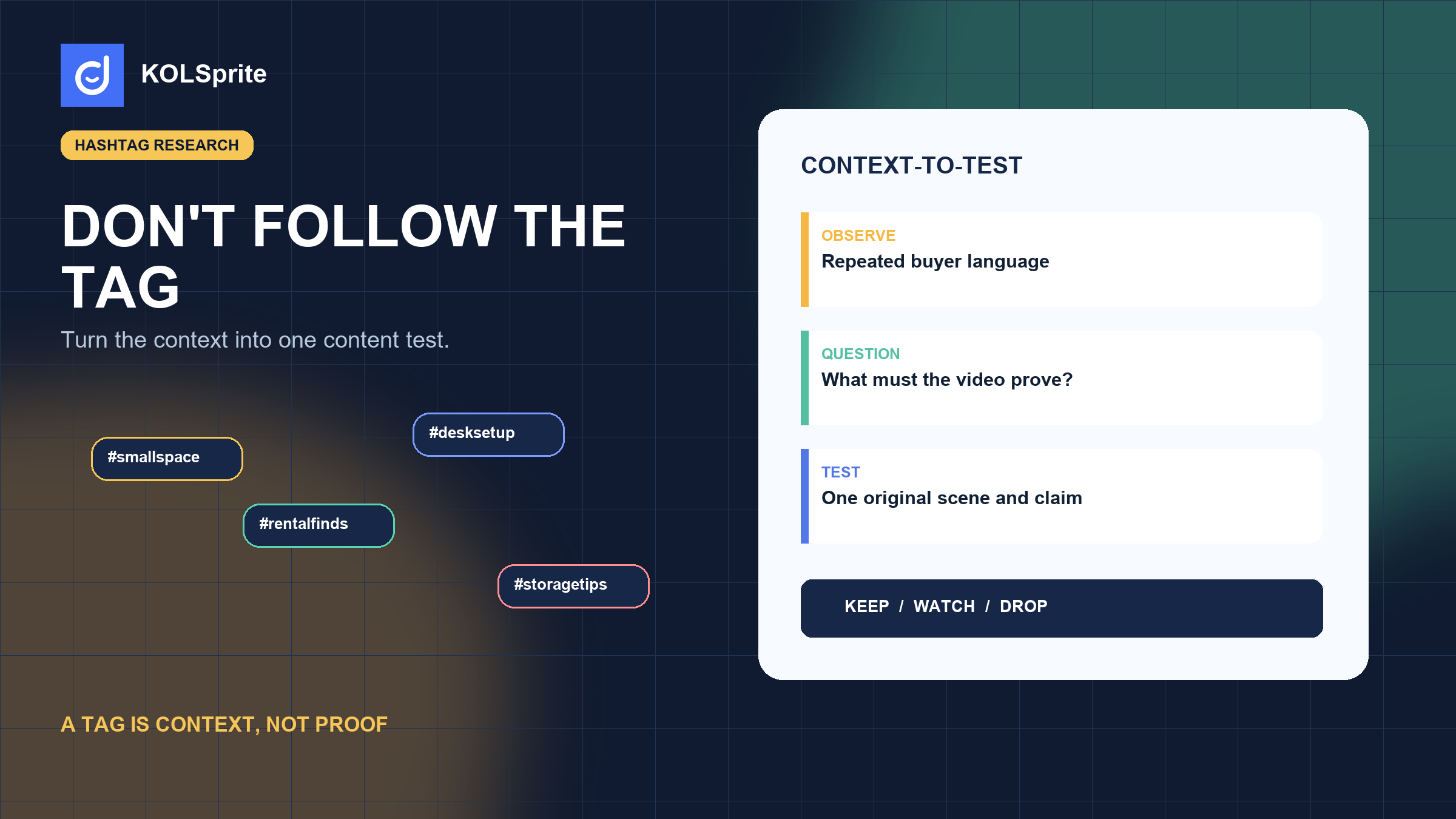
Ten-second answer: Use a hashtag to locate language, formats, and public questions. Then write one testable claim, one audience situation, and one reason the tag may be misleading. The usable output is a Hashtag Context-to-Test Card, not a saved list of tags.
Most teams do not need “more hashtags.” They need an answer to a harder question. Is a buyer trying to solve a problem? Is a product use case becoming easier to explain? Is a format helping people compare options? Or is a broad entertainment label simply collecting unrelated attention? These are different research questions, and they produce different content choices.
Begin by naming the decision. An Amazon seller might need to decide whether a product deserves a demonstration test. A Shopify brand may need language for a product page video. A creator manager may be trying to see whether a particular hook feels natural in a niche. The tag can help surface public examples, but only after the decision is clear.
Current search results for TikTok hashtag research mix official trend surfaces, tag discovery pages, generators, and third-party analysis tools. That mix is a clue: the search intent is broad. It means your process needs a boundary. A convenient discovery source is not automatically a source of market evidence.
An isolated tag usually gives weak context. A cluster is more useful because it shows the language that travels with the idea. Open a sample of public posts and write down the tags that recur beside the first one. Then note the visible format: tutorial, comparison, humor, before-and-after, packing video, reaction, or creator diary. The tag may be broad, while the format tells you what people are actually using it for.
Keep an eye on collisions. A tag may serve several unrelated audiences, or it may be attached to generic discovery labels such as #fyp. In those cases, volume alone is especially weak evidence. The useful signal is not that a label appears often. It is whether a recognizable buyer situation, phrase, or explanation repeats across relevant posts.
| What the cluster shows | What it may support | What it does not prove |
|---|---|---|
| Repeated problem language in captions | A phrase to test in an original hook | That the phrase will sell a product |
| Several demos using one setting | A scene worth exploring in a brief | That the scene caused performance |
| Comments asking the same question | An objection to address clearly | A representative customer survey |
| Unrelated posts under one popular label | A reason to narrow the research | A valid trend conclusion |
Evidence asset: Hashtag Context-to-Test Card. Source range: a dated review of public posts in the tag cluster. Limit: public posts and comments are directional context, not a demand forecast.
Use KOLSprite to review public TikTok content context, captions, and comments before a team turns a tag observation into an original test.
Register and claim a three-day trial
Tags often make a content idea look cleaner than it is. Comments can show where viewers are confused, skeptical, or simply responding to a creator's personality rather than the underlying product use. Read a small, purposeful sample. You are not counting sentiment. You are looking for the language that changes the proposed video.
Suppose a tag cluster seems to support “quick organization.” The comments may reveal that viewers care less about speed than about whether the item works in a rental apartment. That changes the test. The video no longer needs a generic fast-motion montage. It may need one clear scene that shows a temporary setup and names the constraint. The tag gave you the surface; the comments gave you the decision.
KOLSprite can support this review in the TikTok browsing flow by helping teams retain supported public content context, inspect available subtitles and comments, and compare references before a brief is written. It is not a substitute for audience research, sales data, or a claim that a tag predicts performance. Its contribution is to keep the evidence attached to the question.
A test needs a claim that can be seen, not a theme that can be admired. “Try the #smallspacefinds trend” is not a test. “Show how the product stores under a desk in a rental bedroom, then answer the cable-management question in the caption” is a test. It has a scene, an audience situation, a proof element, and a question you can review after the post is live.
What repeated in relevant public posts, captions, or comments?
What might the pattern mean for one buyer situation?
What will your creator or team show, say, and leave out?
What result would tell you the tag was not useful for this product?
The disconfirming signal matters. It prevents the team from changing three things at once and calling any response a win. If the test does not earn clear watch time, comments, saves, qualified clicks, or another metric that matters to your business, record what the tag did contribute. It may have supplied language but not a format. That is still learning.
TikTok's Creative Center can be useful for an initial scan of trends and creative references. Use it as a starting surface, not as a conclusion. TikTok Creative Center presents current trend information, while a product team still has to decide whether the examples match its audience, offer, and content constraints.
For deeper product research, connect the tag review to a related TikTok video analyzer creative brief. If comments are changing the decision, the AI comment analysis guide helps frame what public responses can and cannot tell you. Those links move the work from discovery toward a decision record.
Drop the tag when the posts are too mixed to describe one audience situation, when the strongest examples depend on a creator's personal story that your brand cannot reproduce, or when the only conclusion is “this looks popular.” Popularity can be a reason to keep watching. It is not enough to direct production.
Also drop a tag when its language pushes the team toward a claim it cannot support. A clean, modest demonstration usually outlives a trend label. The point of research is to find a useful angle, not to borrow confidence from a word that happens to be circulating.
Join the KOLSprite Discord to compare public content signals, buyer questions, and the limits that keep a tag from becoming a false demand claim.
 +
+
Join the KOLSprite Discord community
A tag-based observation should not arrive in a creator brief as a command to copy a trend. Translate it into the buyer problem and the proof you want to see. A creator can then decide how to make the idea feel native to their own voice. That preserves the useful insight while avoiding the awkward result that comes from borrowing another account's surface treatment.
For example, the research note may say that viewers keep asking whether an item fits under a desk. The brief can ask for an original small-space demonstration and an honest answer to that question. It does not need to name a tag at all. The tag did its job during discovery; the buyer situation now does the creative work.
That translation also makes later review easier. The team can judge whether the test answered the original question, even after the tag has cooled or the content format has changed.
After the test, keep only the tag language that helped the team describe a real buyer situation. Put the rest in a short archive with a reason: too broad, wrong product moment, creator-specific, or unsupported by the public context reviewed. This small cleanup prevents a temporary discovery surface from turning into a permanent content strategy.
On the next pass, start with the retained buyer question rather than the old tag. You will often find better examples because the research has moved from a platform label to a useful problem statement.
When a team uses KOLSprite for this work, it can save the public post, the tag context, and the buyer question in one review trail. That makes the next chat much simpler. A teammate can open the same post and see why it was kept. They do not need to guess from a tag name alone.
The useful record is still small. It has one source, one plain note, one test idea, and one limit. That is enough to help a creator or content lead make an original post. It also makes it easy to drop a tag when the source does not support the idea.
Keep the card near the brief. If the test changes, update the card with the new question. The old tag may fade, but the buyer problem can still guide the next piece of work.
TikTok hashtag research earns its place when it leaves the team with one documented test. The card should say what you observed, what you think it means, what you will make, and what would change your mind. That is enough structure to keep a creative discussion honest without turning it into an operations manual.
Over time, these cards also become a better library than a saved-tag sheet. You can see which phrases led to useful questions, which formats did not translate, and which audience situations keep returning. The work becomes cumulative because the team saved a decision, not just a label.
Continue the research: content analytics for a creative choice · buyer-question mining · turn research into a creator brief.
Newer Article
<<Track Creator Test Learnings Across Campaigns
Latest Articles
As an essential, data-driven toolkit for TikTok influencers and marketers, KOLSprite provides powerful features for effortless creator discovery, trending content identification, and actionable real-time insights.
It empowers users to make smarter decisions and significantly boosts their TikTok business.
 Refer & Earn