 +
+
If you manage product videos, a TikTok hashtag generator should help you finish one specific caption. It should not hand you 30 broad tags and leave you to guess. The direct answer is simple: start with the exact subject of the video, generate related tags, then keep only the tags that match the buyer job and visible proof. This guide gives you a three-layer tag set, a rejection test, and a small measurement note you can use after publishing.
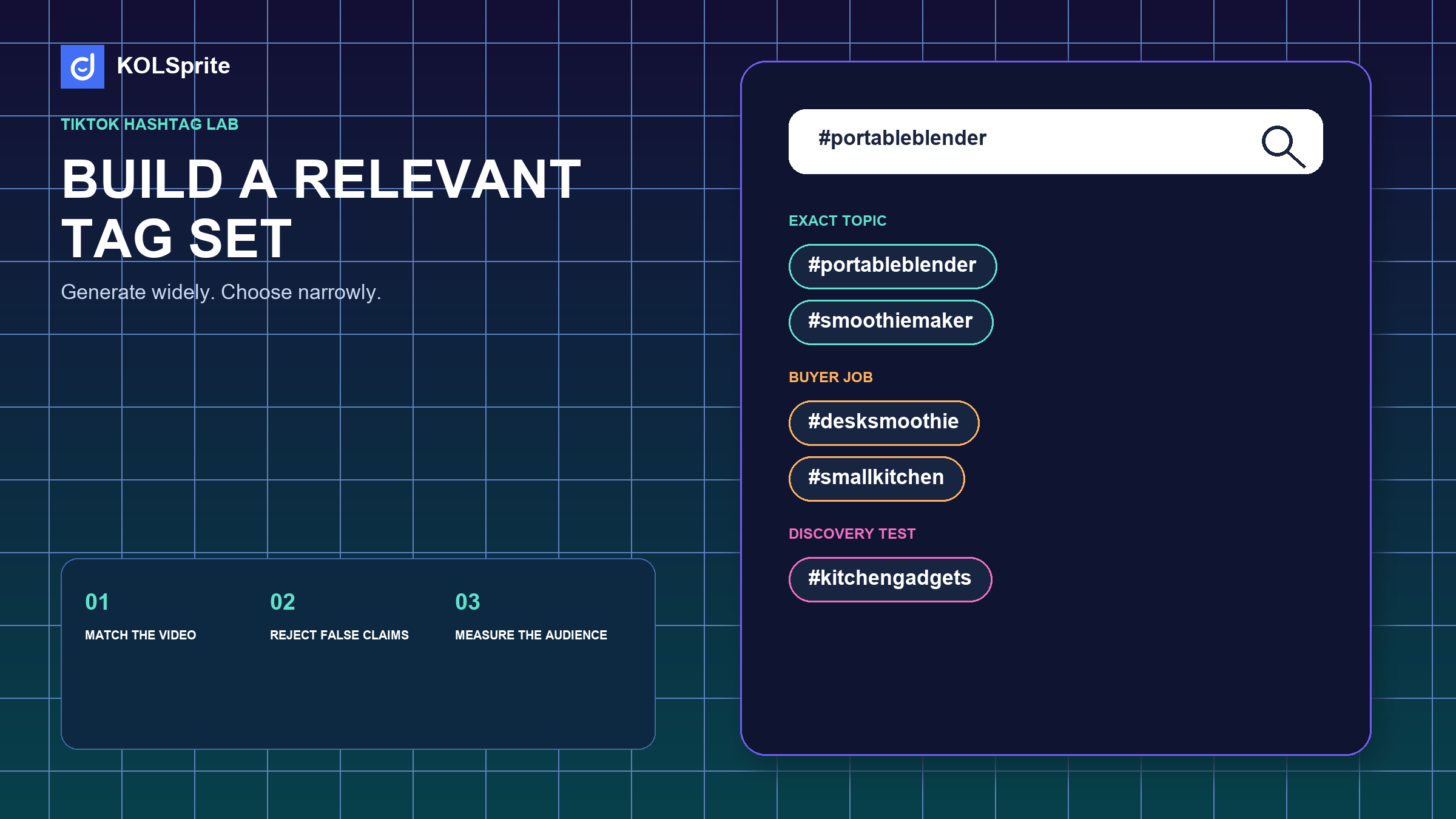
Ten-second answer: use one exact topic tag, two to four close variants, and at most one wider discovery tag. Delete any suggestion that describes an audience, product, or promise the video does not show. This is a starting test, not a TikTok rule.
A generator is good at producing candidates quickly. It can take a seed such as portable blender and surface related language you may not have considered. KOLSprite's free hashtag tool accepts a seed hashtag, returns related options, and lets you copy the displayed set. The extension adds topic analysis and related-tag discovery while you browse TikTok.
That is useful, but it is not a forecast. A tag does not make an average video relevant, and a large tag does not guarantee useful reach. TikTok's official Creator Search Insights lets creators review searched topics, related videos, and search analytics. Hashtags are one clue among several. Treat the generated list as a research queue, not a scorecard.
Do not optimize for the longest list. A smaller set can make the subject easier to understand. If a tag attracts people who want a different product or use case, extra impressions are not a win.
Name what the video is plainly about. For a compact blender demonstration, that may be #portableblender. This is the anchor.
Add tags that describe the use the clip actually shows, such as a smoothie at work, travel, or a small kitchen. Do not add all three unless the video proves all three.
Use one or two close category terms that help the viewer place the product. A juicer tag may be wrong if the product never juices fruit.
Keep at most one wider tag when it still fits the content. A broad tag is a test, not a permanent requirement.
This structure prevents a common mistake: treating every related word as equally useful. It also makes the next review easier. You can explain why each tag exists instead of saying it "felt trending."
Imagine a 20-second video that shows a rechargeable blender making a single smoothie at an office desk. The proof is portability, a small serving, and a clean result. The video does not test ice, battery life, travel security, or dishwasher safety.
| Candidate | Keep? | Reason | What the video must show |
|---|---|---|---|
| #portableblender | Keep | Exact product topic | A portable blender in use |
| #desksmoothie | Keep if active | Matches the buyer setting | The office or desk context |
| #kitchengadgets | Test | Wider product neighborhood | A clear gadget demonstration |
| #crushedice | Reject | The clip does not test ice | A real ice test would be required |
| #viral | Usually reject | No topic or buyer-job meaning | Nothing specific; it adds little context |
The useful outcome is not that one tag is "best." The outcome is a defensible set that matches the creative. This keeps the caption, spoken hook, and visible action on the same subject.
KOLSprite lets you search related hashtags, inspect topic context, and keep the next content decision close to the TikTok page instead of working from a generic list.
Register and claim a three-day trial
KOLSprite can speed up steps four and five by keeping related tags, topic statistics, and the TikTok page in one browsing flow. This is a natural product role because the decision begins with a real video and ends with a set attached to that video. It is not a reason to paste every result.
After publishing, record the date, the exact tag set, the video's main phrase, the first-frame promise, and the audience response you care about. For a product video, that response may be qualified comments, profile visits, or product questions. Views alone cannot tell you whether the tags reached the right people.
Change one layer at a time when you test another video. If the subject, hook, creator, offer, and tags all change, you will not know what to learn. A practical note can be very small:
Post-publish note: "Exact tag matched the product. Buyer-job tag brought three office-use questions. Broad gadget tag added reach but no useful comments. Keep the first two; replace the third in the next test."
This is more honest than calling a tag "winning." It also gives the content team language it can use in the next script.
Set a short time limit. Hashtag research can expand forever because every tag opens another page. The goal is to finish a caption, not map the whole topic.
This small routine works for an agency as well as a solo seller. It creates a clear stopping point. It also leaves a record another editor can review.
A huge result count can feel safe. It often means the tag contains many different jobs. Your office smoothie clip may sit beside recipes, gym routines, and full-size kitchen reviews. The number is large, but the context is loose.
Plural, singular, and minor spelling changes do not always add a new audience. Use variants only when the result pages show a real difference in meaning.
A tag such as "best blender" makes a comparison claim. If the video does not compare products, the tag asks the creative to prove something it never addresses.
Their product, market, account history, and video may be different. Use the set as a source of candidates. Rebuild it against your own clip.
Share the video topic, the buyer job, and the tags you plan to keep. Other operators can help spot a tag that is popular but unrelated.
 +
+
Join the KOLSprite Discord community
Do not send a creator a list with no reason. Put the tags under three small headings: required topic, optional buyer-job terms, and test tag. Add the proof that supports each group.
| Brief field | Example | Creator instruction |
|---|---|---|
| Required topic | #portableblender | Show the product working in the clip. |
| Buyer job | #officesmoothie | Keep the desk setting visible. |
| Optional test | #kitchengadgets | Use only if the post still reads naturally. |
| Do not use | #crushedice | No ice test was approved. |
This turns tags into a content boundary. The creator knows what must appear and which claim is out of scope. The reviewer can approve the caption faster because the reason is visible.
One post rarely proves much. Use the first result to plan the next clean comparison. Keep the product and proof similar. Change only one useful layer, such as the buyer setting or the wider discovery tag.
If a tag brings many unrelated comments, remove it. If a narrow term brings a few strong product questions, keep it even when total reach is smaller. A seller needs useful attention, not only a large count.
A tag register can be one sheet. Give each row a tag, topic, buyer job, date checked, example page, test status, and last result. This prevents the team from researching the same broad terms every week.
Do not call a tag evergreen. Meanings and result pages can change. Recheck it when the product, market, or creative shifts. Archive a tag when it repeatedly brings the wrong audience or no longer matches current results.
For teams in several markets, keep separate rows by language and region. A direct translation may lead to a different topic. Ask a local reviewer to check the result page before the term enters a brief.
Tag, plain meaning, market, buyer job, source page, last checked, approved use, rejected use, and next test.
The register is not a score database. It is a memory aid. Its job is to preserve why a tag was chosen and what the team learned.
Review the register once a month with published examples in view. Remove duplicate ideas, correct labels that drifted, and mark any tag whose result page now serves another intent. This light governance step matters because a useful term can become misleading when trends, products, or audience language change. The content lead should approve new required tags, while creators keep room to suggest language that sounds natural in their communities. That balance gives the brand a clear subject without turning every caption into the same template.
Document the review criterion consistently so regional editors can distinguish a relevant discovery term from an attractive but misleading popularity signal.
Hashtags work best when they repeat the subject already present in the script and visuals. If you need the spoken language first, use the TikTok transcript research workflow to separate the creator's wording from the buyer problem. If the phrase came from customer reactions, the AI Comment Analysis guide shows how to keep questions and objections visible.
For a broader search plan, the TikTok SEO product-language workflow helps connect search wording to a claim the video can prove. That creates a useful loop: buyer language shapes the script, the script shapes the tag seed, and the published response shapes the next brief.
A TikTok hashtag generator is most useful when it shortens research without replacing judgment. Generate broadly, choose narrowly, and keep a note that tells the next person what happened. That is a repeatable content practice, not a hashtag ritual.
Sources and boundaries: KOLSprite Hashtag Generator and KOLSprite extension capabilities, accessed August 10, 2026. Generated suggestions can be inaccurate or irrelevant; the publisher remains responsible for the final caption.
Latest Articles

As an essential, data-driven toolkit for TikTok influencers and marketers, KOLSprite provides powerful features for effortless creator discovery, trending content identification, and actionable real-time insights.
It empowers users to make smarter decisions and significantly boosts their TikTok business.

 Refer & Earn