 +
+
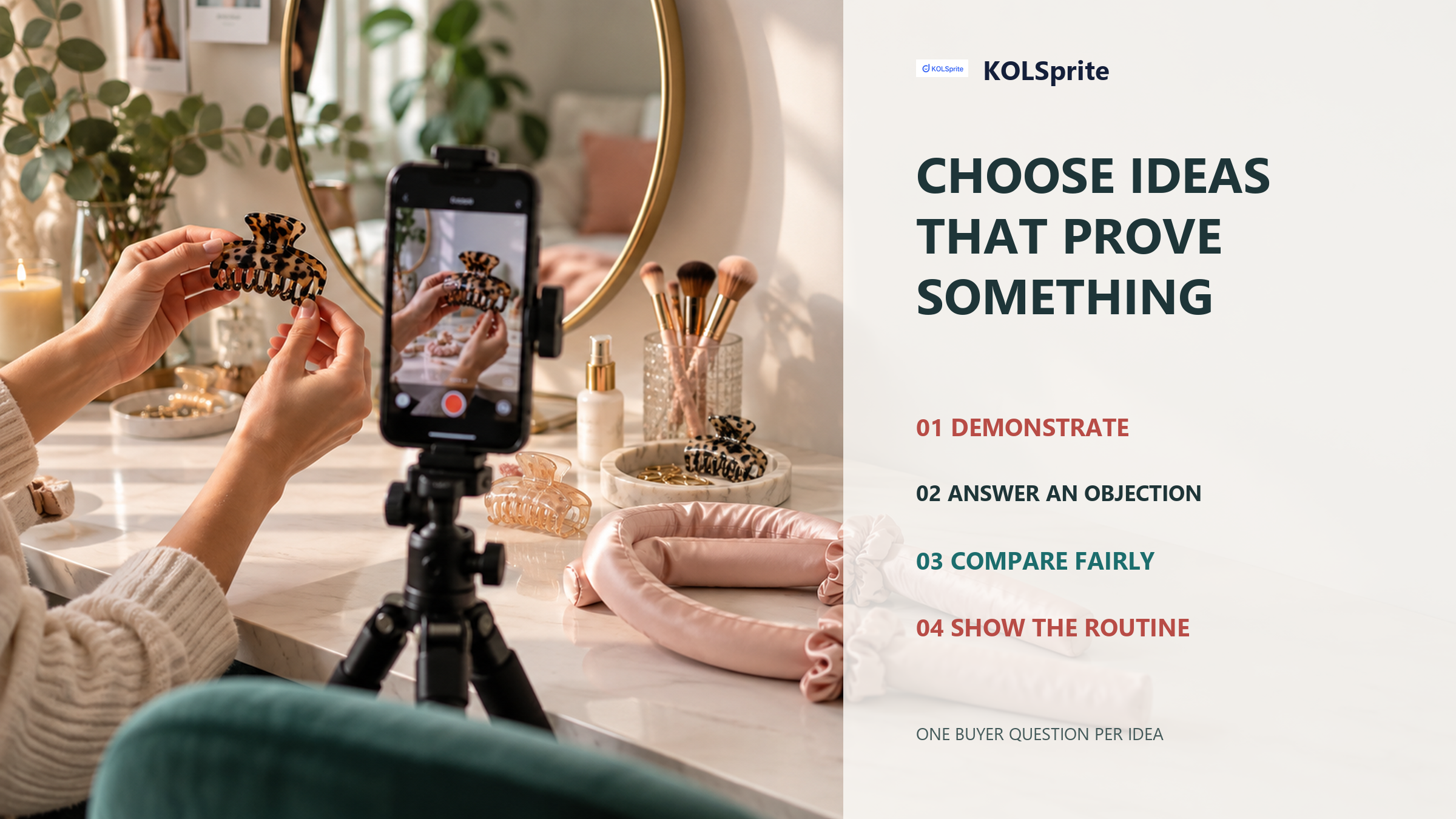
If your DTC team keeps collecting TikTok content ideas but cannot decide what to film, start with the buyer's unanswered question. Choose one proof job: demonstration, objection, comparison, or routine. Then decide what your own footage can show. You will leave with a four-cell idea board that turns a vague prompt into a filmable product brief. Format comes after the proof job, not before it.
The best TikTok content ideas tell viewers what they can judge after watching. “Unboxing” is a format. “Show whether this travel case opens flat without spilling its contents” is a proof job. The second version guides the shot list and approval check. It also gives the team a reason to reject a trendy treatment that hides the product.
Format-first planning often begins with labels such as tutorial, trend, voice-over, reaction, or day in the life. Those labels describe presentation, not evidence. A team can execute them cleanly and still leave the main purchase question unanswered. The failure becomes obvious in review: people debate whether the edit feels native, but nobody can state what the viewer learned.
When you review public product videos, note the question each scene answers before noting its style. A fast edit may make an idea look exciting, yet hide the action a buyer needs to see. TikTok's creator guidance urges brands not to oversell a product or make it out to be something it is not. Keep a source note for the treatment you observed, then write a fresh demonstration for your own product. A public example does not give you rights to reuse its footage or a reason to expect the same result for your offer.
The cure is a one-sentence brief: “The buyer wonders whether ___, so this video will show ___.” If the blank cannot be filled with visible, owned evidence, the idea is not ready. It may need a different proof job, a product expert, or a claim review before production begins.
The board below uses beauty-accessory examples, but the logic works for many physical products. Each cell links a buyer question to proof, then names the failure that should kill the idea during review.
| Proof job | Buyer question | Beauty-accessory example | Proof needed | Failure mode |
|---|---|---|---|---|
| Demonstration | How does it work? | Load and close a divided travel makeup case. | One continuous open-close sequence. | Fast cuts hide the key action. |
| Objection | Will this be awkward or messy? | Clean a reusable applicator after a normal use. | Visible residue, cleaning steps, and final condition. | The script claims “easy” without showing effort. |
| Comparison | Which option fits my use? | Compare two cosmetic bags for a weekend trip. | Same items, same packing task, relevant differences. | Unequal setups predetermine the winner. |
| Routine | Where does it fit in real life? | Use a heatless styling accessory during a bedtime routine. | Clear sequence, elapsed-time context, and honest end state. | Lifestyle shots replace the product step. What the platform says:TikTok's creator guidance tells marketers not to oversell or make a product out to be something it is not. What follows for this brief: An attractive format cannot rescue a line that the brand's own footage cannot support. The team should narrow the line or film proof it can own. |
Source note: The linked platform advice supports honest product presentation. The four-cell board is this article's editorial application; test each cell against your own footage and approved claims.
The cells are not campaign themes. They are decision tools. Pick the cell that best matches the doubt holding back the buyer. If two doubts matter, make two briefs. Trying to prove operation, answer a durability objection, compare alternatives, and show a full routine in one short video usually weakens all four.
Install KOLSprite for Chrome, review a permitted reference, and separate its treatment from the proof your product can honestly show. Use desktop Chrome. On a phone, open this article on your computer to install the extension.
A demonstration explains an operation or visible result. Begin with the state the viewer recognizes, show the product action without hiding the important step, and end on the state the buyer needs to inspect. For the travel case, the evidence might be the exact items loaded, the dividers being adjusted, the closure, and the case reopening. Avoid a claim such as “fits everything” when the footage proves only one specific packing set.
An objection video begins with a reason not to buy. It should face the concern, not merely repeat a benefit. If cleaning is the objection, show the normal residue, the cleaning method, the effort, and the final condition. The line “rinses clean in seconds” needs support for both the method and the time. If the brand cannot support that wording, describe what the viewer can directly see.
During review, mute the audio. If the essential proof disappears, the camera is not carrying enough of the claim. Then listen without watching. If the words promise more than the image shows, narrow the line or add a valid proof shot. This two-pass test catches many polished but weak ideas.
A comparison is useful only when the basis is clear. Compare two bags with the same items and the same packing goal. Name the tradeoff rather than forcing a universal winner. One may hold more; another may fit a smaller tote. That conclusion helps viewers choose. A vague “ours versus theirs” frame invites weak claims and may hide the real use case.
A routine proof job shows where the product enters and what it changes. The product must remain visible as an action, not a prop. For a heatless styling accessory, show the starting condition and placement. Then show the wait period, removal, and final state. Do not imply that one person's result is universal; hair type and technique may change it.
Reject a comparison when the setups are unequal or the competitor cannot be represented fairly. Reject a routine when the product step is edited out, the elapsed time is unclear, or the result depends on an unspoken condition. A beautiful video that cannot survive those checks is not yet useful product content.
Public reference review can sharpen the board without turning it into a copy list. Start with the buyer's question. Review permitted public product videos and representative comments. Record how the reference frames the question, which product action is visible, and what viewers still ask. Separate those observations from your brand's planned concept.
Use permitted public product videos, scripts, and comments as KOLSprite inputs. Compare how references show a product and phrase buyer questions. The output is a source note that separates observed treatments from the brand's original brief. The team decides which proof job it can support with its own footage.
A useful source note has four lines: unresolved buyer question, observed public treatment, evidence gap, and original brand response. For example, a reference may use rapid packing cuts, while comments still ask what actually fits. The original brief can answer by showing a fixed set of items in one continuous sequence. The insight comes from the gap; the execution remains original.
This workflow works best after starting with the buyer question and checking the use case before borrowing a format. Those steps prevent a popular visual treatment from overruling the product decision.
KOLSprite can speed public-reference review. It cannot grant reuse rights, confirm that an idea will perform, or replace original filming and claim substantiation. A human team must judge rights, evidence, brand fit, and final approval.
Discuss whether the idea gives the camera a real proof job.
 +
+
A strong board saves money by making rejection easy. Ask five questions before a shoot: Is the buyer doubt specific? Can the camera show the answer? Does the brand own or have permission to use the evidence? Does the spoken claim stay within that proof? Will the viewer know what to inspect? A “no” means revise the brief, not add more editing notes.
Then run a language test. Remove vague words such as amazing, perfect, effortless, and game-changing. Replace them with the action or condition the camera will show. “Perfect for travel” might become “shows a weekend packing set inside the closed case.” The second line is narrower, but it gives the crew a shot and gives the reviewer a check.
Finally, protect the product from the hook. An opening can create curiosity, but it should not misstate the evidence that follows. If the hook promises a test, show the test. If it names an objection, address that objection. If it raises a comparison, keep the conditions fair. Reject any hook that earns attention by creating a claim the body cannot support.
Once a cell passes the test, turn it into a compact brief. Write the buyer question, proof job, starting state, product action, end state, and claim boundary. Add the approved product facts and production constraints your team already owns. That is enough to guide a first script without dictating every word.
For the travel case, the brief could say: the buyer asks what fits; the job is demonstration; begin with a fixed weekend set on the table; load it in one continuous sequence; close and reopen the case; describe only that shown set. The format may be a voice-over, creator explanation, or text-led sequence. The proof remains stable when the treatment changes.
If comments later reveal a sharper question, use turning a question into an original UGC script as the next action. Do not paste a comment into a script and call it research. Verify that the question matters, decide what evidence can answer it, and write an original treatment.
A large inspiration list feels productive because it postpones choice. A four-cell board forces the useful choice early: what must this video prove? Select demonstration for operation, objection for resistance, comparison for a tradeoff, and routine for context. Build each idea from owned evidence, reject claims the footage cannot carry, and let the format change only after the proof job is sound.
Latest Articles
As an essential, data-driven toolkit for TikTok influencers and marketers, KOLSprite provides powerful features for effortless creator discovery, trending content identification, and actionable real-time insights.
It empowers users to make smarter decisions and significantly boosts their TikTok business.

 Refer & Earn