 +
+
If you research competitors for a Shopify or Amazon product, the first search result is not a competitor set. It is a noisy collection of keyword matches, popular records, adjacent categories, and products that may solve a different buyer job. This guide shows competitive and creative teams how to clean a TikTok competitor analysis before they count hooks or copy a pattern. You will see a real `portable blender` search that returned no blenders in its first five records, then build a retention rule and product-level brief that supports a defensible content decision.
Define the buyer job and mechanism before searching. Keep a result only when it competes for the same purchase or replaces the same job in the decision you are studying. Record every exclusion reason. Do not calculate a content pattern from an unclean set.
Search relevance is not competitive relevance.
A search system is trying to retrieve useful records. Your team is trying to answer a business question. Those goals overlap, but they are not identical.
If the query is "portable blender," the business question might be: which small rechargeable blenders compete for a travel-smoothie buyer? A result can contain the word portable and still fail the job. A power bank is portable. A garment steamer is portable. A pressure washer can use a bottle. None should be counted when the team studies blender demonstrations.
False positives create three expensive errors. They inflate the apparent market, distort common hook counts, and send the creative team toward scenes that do not belong to the product. The error looks quantitative because the spreadsheet has many rows. It began as a classification failure.
We called KOLSprite Product Search for `portable blender` in the US market. The first attempt with an added sort field returned a server error. Following the research fallback rule, we retried once with a narrower request and no optional sort. The response succeeded and reported a large result universe.
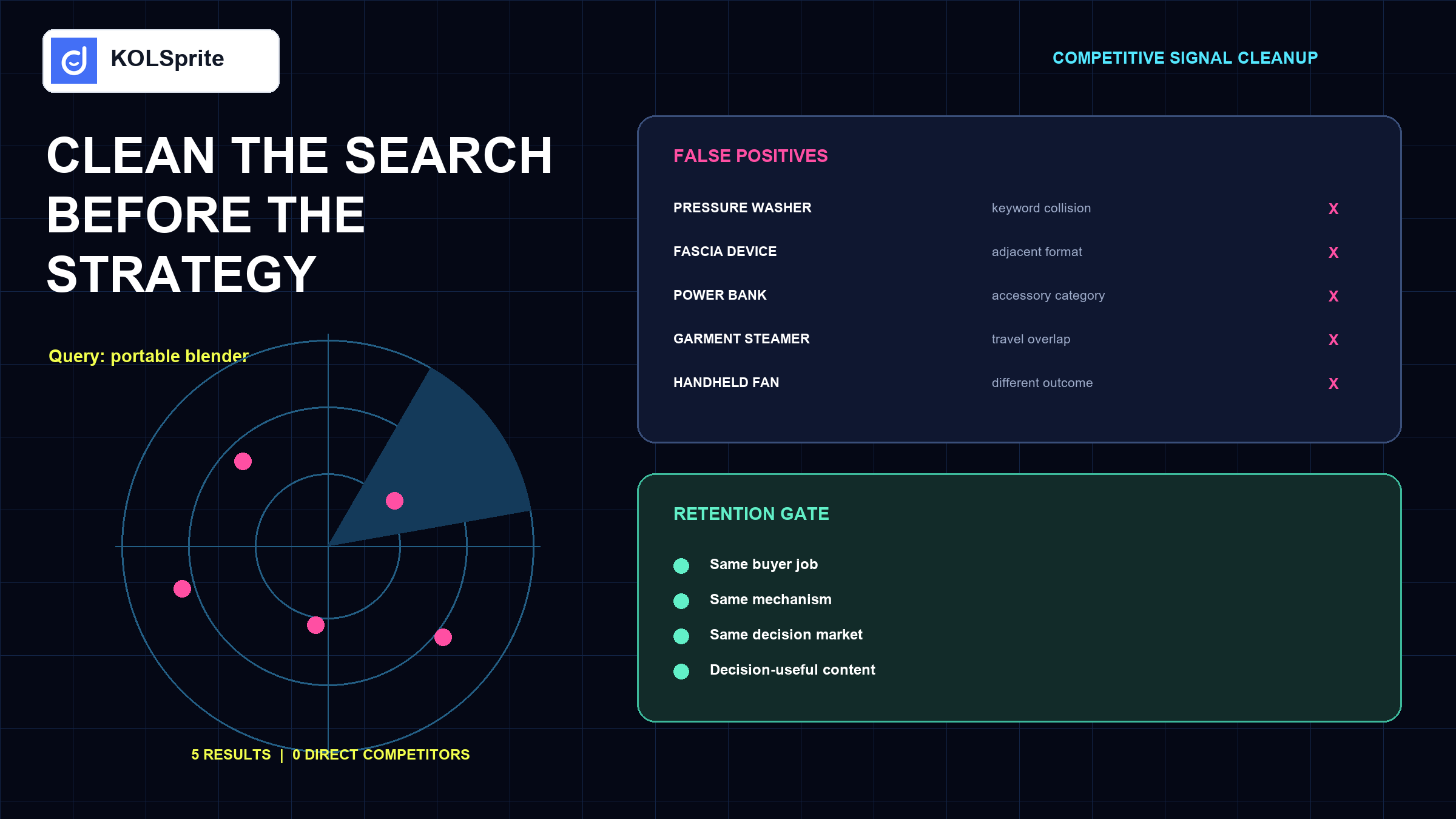
The first five records were a cordless pressure washer, a waist-and-back fascia device, a magnetic power bank, a garment steamer, and a handheld fan. None was a portable blender. The records were valid products with substantial visible activity, but they were invalid inputs for the stated competitor question.
| Returned product | Why it matched loosely | Same buyer job? | Same mechanism? | Decision |
|---|---|---|---|---|
| Cordless pressure washer with bottle. | Portable and bottle-related language. | No. | No. | Exclude: keyword collision. |
| Wearable fascia device. | Portable rechargeable device. | No. | No. | Exclude: adjacent device format. |
| Magnetic power bank. | Portable charger language. | No. | No. | Exclude: accessory category. |
| Travel garment steamer. | Portable travel product. | No. | No. | Exclude: travel-use overlap only. |
| Handheld fan. | Portable personal device. | No. | No. | Exclude: different outcome. |
A weak report might describe these as "top portable product trends." That may be another legitimate question, but it is not portable-blender competitor research. Rename the question or clean the set. Do not quietly switch in the middle.
Research note. KOLSprite US Product Search for `portable blender`, accessed August 3, 2026. One sorted call returned a server error; the allowed narrower retry returned five reviewed records, all excluded from the portable-blender competitor set. This is a retrieval-quality case, not a statement that KOLSprite never returns relevant blenders. Query, filters, category constraints, and result pages can change the outcome.
Direct competitors should normally pass all four. Indirect alternatives may fail the mechanism test by design, but they must pass the same buyer-job test and be labeled as alternatives. Do not mix direct and indirect records in one count.
Use a short list of reasons so different researchers clean data consistently:
The exclusion list is not administrative waste. It is an audit trail. It lets another researcher challenge the boundary and reproduce the decision.
Start by adding category, price, or exact-product constraints in Product Search. Use exclusion keywords only after you understand why the noise appears. Open a relevant exact product ID before studying content. Then use Video Search with that product ID so broad keyword relevance does not pollute the creative set.
If the first page remains noisy, change the query from a broad phrase to the mechanism, use a category filter, or test a known product record. Document the failed route. A failed query teaches the team which boundary the system needs.
Do not treat the cleanup as evidence that the tool is poor. The practical advantage of an embedded research workflow is that you can inspect the exact product and content instead of exporting a large result and trusting the label. The researcher still owns the classification.
Once the retained set is valid, create one row per product, not one row per video. Use linked videos as evidence fields under the product. A useful brief contains:
| Field | Question it answers | Do not infer |
|---|---|---|
| Product and stable ID. | Which exact item is being compared? | That similarly named listings are identical. |
| Buyer job. | What outcome competes with ours? | That category membership proves the job. |
| Mechanism and proof. | What does the content visibly demonstrate? | That a spoken claim is technically valid. |
| Offer context. | What price and bundle were visible at access time? | That the offer is permanent or profitable. |
| Repeated questions. | Which objections deserve review? | That comment frequency equals market demand. |
| Content gap. | What useful proof is missing across retained records? | That being different automatically improves conversion. |
Suppose five valid portable blenders all show fruit and ice in a finished drink, but none shows cleaning the blade area during travel. The gap is not "make a cleaning video" yet. Verify that your product can be cleaned safely in the setting, that disassembly and water use match the instructions, and that the demonstration does not hide a difficult step.
A content gap is defensible when it is important to the buyer, absent or weak in the clean competitor set, demonstrable by your product, and connected to a measurable decision. If it is merely visually different, it is a style choice.
The indirect competitor guide helps when the buyer may choose another method rather than another brand. The competitive pricing proof workflow keeps offer comparisons tied to comparable value. Once the set is clean, the content proof-test framework can turn one missing proof job into an original brief.
Repeat the exercise with another researcher. If the retained sets differ sharply, the brief or taxonomy is too vague. Resolve that before presenting a chart.
Keep the failed page. It is useful proof of what went wrong. Then set the item type to the right class, use a price band that fits the brief, and add words tied to the blend job. Review the next set by hand.
If a real blender appears, open the exact item. Check the title, shop, price, and linked clips. Watch for the same job: a drink made away from a full kitchen. Reject a food chopper if the team does not see it as a real choice for that job. Keep a shaker cup only in the indirect lane.
TikTok's Creative Center can help the team spot trends and ad ideas. It does not clean this item set for you. Use it to spark a new lead. Use the exact product path to test that lead.
When three clean items remain, read their clips. Mark the proof, the claim, the scene, and the buyer doubt. Now a count has a base. Before that point, a chart only makes the noise look neat.
End the work with six lines. Name the search. Name the buyer job. List the kept items. List the main reasons for each cut. State the one gap worth a test. State the fact that could still stop the test.
This note helps the next team move fast. A writer can see which clips count. A product lead can check the claim. A manager can see why the set is small. No one has to guess what the chart meant.
A useful TikTok competitor analysis is not the longest list. It is the smallest defensible set that answers the buyer-job question. Keep the search path, exclusions, exact product IDs, proof fields, and limits. KOLSprite makes the product-to-video path faster; disciplined classification makes the conclusion trustworthy.
Clean a noisy product search, retain exact competitors, and inspect their linked content. Create a KOLSprite account to claim a three-day trial membership.
Register for a three-day KOLSprite trial
Bring the buyer job, retained products, and exclusion reasons. A second researcher can test whether the boundary is reproducible.
 +
+
Challenge the competitor set on Discord
Latest Articles

As an essential, data-driven toolkit for TikTok influencers and marketers, KOLSprite provides powerful features for effortless creator discovery, trending content identification, and actionable real-time insights.
It empowers users to make smarter decisions and significantly boosts their TikTok business.

 Refer & Earn