 +
+
If you run a Shopify store, a competitor's lower TikTok price can feel like an urgent reason to discount. It is not. The products may serve different jobs, include different accessories, use different offers, or rely on different proof. This guide shows how to run competitive pricing analysis with three layers: a clean comparable set, the value each product proves in content, and your private Shopify economics. You will end with a price test, not a race to the bottom.
Compare only products a buyer could reasonably choose instead of yours. Record the actual offer, product form, accessories, trust signals, and proof. Then place your contribution-margin floor beside the visible price range. If the competitor is cheaper because the product is different, do not match it.
Price is comparable only after the product and promise are comparable.
We searched KOLSprite for "label printer" in the US market. The first results included a clothing clean-out bag, Christmas stickers, body oil, an office printer, and a shipping-label printer. Their prices could not form a useful average. They shared words, not a buyer decision.
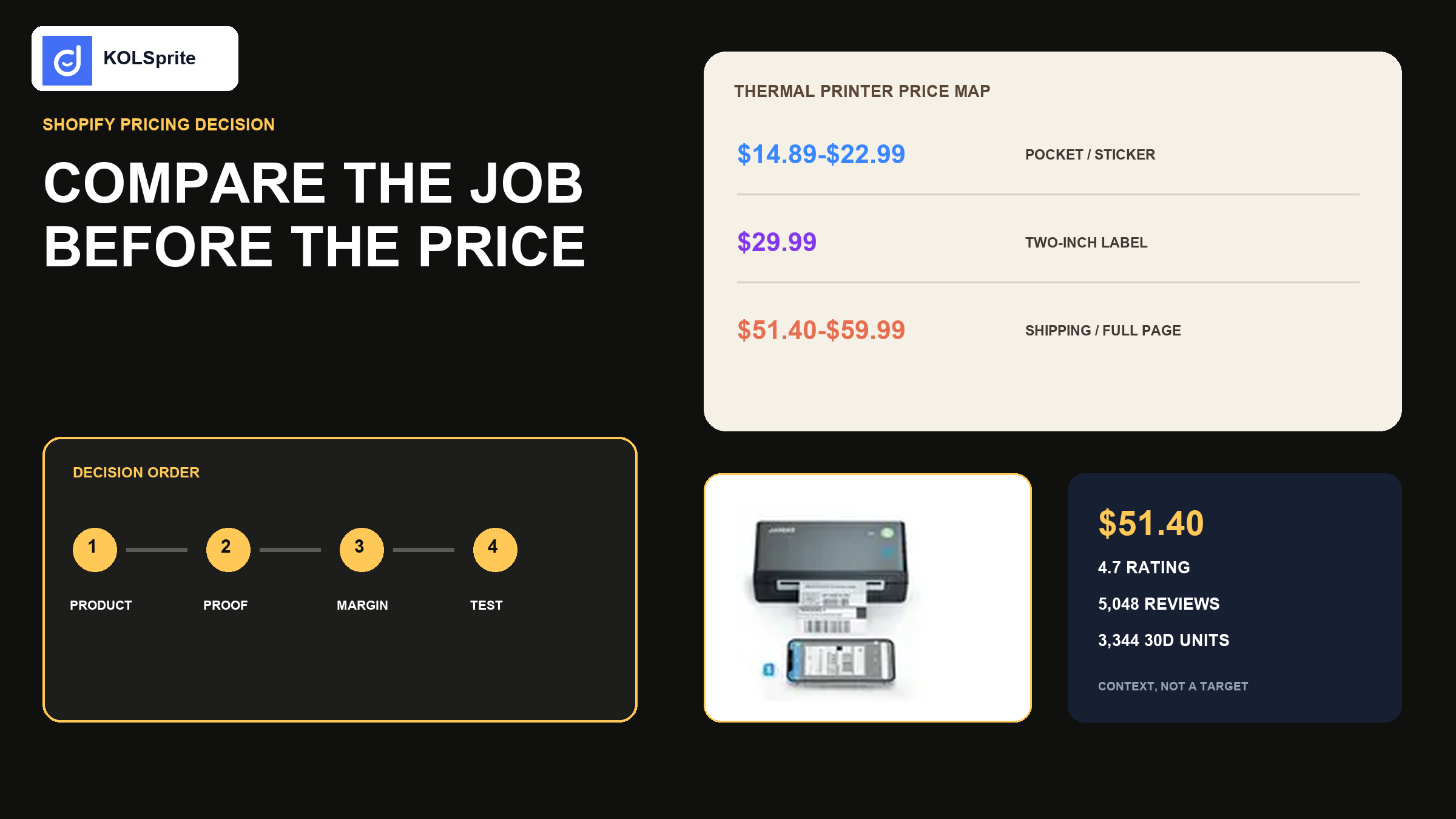
A more exact search for thermal label printers produced several usable formats. A JADENS shipping-label printer was listed at $51.40, with an original-price field of $99.99, 3,344 units in the latest 30-day field, a 4.7 rating, 5,048 reviews, 967 linked creators, and 2,318 linked videos. An inkless portable office printer was listed at $59.99, but it supported letter and A4 paper rather than the same shipping-label job.
A small pocket sticker printer was listed at $14.89. A XenGro mini sticker printer was $22.99. A NIIMBOT two-inch label printer was $29.99. The last three were closer to home, school, organization, or small-label jobs than full shipping labels. The search did not reveal one market price. It revealed several product jobs inside one phrase.
Research note. KOLSprite US product-search records, accessed July 30, 2026. Five exact-query records and five refined thermal-printer records were reviewed. Irrelevant keyword matches were excluded. Public price and commerce fields are dated marketplace snapshots, not a full category census or audited profit data.
For a Shopify seller serving small ecommerce businesses, the relevant question may be: what else would a buyer choose to print standard shipping labels from a phone and laptop? That definition excludes a pocket sticker printer, even if both products use thermal printing. It may also exclude a full-page portable printer if the buyer cares most about shipping workflow.
Write the comparison rule in one line. Include output size, supported devices, connectivity, required supplies, likely use, and package contents. A competitor enters the price set only when it passes the rule. Keep near alternatives in a separate section because they can still shape value perception.
Shopify defines competitive pricing as setting price with reference to what direct competitors charge. Its guidance also warns that price matching can shrink margin and weaken differentiation. That is why the comparable set must be narrow and the value review must come before a discount.
| Observed band | Example product | Primary job | Do not infer |
|---|---|---|---|
| $14.89-$22.99 | Pocket and mini sticker printers | Notes, crafts, small labels, and organization | That they replace a shipping-label printer |
| $29.99 | NIIMBOT two-inch label printer | Small business, office, home, and school labels | That all shipping formats are supported |
| $51.40-$59.99 | Shipping-label or larger portable printer formats | Shipping workflow or full-page portable printing | That both products have the same paper and software job |
The bands are not recommended prices. They are a map of the product forms returned in one dated search. Your own item belongs in the band whose job and specifications it can honestly match.
A lower price is powerful when the buyer sees the products as interchangeable. Content can change that perception by proving a difference. A shipping-label printer may show setup with Shopify, label alignment, print speed, supported label size, and a real packing station. A pocket printer may show journaling, pantry labels, or school notes. Those demonstrations make the job visible.
Use KOLSprite product search to preserve the exact comparable item, then review its linked content in video search. Record the proof, not just the hook. Does the creator show pairing, printing, peeling, scanning, and placing the label? Does the video answer supply and compatibility questions? Is the offer driving attention more than the product difference?
If your $59 product shows a complete five-minute shipping workflow and the $15 product shows decorative notes, the price gap is not a direct undercut. If another shipping-label printer shows the same job at $51.40, that is a closer pricing signal.
| Field | Your Shopify offer | Comparable A | Comparable B |
|---|---|---|---|
| Product job | Standard shipping labels | Standard shipping labels | Portable A4 and letter printing |
| Visible price | Enter current price | $51.40 snapshot | $59.99 snapshot |
| Included supplies | Verify package | Verify exact package | Verify exact package |
| Device support | Verify systems | iOS, Android, Windows, Mac, Chromebook in title | iOS, Android, and laptop in title |
| Proof shown | Audit current page and videos | Review linked videos | Review linked videos |
| Trust | Reviews, warranty, support, returns | 4.7 rating; 5,048 reviews in record | 4.5 rating; 5,249 reviews in record |
| Private economics | Known to your team | Unknown | Unknown |
The table forces the team to leave unknown fields blank. It also stops a crossed-out original price from becoming a permanent market value. Promotions, coupons, shipping, and bundles can change the actual offer.
Your minimum sustainable price depends on landed cost, payment fees, fulfillment, shipping subsidy, returns, support, discounts, affiliate commission, paid media, and required contribution. Calculate it with your own records. Public competitor prices cannot reveal whether another seller is profitable.
Use a downside case. If return rate rises or affiliate commission is needed, does the proposed price still make sense? If not, the team must improve cost, change the offer, prove more value, or leave the comparison. Matching a loss-making competitor is not a strategy.
Keep the floor separate from the test target. The target may sit above the floor because the product includes stronger support, a better warranty, easier setup, or a clearer business use. The proof layer must make that reason visible.
Use this when the item has a real advantage that the page does not show. Add a setup sequence, compatibility chart, packing-station example, or support promise. Test whether qualified conversion improves before giving away margin.
Add the correct starter labels, a setup guide, or a limited bundle. Make the included value explicit. Avoid a bundle that adds cost without solving a buyer question.
Use this when close substitutes offer the same job and proof at a lower price. Set an end date, traffic scope, primary metric, and margin guardrail. Do not change the page, audience, and price at the same time.
If your floor sits above the accepted range and the product has no provable advantage, a discount may only delay the problem. Narrow the buyer, improve the product, or stop funding the offer.
Start with the highest-traffic relevant product page. Keep the product, creative source, and main acquisition mix as stable as possible. Test either the value proof or the price first. Use conversion rate as the primary measure and contribution per visitor as the financial guardrail. Watch return rate, support contacts, and average order value.
If a lower price lifts conversion but reduces contribution per visitor, the test may be a loss. If stronger proof holds conversion at the current price, the brand has protected margin. If neither works, the comparable set or product position may be wrong.
Shopify's pricing guidance recommends combining costs, demand, and competitor behavior. TikTok evidence strengthens the demand and positioning side by showing which use cases people can see. It does not replace a controlled store test.
Comments and support tickets can reveal why a cheaper product looks sufficient. Buyers may not understand label size, device support, print method, supply cost, or software setup. Add the missing answer close to the offer. Do not attack the competitor or make claims you cannot verify.
For example, a heading such as "Built for standard shipping labels" is more useful than "Professional quality." Show the supported size, devices, setup steps, and one real packing flow. A buyer who needs craft stickers can choose another product. Better pricing pages qualify as well as persuade.
The TikTok comments product-research guide can help identify the buyer language. The TikTok Shop versus Amazon guide explains why marketplace and content-driven buyers may compare value differently.
Fast-moving categories may need a monthly review. Stable categories may need one each quarter or before a major promotion. Save the date, products, prices, proof, offers, and decision. Do not overwrite the old snapshot. A change matters only when the team can see what changed.
Set a trigger for an earlier review: a close competitor enters, a major offer changes, conversion falls, returns rise, or a new TikTok proof format changes how buyers understand the product. The trigger should lead to a fresh comparable set, not an automatic discount.
The merchant opens with the buyer's job. "We sell a printer for standard ship labels." That rules out the low-cost pocket printer. It may look close in a search, but it does not do the same work.
The research lead shows two close offers. One is $51.40. One is $59.99, but it prints full sheets and serves a wider office job. The team does not average the two. It checks what comes in each box and what the linked videos prove.
The page owner then shows the current Shopify page. Setup is not clear. The page does not show a real packing flow. The team agrees that a price cut would not fix that gap. It chooses a proof test first.
Finance states the floor. The group does not share the figure outside the team. At that floor, the brand can still pay fees, cover normal returns, and fund support. A deeper price cut would break the rule.
The new page shows phone setup, one standard label, and a full pack-and-stick step. The price stays the same for the first test. If the page works, the brand keeps its margin. If it fails, the team can test a small offer change next.
No one claims that a public TikTok price is the true market rate. No one calls the cheaper item a direct rival until the job matches. The meeting ends with one change, one metric, and one date. That is enough.
The KOLSprite records do not reveal competitor margin, coupons, stock limits, paid traffic, return rates, or every package detail. Search results can contain false positives. Visible commerce fields are directional. A linked video can show proof without proving it caused every sale.
A sound competitive pricing analysis uses those limits to size the claim. The observed range is context. Your product job, proof, economics, and store test create the decision.
Do not match the $14.89 pocket-printer price. It serves a different job. Compare your offer first with exact shipping-label formats around the observed $51.40 range, verify package and device support, and audit the proof buyers can see. If your margin floor permits it, test one value-proof update before a price change. Discount only when a close substitute offers the same job and your controlled Shopify test supports the move.
Create a KOLSprite account and claim a three-day trial membership. Use the trial to put this workflow into practice before your next product, content, or creator decision.
Register for a three-day KOLSprite trial
Share the product job, observed price band, and margin guardrail without exposing confidential costs. Another seller may spot a false comparison or missing proof.
 +
+
Review the pricing decision on Discord
Latest Articles

As an essential, data-driven toolkit for TikTok influencers and marketers, KOLSprite provides powerful features for effortless creator discovery, trending content identification, and actionable real-time insights.
It empowers users to make smarter decisions and significantly boosts their TikTok business.

 Refer & Earn