 +
+
A TikTok comment export is useful when you need the exact words people used, not another summary from memory. The direct workflow is: define one research question, export the public comments to Excel, keep the source and engagement context, tag questions and objections, and assign a next action. By the end of this guide, you will have a five-column decision sheet that can improve a product page, creator brief, FAQ, or next research task.
Ten-second answer: do not start by exporting everything. Start with a decision such as "Which objection blocks first-time buyers?" Then make every kept row answer or challenge that question.
Manual copying creates a biased sample. People naturally save comments that confirm the idea they already like. They also lose the source, reply context, or engagement count. A file gives the team a stable record and makes disagreements easier to inspect.
KOLSprite added Export Video Comments to Excel to its extension workflow. Its AI Comment Analysis can also organize buyer questions, pain points, purchase intent, and competitor mentions. Use the export when you need row-level evidence. Use the analysis when you need a fast map of the conversation. They solve different parts of the job.
Boundary: public comments are directional evidence. They are not a representative survey, and they do not prove that every viewer or buyer shares the same opinion.
TikTok's official Comment Insights also uses AI to group public comments into topics and gives users controls over whether their comments are included. That makes source context and privacy choices part of the research, not an afterthought.
A vague goal such as "understand the audience" produces vague tags. Pick one decision that the team can make this week. Good examples include:
If the exported rows cannot change a product, content, support, or research decision, the team does not need the export yet.
The research question belongs at the top of the sheet. It keeps an interesting joke or unrelated debate from taking over the analysis.
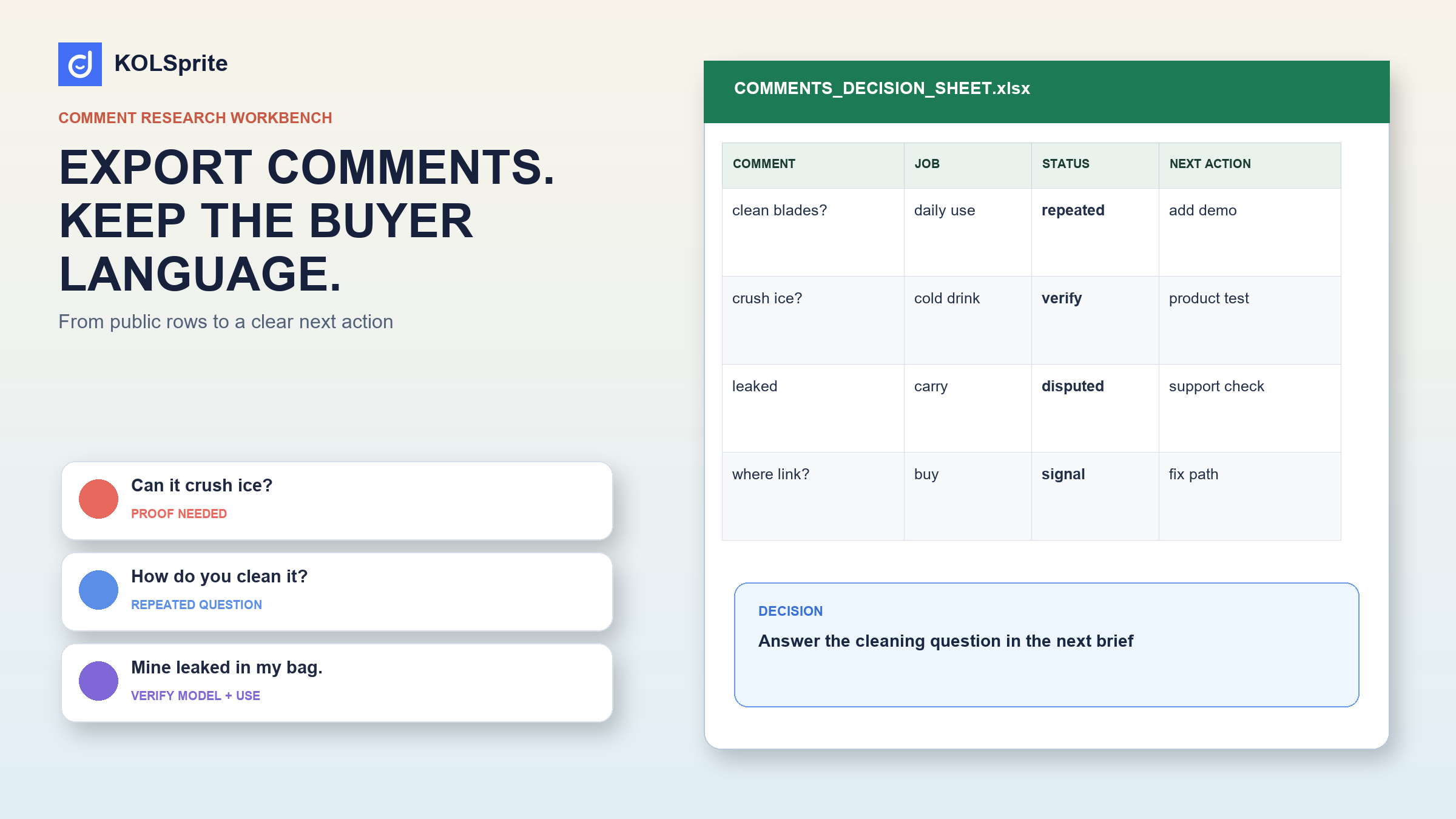
| Verbatim comment | Buyer job | Question or objection | Evidence status | Next action |
|---|---|---|---|---|
| Keep the exact public wording needed for analysis. | What is the person trying to do? | What blocks or confuses them? | Single, repeated, disputed, or unclear | Brief, PDP, FAQ, product test, or no action |
| "Can it crush ice at work?" | Make a cold drink away from home | Performance and setting | Needs product proof | Run a controlled ice test before making the claim |
| "How do you clean the blades?" | Use it daily without a mess | Cleaning effort | Repeated question | Add a cleaning demonstration and product-page answer |
| "Mine leaked in my bag." | Carry a prepared drink | Leak risk | Important but unverified | Check model, lid, usage, and support records |
The sheet separates a person's words from the team's interpretation. That matters. "Can it crush ice?" is a question, not proof that the product can or cannot do it.
A good cleaning pass improves usability without pretending the file is neutral. A short note should describe what was removed and why. One sentence is enough: "Removed empty rows and exact duplicates; kept repeated wording and all substantive disagreement."
KOLSprite can export video comments to Excel and use AI Comment Analysis to organize questions, pain points, purchase intent, and competitor mentions beside the source video.
Register and claim a three-day trial
Use plain labels such as price question, setup question, performance claim, shipping concern, comparison, positive outcome, negative outcome, or unclear. Avoid deciding what the business should do yet.
Now ask whether the comment changes a content, product, or service action. A repeated setup question may become a tutorial. A claim dispute may require testing. A shipping complaint may belong with support and operations, not the creator brief.
This two-pass method reduces the urge to turn every comment into content. Some rows are useful because they tell the team to stop making a promise.
KOLSprite's AI Comment Analysis can produce a structured report in a few seconds and identify common themes. The result points to sections of the conversation worth reading. Important conclusions still need to be checked against the exported rows, especially when a product or compliance decision depends on them.
Practical rule: the summary helps you find the pattern; the export helps you show the evidence. Keep both linked to the same source video.
Suppose the comments repeatedly ask about cleaning, ice, and leaks. A brief that merely says "show how convenient it is" hides the real work. Three proof tasks make the request concrete:
The comments did not prove those product qualities. They told the team which questions need proof. This distinction makes the brief more useful and safer.
Begin with 25 to 50 rows. That is enough to test the codebook before the file becomes hard to change. Read each row once and apply one plain label. When a comment fits two ideas, choose the label closest to the research question and add a short note.
Suppose the question is, "What keeps a first-time buyer from trusting this portable blender?" A cleaning question becomes maintenance. A leak complaint becomes carry risk. A joke about the creator's kitchen becomes off topic. A request for the product link may become purchase path.
After the first 25 rows, review the labels. Merge labels that mean the same thing. Split a label only when it leads to a different action. For example, "performance" may be too broad if ice, battery, and capacity require different product tests.
Stop and revise the codebook when two editors would label the same row in different ways. Clear labels matter more than a fast row count.
A count tells you what appeared in the exported set. It does not tell you how common the view is in the full customer base. A precise finding reads, "18 of 214 exported comments asked about cleaning," rather than "customers care most about cleaning."
The denominator matters. The file should also note whether the video was an ad, a creator post, a tutorial, or a complaint. The format can shape the comments, and a creator's prompt can make one theme look larger.
Likes on a comment can help you find language that resonated. They still do not prove purchase intent. Use them as a review signal, not a sales metric.
Bring five anonymized comments and the decision you are trying to make. The group can help separate a repeated signal from an isolated reaction.
 +
+
Join the KOLSprite Discord community
Do not export when one public answer is enough. If you only need the return policy stated by a brand, check the official source. Do not use public comments to decide a private support case. Do not collect more personal data than the task requires.
Export is worth the effort when the team needs a pattern, a shared evidence file, or an audit trail. It is also useful when several people must review the same language. The file should make a decision easier. If it only makes the research folder larger, stop.
The disagreement is important. A clean summary can hide the fact that buyers report different results. Keep that tension visible until a product test or larger evidence set resolves it.
A meeting-ready sheet has a frozen header row, filters, and the source link at the top. The decision question sits in a large note above the table. A short method note under the data records the access date, exported row count, removed rows, languages, and limits.
That note should be brief. The audience does not need a diary of every cleaning step. They need enough context to judge the finding. A good note may read: "Public comments exported August 10, 2026. Exact duplicates and empty rows removed. Spanish rows translated with originals retained. Findings are directional."
Choose one supported theme. Write the current experience, the proposed change, and the signal you will watch. Keep the change small enough to review.
For example: "Cleaning questions appeared in 18 of 214 kept comments. Add a 10-second cleanup section to the next creator brief. Watch for fewer repeated cleaning questions and more questions about use."
This does not claim the cleanup section caused a sale. It shows why the change was made and what the team expects to learn. Add the result to the same sheet after the next post.
When no theme is strong, keep the file as a reference and take no action. Research is allowed to end without a new campaign idea.
Record that no-action result as well. It protects the team from reopening the same weak idea next week. Include the source, the question, the sample limit, and the reason no change was made. A later video may add new evidence. Until then, the honest answer is that the current comments do not support a business change. This restraint is part of good customer research, not a failure of the export.
Send repeated product questions to the product-page owner. Send content questions to the creator lead. Send delivery or support issues to the team that can verify them. Keep disputed claims in a test queue until someone produces evidence.
If spoken language is more important than reactions, pair the sheet with a TikTok transcript generator workflow. For a broader product decision, connect the rows to the viral-product validation checklist. The internal loop is clear: video creates a response, comments reveal questions, product evidence answers them, and the next video tests the answer.
A TikTok comment export earns its place when it preserves customer language beside a decision. The useful deliverable is not a large spreadsheet. It is a smaller, reviewable sheet that tells the team what to prove, answer, test, or leave alone.
Product evidence: KOLSprite Extension Update Log and AI Comment Analysis guide, accessed August 10, 2026. Follow applicable platform rules, privacy obligations, and research ethics when handling public comments.
Older Article
TikTok Hashtag Generator: Build a Relevant Tag Set>>
Latest Articles

As an essential, data-driven toolkit for TikTok influencers and marketers, KOLSprite provides powerful features for effortless creator discovery, trending content identification, and actionable real-time insights.
It empowers users to make smarter decisions and significantly boosts their TikTok business.

 Refer & Earn