 +
+
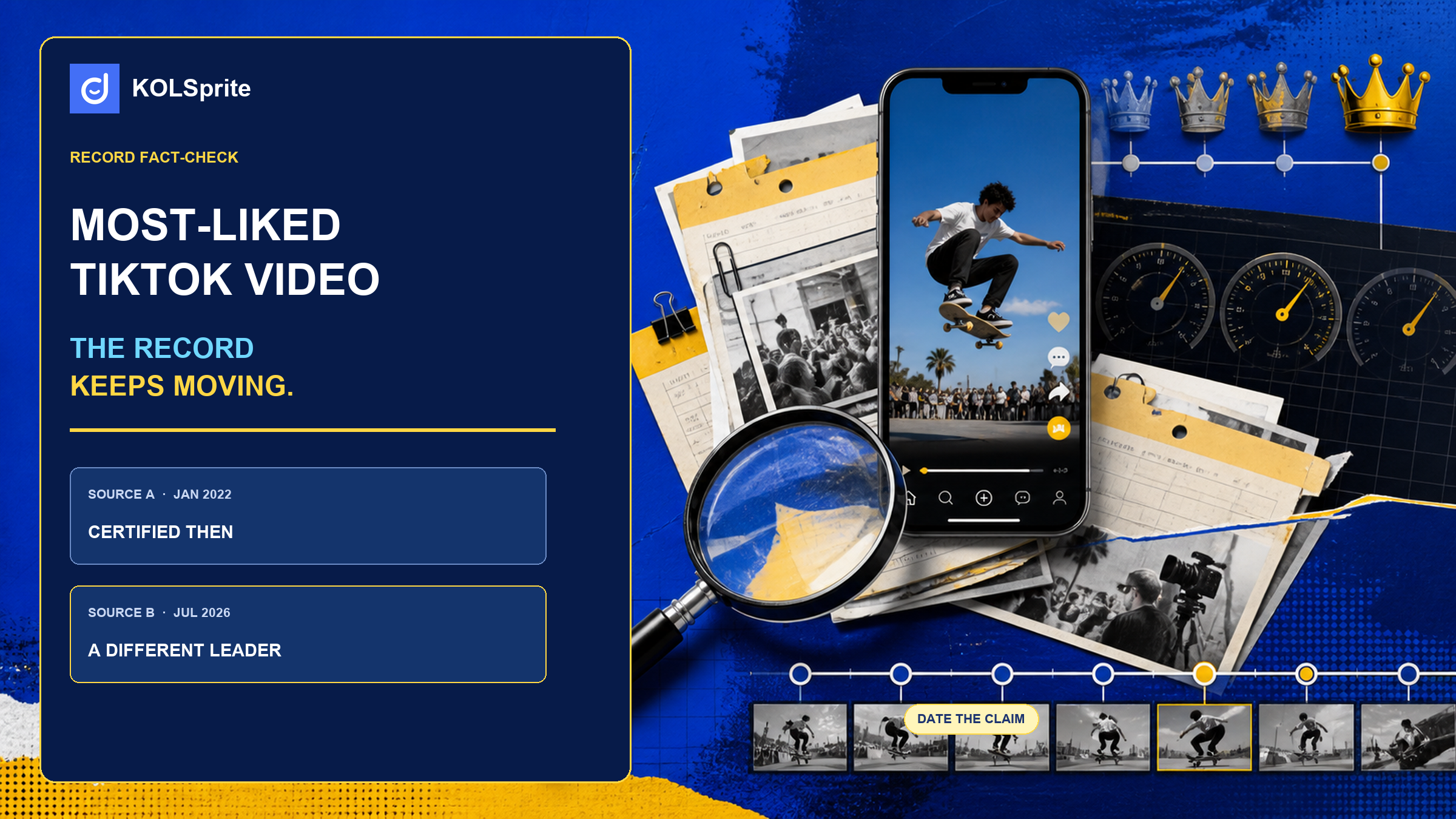
A record question should have a short answer. It rarely stays short. The most liked TikTok video changes as live counts move, posts vanish, and publishers update at different times. Public pages may also disagree on what is current. A brand can verify a claim for a set date. It should not turn that claim into next week’s creative brief.
That matters because record videos are outliers. A creator’s audience, a sound, a cultural moment, one clear action, and the way TikTok spread the post all came together. Another account cannot recreate that mix on command. The useful lesson is smaller: inspect what viewers can see, date the evidence, and say what will not transfer.
When someone asks who holds the record, first ask, “According to which source, on what date?” A world-record organization may preserve an entry from the time it was verified. A music-industry publication may report a later change based on its own research. The platform count may change again before either editorial page is revised.
That does not make the question pointless. It changes the required answer. A responsible answer identifies the source, gives its publication or record date, and says when the page was checked. It does not flatten conflicting pages into a timeless fact. The date is part of the claim.
| Source | Dated claim | What the source supports | Conflict or limitation |
|---|---|---|---|
| Guinness World Records | Its record entry is dated January 25, 2022 and identifies Bella Poarch for the most-liked TikTok video. | That Guinness recorded and published this record claim at that point in time. | It may not reflect later changes, deleted content, or current live platform counts. |
| RouteNote | Its July 2026 report says Leah Halton overtook the record and says the Bella Poarch post was removed. | A later editorial account of a changed ranking and a removed post. | It is not a live platform record authority; counts and availability can change faster than editorial pages. |
Source note, reviewed August 21, 2026: Guinness’s record entry carries a January 25, 2022 date, while RouteNote’s July 2026 report describes a later leader and the removal of the Bella Poarch post. Scope: comparison of those public editorial pages. Limitations: live TikTok counts, post availability, and ranking methods can change before either page is updated.
The two sources do not need to be forced into agreement. Guinness documents a historical record state. RouteNote reports a later state. The gap tells the reader why a static answer needs a date. It also tells a content team not to use an old ranking screenshot as if it were a current platform fact.
A fact-check desk should keep its wording close to the source. Do not give a current count unless the source gives it and the date is clear. An old list also cannot prove that a deleted post is still live. If the named record holder changes, explain why the source changed. These small habits keep a familiar search query from turning into a stale claim.
Once the factual answer is dated, watch the example as a piece of public creative. What happens in the first seconds? Is there one visible action that makes the video understandable without explanation? Does the sound carry recognition? Does the creator’s existing context make the post legible to an audience that already knows them? These are observations, not instructions.
A seller may learn from one clear action, the timing of a reveal, or an image viewers know at once. Much more may not transfer. That includes fame, a certain sound, an established bond with the audience, timing, and the chance behind public reach. A record is an outlier to inspect, not a goal for an ordinary product post.
Use KOLSprite to inspect supported public video and creator context, save dated evidence, and compare visible features while treating live counts and rankings as changeable.
Register and claim a three-day trial
| Visible observation | Possible bounded lesson | What does not transfer automatically |
|---|---|---|
| The video relies on a simple visible action that a viewer can understand quickly. | A product test may make its first use case legible in the opening seconds. | Record-level reach, creator fame, sound association, and the original cultural moment. |
| The post is attached to a creator with established public context. | Consider whether the target audience needs more context before a product claim lands. | The creator’s audience relationship, identity, or trust. |
This note stops a creative team from borrowing the easiest surface detail. It asks a harder question: does our viewer share the context that gave the action meaning? If not, a direct copy may fail and may not fit the brand.
TikTok’s Creative Center help page is one public route for creative discovery. Public examples can be sorted, inspected, and saved with a research date. They cannot establish complete platform coverage, certify a world record, recover deleted posts, or prove why a video travelled as far as it did.
KOLSprite can help teams inspect supported public examples and the public context around a creator or video. Teams can also organize dated evidence and compare visible creative choices. KOLSprite does not certify a record, cover all of TikTok, prove cause, or grant reuse rights. Those limits keep a research note from making a claim it cannot support.
For a broader method of deciding whether a public format is worth testing, see TikTok trend analysis test-watch-exit. For audience context that may shape how a visible action is read, use TikTok audience insights workflow.
Join the KOLSprite Discord to compare record evidence, stale rankings, and the creative observations that remain useful after the leaderboard changes.
 +
+
Join the KOLSprite Discord community
A record post can be fascinating and still have little to say about a product launch. Put it in a reference folder with the evidence ledger. Then move to the next assignment. Pick one visible element that can be adapted without copying the post. Write the condition for its test. A team might test an immediate product demonstration. It should not promise record-scale engagement as the outcome.
That is a healthier use of a famous example. It gives the social lead something concrete to discuss while leaving room for category fit, product truth, and original execution. It also makes the limitation visible to anyone who sees the reference later without the context of the meeting.
The record question deserves a direct response, followed by the evidence that qualifies it. Keep the historical Guinness entry, the later RouteNote report, and the review date together. Keep the creative lesson smaller than the headline. A clear action, creator context, sound, and timing may interact in ways a brand cannot reproduce.
Use current public examples to study visible choices. Keep the date beside the evidence. Let the next brief describe a test that belongs to your own product. That gives the record a proper place in the work: a fact to verify and an outlier to examine.
The label most liked TikTok video can also hide several questions. Does the reader mean the all-time high, the top post that is still live, one creator’s top video, or a recent leader? Each is a different claim. A fact-check should say which one it answers. It should not imply that it settled every version.
The count itself also has limited creative value. A large number tells you that an extraordinary amount of interaction occurred around a public post. It does not tell a brand who watched to completion. It cannot show which creative detail held attention or whether the result would survive a product message. Counting likes may be useful for a record page. It is a weak substitute for studying the sequence of the video and the context around it.
When a team inspects an outlier, preserve a few concrete details. Record the review date, source page, public availability, and visible opening action. Also state why the lesson is limited. This is enough for another editor to understand the note later. It also prevents a familiar claim from becoming detached from the evidence that made it plausible on the day it was written.
A most liked TikTok video can therefore be a reference point without becoming a target. The brief that follows should name a product truth and a viewer task, then test a visible choice the team can own. It should not borrow celebrity context or assume a sound carries the same meaning. It also should not promise an outcome that a record-level outlier produced under different conditions.
Use a final editorial question before sharing the answer: would a reader understand what is confirmed, what is reported by a later source, and what may have changed since either page was published? If the answer is yes, the article has done its factual job. The remaining work is creative judgment, where dated public evidence can inform a decision without dictating it.
Teams that want a second public reference before framing that judgment can compare the record example with TikTok Creative Center seller validation. The comparison should stay focused on visible creative features and source dates. It cannot settle a live record question or turn public attention into a forecast.
Keep the evidence ledger with the answer when the page is updated. A later source may change today’s answer. The older source can still be right for its own date. Showing both is clearer than erasing the past and asking readers to trust a change with no explanation.
Latest Articles

As an essential, data-driven toolkit for TikTok influencers and marketers, KOLSprite provides powerful features for effortless creator discovery, trending content identification, and actionable real-time insights.
It empowers users to make smarter decisions and significantly boosts their TikTok business.

 Refer & Earn