 +
+
If your creator report has clicks, sessions, discount codes, video views, and sales in separate sheets, the missing piece is not another dashboard. It is a shared key and a decision path. This guide helps ecommerce marketing operations teams build influencer campaign tracking from creator research through the landing page and GA4. You will leave with a UTM naming map, a small event ladder, and a weekly decision card that separates public creator evidence from first-party site behavior and commercial results.
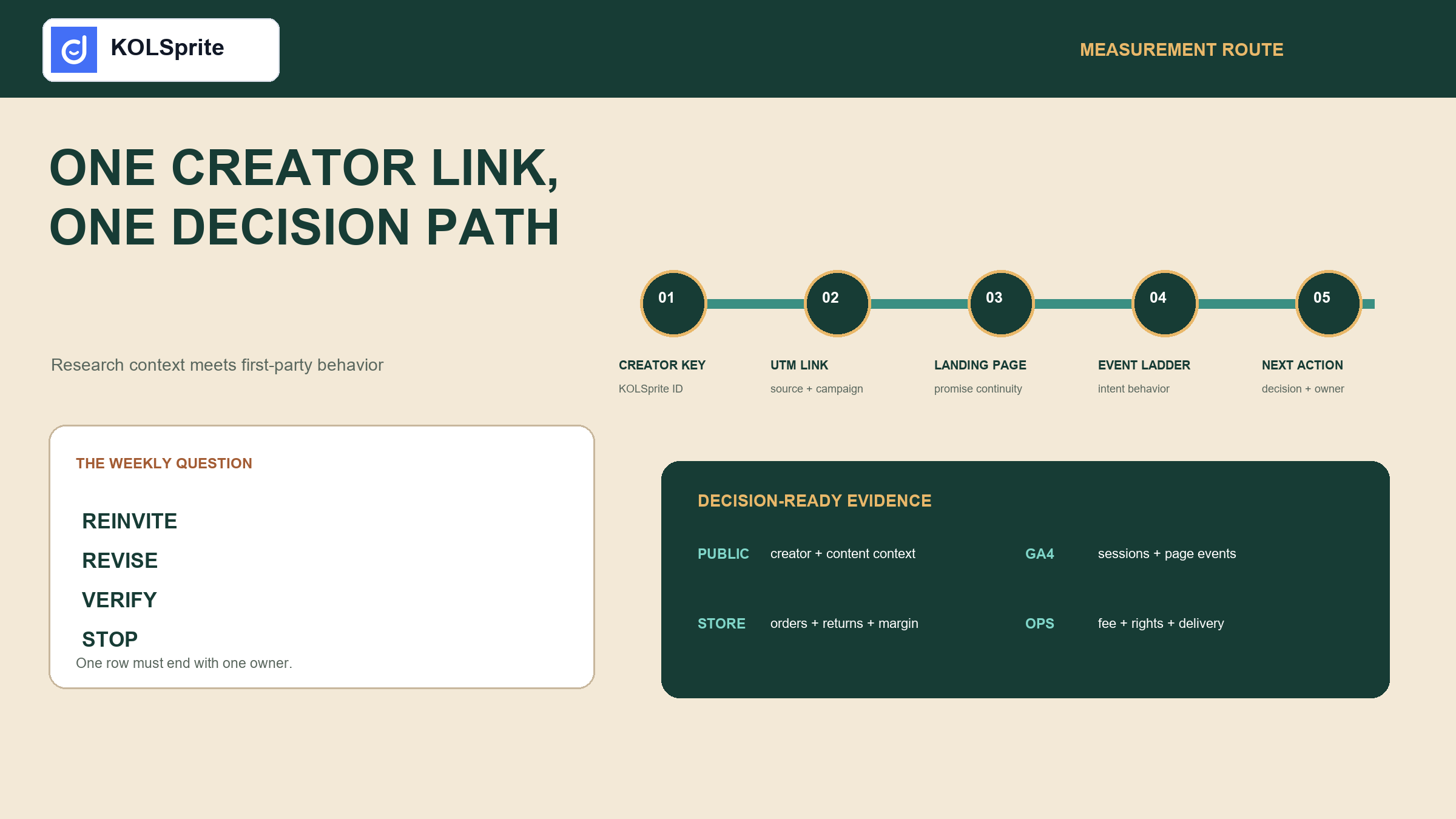
Give each creator-campaign combination one stable internal key. Carry that key from the KOLSprite research record into the link name, landing-page record, event review, and partnership decision. Use only the events that answer the next decision. Keep platform views and estimated commerce fields separate from GA4 sessions and store orders.
A tracking plan is useful only when one row leads to one next action.
Before writing a UTM, finish this sentence: "At the end of this test, we will decide whether to reinvite the creator, revise the landing page, change the offer, or stop the angle." That decision tells you which evidence belongs in the report.
If the goal is to evaluate traffic quality, sessions, engaged sessions, key page actions, and orders may matter. If the goal is to choose a better product angle, product-detail expansions, comparison clicks, and add-to-cart behavior may matter more than a last-click sale. If the creator was hired only to produce an asset, landing-page attribution may be secondary to content quality and rights.
Do not force one measurement model onto every creator job. Research creator, affiliate seller, creative producer, awareness partner, and conversion partner are different roles.
Handles can change. Display names can repeat. Campaign names can be typed five ways. Keep an internal creator key that maps to the stable public creator ID and the current handle. For example:
| Field | Example | Owner |
|---|---|---|
| Internal creator key. | cr_0176_jenna. | Partnership operations. |
| KOLSprite stable creator ID. | 176895539752374272. | Research record. |
| Current handle. | jennam4e. | Research refresh. |
| Campaign key. | fan_us_launch_aug26. | Marketing operations. |
| Link version. | themepark_a. | Growth or web owner. |
The internal key does not need to appear in public copy. It needs to be consistent in the partnership system, link builder, reporting table, and decision notes.
In the handheld-fan research case, KOLSprite connected exact product-linked videos with stable creator IDs, visible video metrics, creator region, recent product categories, and public creator fields. For Jenna Mae, the selected video used a theme-park mistake-and-relief angle. The creator record showed that fans were part of the product history. That context explains why the creator entered the test and which promise the link represents.
KOLSprite does not know the user's later Shopify session, checkout, refund, or lifetime value. GA4 does not know why the creator was shortlisted or whether the content matched the product brief. The useful report joins the records without pretending either tool owns the full story.
Research note. KOLSprite US exact product-linked video and exact-handle creator records for creator ID 176895539752374272, accessed August 3, 2026. Public fields support creator and content context only. The example campaign key and link below are illustrative. GA4, ecommerce orders, costs, and partnership terms remain first-party records.
Google's official campaign URL guidance recommends using consistent `utm_source`, `utm_medium`, and `utm_campaign` values, with other parameters where relevant. Parameter values are case-sensitive, so `TikTok` and `tiktok` can split reporting.
| Parameter | Rule | Example | Do not put here |
|---|---|---|---|
| utm_source. | Platform that sent the traffic. | tiktok. | Creator name. |
| utm_medium. | Stable channel class. | creator. | Paid amount or content title. |
| utm_campaign. | Shared campaign key. | fan_us_launch_aug26. | A long sentence. |
| utm_content. | Creator key plus asset or angle version. | cr_0176_jenna_themepark_a. | Personal data. |
| utm_id. | Optional internal campaign ID. | cmp_2026_081. | A changing display name. |
A sample link could be `https://example.com/products/fan?utm_source=tiktok&utm_medium=creator&utm_campaign=fan_us_launch_aug26&utm_content=cr_0176_jenna_themepark_a`. Test the full redirect path. Confirm that parameters remain present and that the correct landing page loads on mobile.
Choose three to five steps that describe the buyer's progress on this page. Use GA4 recommended ecommerce events where they fit your implementation, and work with the site owner to validate collection.
GA4's manual campaign report can display dimensions populated from UTM parameters. That does not make every later sale causally attributable to the creator. Consent, device changes, sharing, cookie limits, view-through effects, code leakage, and offline behavior can all break a simple path.
| Evidence lane | Observed fact | Question | Possible action |
|---|---|---|---|
| KOLSprite research. | Creator has exact fan content and a theme-park problem frame. | Was the creator-product fit real and current? | Keep or revise the creator role. |
| Content delivery. | Approved asset used the intended promise and proof. | Did the post execute the brief? | Approve, revise, or change the angle. |
| GA4 landing behavior. | Sessions and selected page events tied to the manual campaign key. | Did visitors engage with the promised proof? | Improve page continuity or keep the route. |
| Store outcome. | Orders, revenue, cancellations, returns, and margin from first-party systems. | Did the test create acceptable economics? | Reinvite, renegotiate, or stop. |
| Partnership record. | Fee, sample, rights, deadlines, and revisions. | Was the operating cost worth the learning and asset? | Change terms or creator role. |
Each lane has a boundary. A high KOLSprite video metric does not replace GA4 behavior. A low last-click order count does not prove the creator had no influence. The decision card shows what is known and which action the combined evidence supports.
High creator views, low tagged sessions: check link placement, CTA, post objective, and whether the content was meant to drive traffic. Do not call the creator a failure before checking the brief.
Healthy sessions, weak proof engagement: the creator may have earned the click while the page failed to continue the promise. Review message continuity and mobile speed.
Strong proof engagement, weak add to cart: inspect price, offer, variant, shipping, trust, and fit questions. The product angle may be interesting but commercially weak.
Orders with high returns: do not celebrate the acquisition result in isolation. Revisit the expectation gap and creator claim.
Few sessions, useful reusable asset: evaluate the creator as a content producer separately from a traffic partner, provided the license supports reuse.
The creator pricing and negotiation-floor guide helps add a cost boundary before the campaign. The usage-rights control keeps reusable assets tied to valid permissions. If the campaign creates returns or confused buyer expectations, use the product-demo expectation review before scaling the same promise.
Assume Jenna Mae posts the fan clip with the theme-park angle. The team gives that asset one link. The source is `tiktok`. The medium is `creator`. The campaign name is the same for all people in the fan launch. The content field holds the stable creator key and the angle version.
Before the post goes live, open the link on a phone. Make sure it lands on the right fan page. Check that the tags stay in the URL. Tap the key parts of the page. Use the live GA view or a test tool to make sure the planned events arrive. Write down who owns a bad link.
Next, check the page. The clip says the fan helps on a long, hot day. The first screen should show the same item and the same use. It should not start with a broad claim about health. It should show size, charge, speed, and the part that cools on touch if that is the chosen angle.
After the first set of visits, read the path. A large drop before the proof may mean the page is slow or the message changed. A large drop after the proof may point to price, trust, stock, or a weak offer. A cart does not yet mean a good order. Add the store result when it is ready.
At the weekly review, keep the row short. State the creator and asset. State the spend or sample cost. State the tagged visits. State the one key page act. State orders and returns when known. Then write the choice.
For example: "Reinvite Jenna for one new desk-use clip. Keep the same page. Change the angle, since theme-park traffic reached the proof but office buyers used the size and noise details more." This is a made-up result to show the form. A real choice must use the team's real GA4 and store data.
The note should also say what the data cannot show. It may not catch shared links. It may miss a view that led to a later direct visit. It may not join a sale across devices. That limit does not make the test useless. It keeps the claim fair.
A good report is calm. It does not rank all creators from one post. It does not call a weak link path weak content. It does not call a high view count a sale. It joins each fact to the job it can do.
Keep the first report small. One creator, one asset, one page, and one clear choice are enough to test the chain. Add more rows only after the names, links, and events stay clean.
Reliable influencer campaign tracking connects why the creator was selected, which promise the asset made, how the link was named, what the landing-page visitor did, and what the team will change. KOLSprite strengthens the creator and content context. GA4 and your store supply first-party behavior and outcomes. The shared key turns those separate systems into an operating decision without pretending the data is more complete than it is.
Carry stable creator research context into your campaign naming and weekly decision record. Create a KOLSprite account to claim a three-day trial membership.
Register for a three-day KOLSprite trial
Share the naming dictionary, event ladder, and next-decision rule without exposing customer or private creator data.
 +
+
Review the tracking route on Discord
Latest Articles
As an essential, data-driven toolkit for TikTok influencers and marketers, KOLSprite provides powerful features for effortless creator discovery, trending content identification, and actionable real-time insights.
It empowers users to make smarter decisions and significantly boosts their TikTok business.

 Refer & Earn