 +
+
If you manage an Amazon catalog, a Shopify store, or both, negative reviews can point to a real defect, a bad expectation, or a buyer using the product in a situation it was never built for. The hard part is telling those problems apart. This guide shows you how to combine Amazon review analysis with TikTok video and comment context before you change the product, listing, or creator brief. You will leave with a completed issue-triage table, a proof rule for each type of complaint, and a 45-minute workflow that product, support, and content teams can run together.
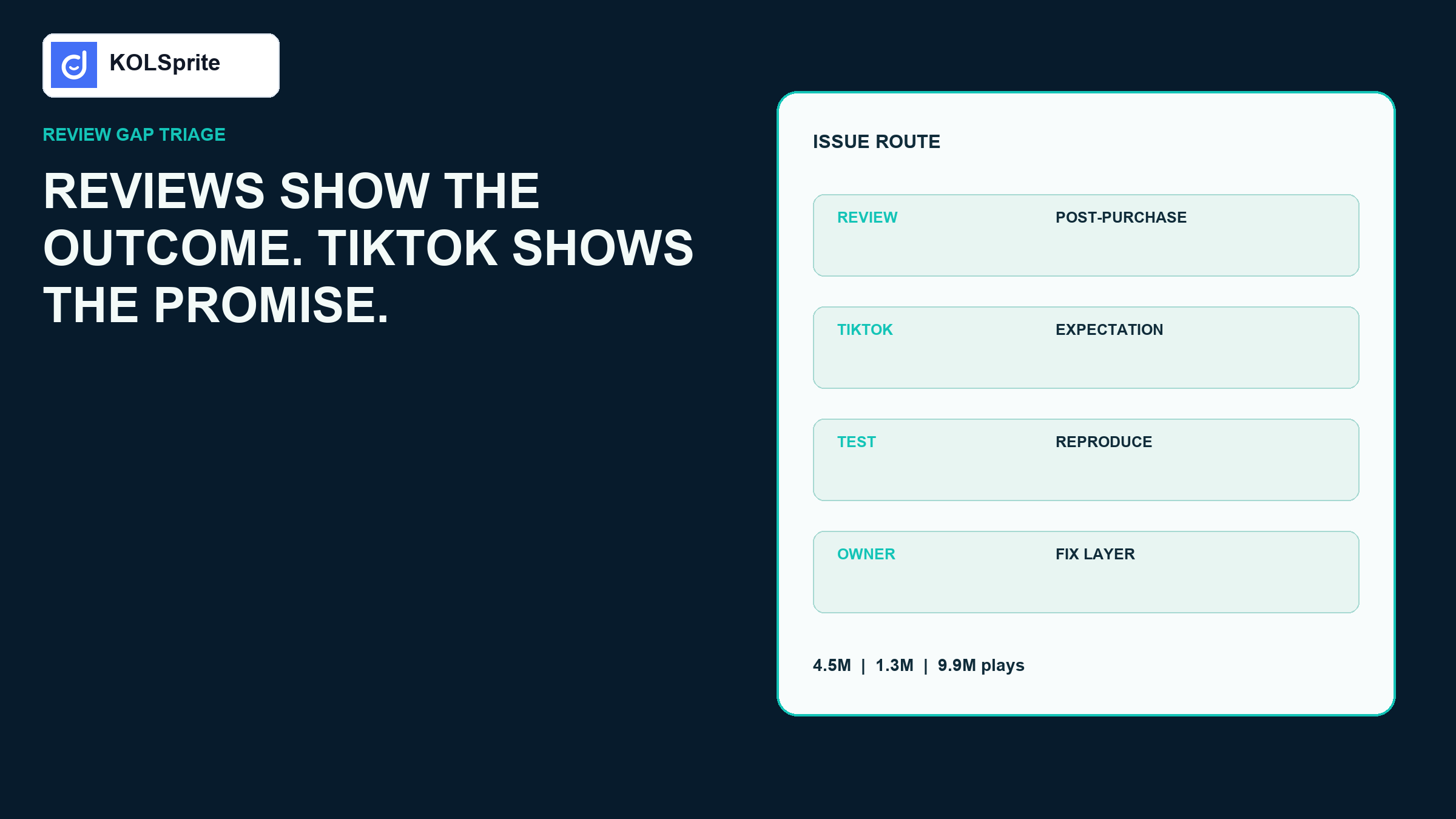
Use Amazon reviews to find repeated post-purchase outcomes. Use TikTok to see the demos, use cases, and expectations that may have shaped those outcomes. Do not merge the two sources into one sentiment score. Match themes by product, variant, buyer job, and time. Then route each theme to one of four owners: product, listing, content, or support.
A complaint is not automatically a defect. First ask what promise the buyer believed.
Amazon says authentic reviews help shoppers make informed choices and can suggest ways to improve items in its official packaging and review policy reminder. Reviews are valuable because they come after a purchase and often describe what happened in real use. They are also incomplete. A short review may omit the setup, variant, seller, or expectation that caused the problem. A one-star comment that says “does not work” could mean the motor failed, the buyer used the wrong lid, the video implied an impossible result, or the instructions were hard to follow.
TikTok adds another view. Product-linked videos show how creators frame the problem, which steps they skip, what they promise, and which use cases attract attention. Comments can expose questions that never reach a product review because the person has not bought yet. That makes TikTok useful for expectation research, not as a replacement for verified reviews.
The sources answer different questions. Amazon reviews show what buyers report after the transaction. TikTok content shows what prospects may see before the transaction. Support tickets show what blocks use after delivery. Returns show what became costly enough to send back. A good investigation keeps those stages separate until the team can prove a link.
Export or sample reviews for one ASIN and one variant. Keep the rating, date, variant, verified-purchase status when available, and the buyer's exact words. Remove duplicate syndicated reviews and obvious references to another product. Group the remaining reviews by outcome, not by isolated terms.
| Weak label | choice-ready theme | proof still needed |
|---|---|---|
| Seal. | Jar loses vacuum within 24 hours after the lid appears sealed. | Jar type, lid condition, food type, device charge, and repeat test. |
| Battery. | Device stops before a normal batch is full. | Charge state, batch size, age, and operating time. |
| Easy. | Buyer completes setup without reopening the instructions. | First-use observation and the step that caused hesitation. |
| Fresh. | Content promises longer freshness without naming food, storage, or time. | product test and claim boundary for each use case. |
The detailed label prevents a broad fix. “Improve sealing” is not a task. “Test whether regular-mouth jars lose vacuum after a clear setup step” is a task. It has a product, condition, result, and owner.
Compare exact TikTok product and video context with your highest-cost review theme. Create a KOLSprite account to claim a three-day trial membership.
Register for a three-day KOLSprite trial
We searched KOLSprite's US Video Search for vacuum sealers and retained choice-useful commerce videos. The returned set covered several product formats: mason-jar sealers, storage-bag pumps, and full vacuum-sealing machines. That range is key. A broad keyword can mix items that solve other jobs.
One mason-jar kit video showed 4.5 million visible plays, 91,500 likes, 388 comments, and a 13-second freshness pitch in the accessed record. Another 41-second demo showed 1.3 million plays and 1,486 comments, while a travel vacuum-bag clip showed 9.9 million plays. The numbers are not proof that one product is better. They show that the same keyword carries different mechanisms, conditions, and promises.
Several captions framed the value as less food waste, easier meal prep, or longer storage. One record claimed that a gadget doubled meal-prep life and paid for itself quickly. Those are strong buyer expectations. Before a seller repeats them, the team needs its own product test, instructions, and claim review. A review complaining about lost vacuum may be a product problem. A review complaining that food did not stay fresh for an implied period may be an expectation problem. The fix depends on which promise was made.
Research note. KOLSprite US Video Search for “vacuum sealer,” accessed August 4, 2026. Eight choice-useful records were reviewed from a much larger result set. Visible plays in the cited examples ranged from about 1.3 million to 9.9 million. Public fields can change. The review did not include Amazon review text, private return reasons, product testing, profit, or causal attribution.
For each repeated review theme, ask four questions in order. First, is the result repeatable with the exact product and variant? Second, did the listing or creator content promise that result? Third, did the buyer follow a visible setup path that makes the result likely? Fourth, can support solve the issue without changing the product?
Do not force every review into one box. A weak lid design and an unclear setup video can exist together. Mark the primary cause, contributing cause, confidence level, and next proof.
| Review outcome | TikTok expectation to inspect | Proof test | Owner | choice |
|---|---|---|---|---|
| Vacuum fades overnight. | Fast one-touch demos may hide lid checks and sealing time. | Repeat 10 seals across both supported lid sizes and log failures. | item. | Fix if repeatable; otherwise, improve setup proof. |
| Food did not stay fresh as long as expected. | “Extends freshness” language may lack food and storage limits. | Verify the claim for named foods and conditions. | Claims and content. | Narrow language before making more videos. |
| Buyer cannot tell whether sealing finished. | Edited demos may remove the sound, indicator, or wait. | Observe five first-time users without coaching. | UX and support. | Add a visible completion cue and short guide. |
| Device feels slow for bulk prep. | Single-jar videos may imply batch efficiency. | Time a realistic batch and compare with the intended job. | Merchandising. | Position for small batches or recommend another format. |
Use KOLSprite Product Search to isolate the exact TikTok Shop format and avoid mixing adjacent items. Open linked videos in Video Search to compare how the feature, setup, and result are shown. For videos with useful discussion, KOLSprite's in-page comment analysis can help summarize repeated topics and questions while you browse. Keep the source video and product attached to every note.
KOLSprite does not read your Amazon Seller Central reviews, test your sample, or decide whether a claim is permitted. Your review export, support data, return reasons, supplier documents, and product test complete the case. The value is the bridge: the team can compare what buyers report with what TikTok prospects are being taught to expect.
Share an anonymized issue table, proof boundary, and next test. Other ecommerce operators can challenge whether the problem belongs to product, promise, instruction, or fit.
 +
+
Review the issue map on Discord
Invite one person from product, support, and content. Spend ten minutes choosing the top three review outcomes by frequency and business cost. Spend ten minutes finding the exact TikTok product format and five to eight linked videos. Spend ten minutes labeling the promise, setup, visible proof, and missing limit in each video. Spend ten minutes assigning each outcome to the four-box test. Use the last five minutes to name one test, one owner, and one date.
Keep the meeting away from broad sentiment totals. A 70% positive score does not tell the product owner which lid to test. A viral clip does not tell the content owner which claim is safe. The useful output is a short queue of choices.
First, do not compare an Amazon review for one variant with a TikTok video for another. Second, do not treat comments and reviews as equal samples. They occur at different stages and can be shaped by the video. Third, do not count repeated phrases as independent proof when creators are repeating the same brief.
Also watch the dates. A product revision, new packaging, or improved instructions can make older feedback less useful. Record the access date and version. If the team cannot confirm the product match, keep the theme as a hypothesis.
A product change needs a repeatable failure. A listing change needs a clear expectation gap. A creator-brief change needs a visible proof job. A support change needs a question that can be solved after purchase. Write the action in that form.
For example: “Film the full regular-mouth jar setup in one take, show the completion cue, and state that storage outcome depends on food and conditions.” That is more useful than “make a better tutorial.” It tells the creator what to show, the claims owner what to check, and support what the buyer should know.
Use the product-demo expectation-gap workflow when return reasons need to be connected to creative proof. Use the TikTok comments product-research guide when you need a broader pre-purchase question map. After the issue is clear, the content proof-test guide helps turn it into an original video test.
Keep the readout to one page. List the exact product and variant, the review outcome, the TikTok expectation, the proof completed, the choice, and the owner. Add a confidence label: observed, repeated, reproduced, or unresolved. Do not report that TikTok “caused” an Amazon review unless you have direct proof.
The language should stay plain. “Three of five first-time users missed the lid check” is useful. “Consumers show negative sentiment around usability” is not. The first sentence can change a guide and a shoot. The second sounds key while hiding the work.
Suppose buyers say a jar loses its seal overnight. The TikTok clips show a fast demo, but they skip the lid check. That gives the team two leads, not one answer. The product owner tests the jar, lid, and pump as sold. The content owner films the full setup and names the limits. Support adds one clear check to its reply. The listing stays unchanged until the team knows which lead is true.
This handoff is easy to review. It names the buyer problem, the proof already seen, the proof still missing, and the next owner. It also keeps the team from fixing a page when the product is at fault, or changing the product when the real gap is a rushed demo.
Good Amazon review analysis does not end with a theme chart. It identifies whether the product, promise, instruction, or fit is failing. Add TikTok setting to see the expectations and demos around the same product. Use KOLSprite to keep that public proof tied to exact products and videos, then let your own testing and buyer data decide what changes.
Latest Articles

As an essential, data-driven toolkit for TikTok influencers and marketers, KOLSprite provides powerful features for effortless creator discovery, trending content identification, and actionable real-time insights.
It empowers users to make smarter decisions and significantly boosts their TikTok business.

 Refer & Earn