 +
+
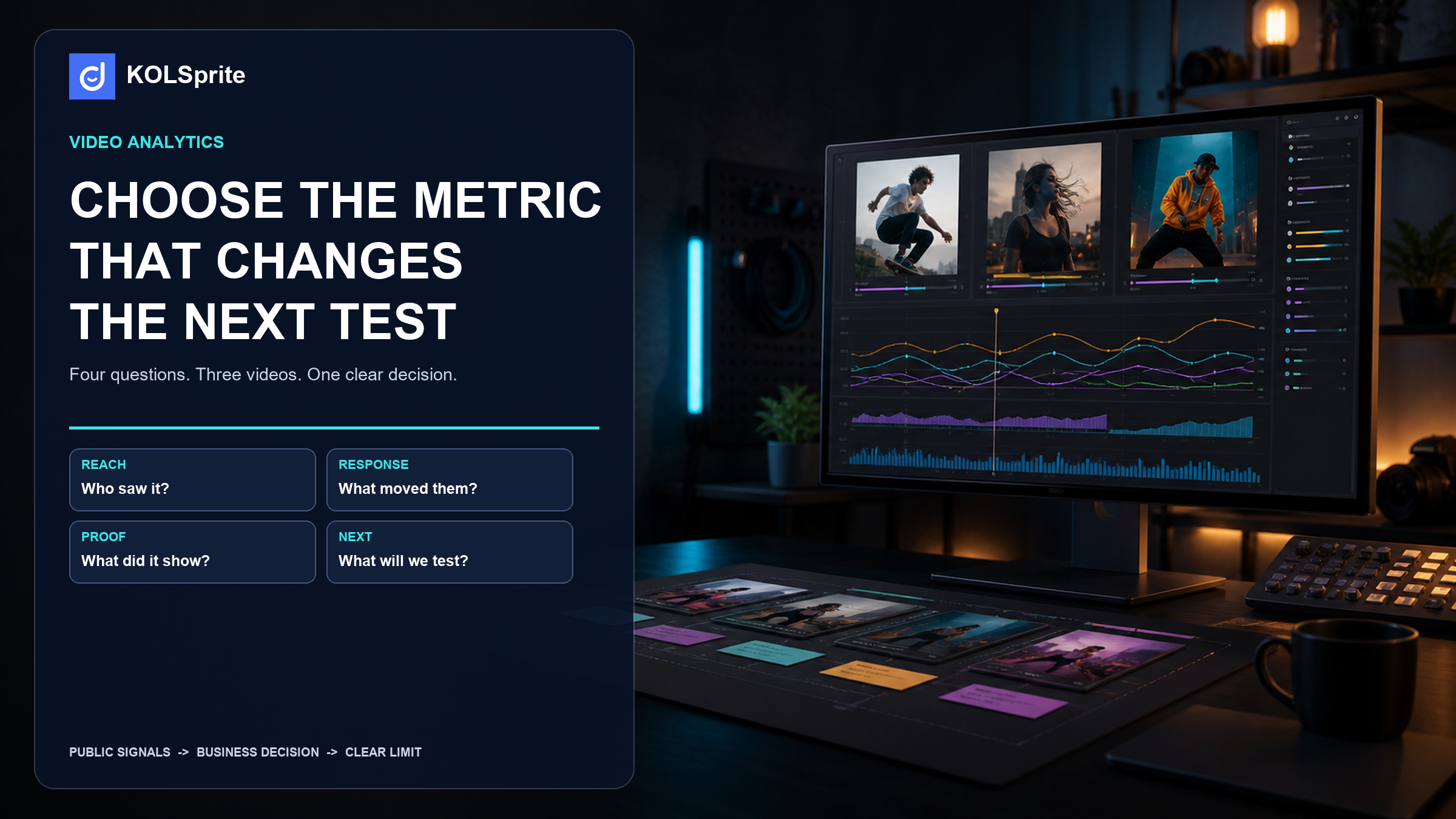
If you lead ecommerce content and have a review full of TikTok videos, the hard part is usually not finding a number. It is deciding which number deserves a change in the next brief. TikTok video analytics works when each metric answers one named question: reach, response, proof, or commerce. Views can tell you where to inspect. Comments can expose a buyer question. Product-linked sales can add useful context. None can prove that a hook caused revenue by itself. This field guide gives you a four-question metric map, a three-video comparison, and a next-test card so your team can leave a review with one controlled creative decision.
Start with the decision, not the dashboard. Use reach metrics to decide what deserves review, response signals to decide what people reacted to, proof signals to decide what claim or demonstration needs work, and first-party commerce data to decide where to spend or reinvite. Do not ask one public metric to answer all four questions.
A list sorted by views looks decisive because it has a winner at the top. It is often a poor creative brief. The highest-viewed video may have reached a broad audience without resolving a product objection. A lower-viewed video may have a comment pattern that reveals the exact proof buyers need before they act. A high-engagement post may entertain people who will never buy the product.
The key point is simple: a metric can be true and still be the wrong input for the decision in front of you. Put the decision in the first column of your report. Then let the metric earn its place.
Write one sentence for each question below. If the team cannot name the question, do not add another column to the review.
| Question | Useful signal | Decision it supports | What it cannot prove |
|---|---|---|---|
| Did this earn attention? | Views, impressions, view trend | Which videos deserve a closer look | Why people watched or whether the attention was qualified |
| Did people respond? | Comments, shares, saves, interaction rate | Which message, question, or format to inspect | Purchase intent or commercial impact |
| Did the product become believable? | Specific questions, objections, repeat comment themes, watched moments | What proof to add, move earlier, or clarify | That the claim is accurate, compliant, or enough to convert |
| Did it help the business? | Store, ad, affiliate, and margin records | Whether to fund, reuse, reinvite, or stop | That public video behavior caused the result |
The native platform can help teams compare selected ad creatives and examine key frames, audience information, and comment analysis in its Video Insights documentation. That is useful for paid creative decisions. Keep it separate from a public-market scan and from your store's own financial record.
Create a KOLSprite account and claim a three-day trial. Compare a small set of videos in context, record the proof each one offers, and leave with one test your team can actually run.
Register and claim a three-day trial
Here is a bounded example from a US, product-linked walking-pad video search reviewed on August 12, 2026. The point is not to crown a winner. It is to show why a team should not turn one metric into a universal rule.
Use this table as a short review, not a scorecard. Put the clips on screen and watch the first moments again. Then ask what each clip lets a buyer see, hear, or ask. A high view total may point to a strong opening. A high comment rate may point to a clear question. The next brief still needs one plain choice about what to test.
| Video | Views | Interaction rate | Product-linked 30-day sales | Better question |
|---|---|---|---|---|
| A | 2,000,000 | 0.81% | 326 | What made this reach so many people, and did the opening create broad curiosity? |
| B | 152,800 | 7.43% | 112 | Which response or demonstration gave a smaller audience a reason to interact? |
| C | 87,200 | 10.6% | 67 | Which proof element prompted stronger reaction, and is it transferable? |
Scope note: US product-linked walking-pad video records, May 1-August 12, 2026; 3,283 records returned, with the first ten reviewed for a directional comparison. Product-linked sales are observed search-result context, not complete attribution, margin, spend, return, or audience data. The sample does not establish causality or a market average.
Video A is a reach lead, not proof that it is your best sales creative. Video C is a response lead, not proof that a 10.6% interaction rate will travel to another product. The contrast changed the right next step from "copy the top video" to "separate the hook test from the demonstration test." That is a more useful interpretation because it creates two small experiments instead of one vague imitation task.
Put three videos side by side, not thirty. Give every reviewer the same short sequence:
TikTok's own guidance describes comparing creative performance across selected metrics and looking at key-frame behavior; it also notes that estimates can differ from summary metrics in some circumstances. That is a useful reminder to treat the screen as evidence for investigation, not a final explanation. See TikTok's Video Insights overview for the platform's comparison and analysis context.
Before you turn a strong example into a new brief, ask three questions. Is the buyer problem the same? Does the video show a real content move? Can the new test hold enough steady to teach you something? A tight-space comparison, timer, setup close-up, or answer to a noise question is a visible move. "It felt real" is not.
Under each video, note the opening, proof moment, creator role, buyer question, and missing business input. This turns a set of opinions into a record another editor can question. It also stops a good-looking edit from being mistaken for the reason a product sold.
When an example does not transfer, keep it as inspiration, not proof. A huge audience, deep discount, seasonal moment, or unsupported claim can make a video a poor direct model. "Do not copy" is a useful call. It saves the next test from a bad comparison.
This is the execution layer. Copy the card into the next review and do not move forward until every blank has an owner.
Decision: ____________________
Reach signal worth keeping: ____________________
Buyer question or proof gap: ____________________
One variable to test: opening / proof order / creator role / offer context
Keep stable: product, target buyer, landing path, and review windowSuccess evidence: ____________________
Business check: spend, orders, refunds, and margin owner ____________________
Next review date: ____________________
Notice that the card does not ask for a universal winner. It asks for a decision, an observed contrast, and a way to judge the next test fairly. That keeps TikTok video analytics from becoming a weekly slide deck that nobody can use.
Bring the three-video comparison, the metric you chose, and the next test you plan to run. The KOLSprite community can help you spot a weak inference before production starts.
 +
+
Join the KOLSprite Discord community
Use KOLSprite when the signal is scattered across public TikTok videos and creator pages. A content lead can search a relevant video set, compare visible content and creator context, narrow a set for closer review, and save the examples that support a brief. The output should be a small evidence set with a written reason for each selection, not a claim that the tool found the answer for you. Start the research step in KOLSprite video search.
The team still has to read the result. A public result can suggest two openings, proof steps, or creator approaches to compare. It cannot show private watch time, your ad spend, customer identity, returns, margin, or full credit for a sale. Those limits matter when someone wants to turn a visible trend into a budget call.
Metrics cost time when teams keep watching them after they cannot change a call. Add a stop rule. Stop using views once the team has picked three videos to inspect. Stop reading comments once you know the repeated question and the proof gap. Stop using public product-linked context when the spend or margin call needs store records you do not have. Waiting for the right business input is often better than gathering more public numbers.
A stop rule also helps with noisy results. Do not rewrite a brief every time one post moves. Review a set of similar posts at a set point. This makes the team less likely to chase a short spike. You cannot make TikTok predictable. You can make your response to doubt consistent.
Say the test out loud at the end of the meeting. "We will show this proof step in the first ten seconds, then check this buyer question on Friday." If that plan takes more than two short lines, the test is too wide. Cut the list. Keep one change, one owner, and one date. Add a note when the facts do not fit. That note is not a loss. It stops a weak guess from driving the next batch. In a fast team, this small pause can save time, budget, and a lot of back and forth.
Ranking by views alone: use views to open a review, not to close a creative decision. Treating comments as votes: read for questions and objections, then validate claims before using them. Calling product-linked sales ROI: pair the content context with first-party cost and finance data. Changing five things at once: a new hook, creator, offer, edit, and audience produce a story, not a useful test.
One more failure is softer but common: writing "make it more authentic" in the brief. Replace it with a visible proof task. Ask for a side-by-side size comparison, a setup sequence, a durability demonstration, or an answer to a named buyer question. A creator can make that instruction their own; the team can still review whether the proof appeared.
Your next content meeting needs one sentence: "We will test this proof sequence with this buyer question because these three videos showed a meaningful contrast." Keep the source links, public signals, and first-party business check beside that sentence. Then assign the owner and review date.
That is the practical value of TikTok video analytics: not more metrics, but a smaller number of defensible creative choices. The data can point to a question. Your controlled test and business records decide what to do next.
Keep the decision connected. Use the related KOLSprite operating guide to frame the wider workflow. Open the supporting research guide when the next question needs a deeper evidence check, then continue with this next-step KOLSprite guide when the team is ready to turn the record into action.
Latest Articles
As an essential, data-driven toolkit for TikTok influencers and marketers, KOLSprite provides powerful features for effortless creator discovery, trending content identification, and actionable real-time insights.
It empowers users to make smarter decisions and significantly boosts their TikTok business.

 Refer & Earn