 +
+
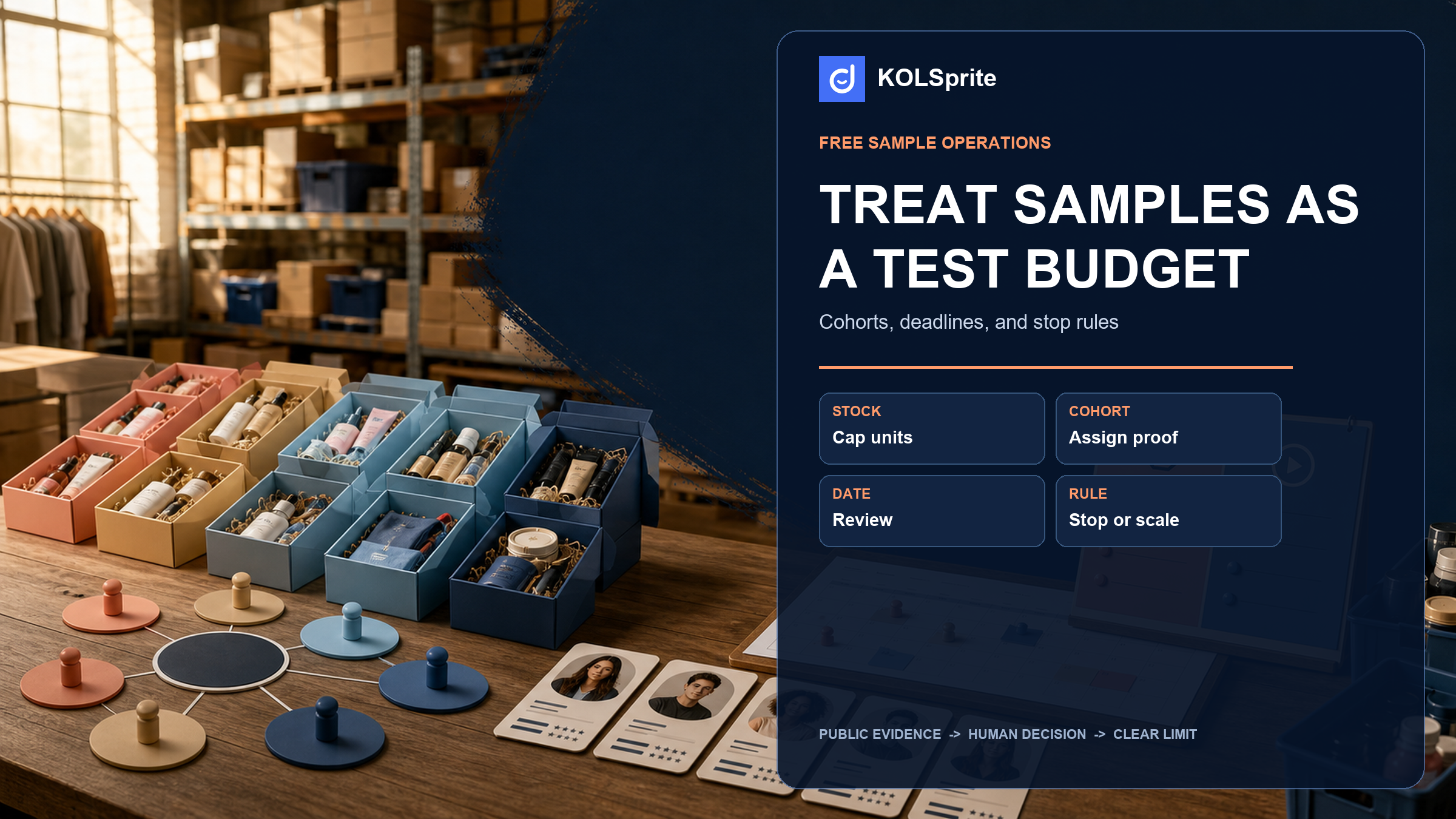
A free sample is free to the creator, not to the seller. The unit, shipping, fulfillment time, support, and lost sellable stock all come out of your budget. TikTok Shop free samples make sense when each cohort answers a product or content question that changes the next allocation. This guide gives seller operations and creator teams a practical worksheet for setting the budget, assigning proof tasks, reviewing the work, and deciding whether the next group gets more units, fewer units, or none.
Ten-second answer: approve samples in small cohorts. Give each cohort one learning question, one proof task, a true per-unit cost, a review date, and a stop rule. Do not open the next cohort until the current one produces a written inventory decision.
The creator does not pay for a free sample, but the seller still does. The cost includes the item, packing, shipping, support, stock risk, and review time. That spend is useful when it answers a clear question. It is wasteful when requests pile up and no one knows which creator or proof task helped.
Start with the true unit cost: product, packing, shipping, expected loss, and staff time. Next, name the decision the sample should improve. It might help you learn whether creators can show a setup step, whether buyers understand a product benefit, whether a certain creator group produces usable demonstrations, or whether a price objection dominates the comments.
Current TikTok Shop campaign and sample guidance should control the platform setup. Conditions can differ by market, program, and campaign type. This article is an operating plan for the seller's own inventory and review process. It does not replace Seller Center settings, require a creator to post, or guarantee sales.
Use a fixed learning budget, not an open-ended request count. For a first cohort, choose a quantity that you can review properly. Ten well-defined samples often teach more than 50 scattered units because the team can compare the work against the same brief.
| Worksheet field | Example question | Decision use |
|---|---|---|
| Unit cost | What does one approved sample really cost the seller? | Sets the maximum learning spend. |
| Proof task | What should the creator make visible or explain? | Keeps the content review focused. |
| Creator cohort | Which audience or format is this group testing? | Prevents mixed results from being compared as one test. |
| Review date | When will the team check public posts and outcomes? | Creates an actual decision point. |
| Stop or continue rule | What result changes the next allocation? | Stops inventory from drifting into habit. |
The budget does not need complex math. A simple rule works: no new cohort until the last cohort has a review note. That one constraint forces the team to learn before it spends more. It also gives finance and operations a clear answer when they ask why sample stock is reserved.
Do not put every approved creator in the same bucket. A product may need different types of proof. A kitchen tool may need a speed demonstration, a cleanup step, and a small-space use case. A skincare product may need an application explanation and a clear claim boundary. A storage item may need a before-and-after view in a real setting. When those jobs are mixed, a weak result tells you very little.
Create small cohorts with one shared task. You can have a "demonstration" cohort, an "objection" cohort, and a "buyer setting" cohort. The creators do not need identical audiences. They need a common question that the team can review. This makes it easier to see whether the product, the message, or the creator selection caused the gap.
Use creators who can show the product working from start to finish. Review whether the key action is visible without a claim the item cannot support.
Use creators who are good at answering the buyer question that blocks purchase. Review comment quality, not only views.
Use creators whose routines make the buyer context obvious. Review whether the setting changes the product story.
Use a three-day KOLSprite trial to review how creators demonstrate similar products, what buyers ask in comments, and which formats match your proof task. Use that public context to improve the cohort plan, then keep sample cost, stock status, campaign settings, and posting obligations in your own operating record.
Register and claim a three-day trial
Sample campaigns fail quietly when nobody owns the review. Set a date before the first unit leaves the warehouse. At that review, look at what is publicly available and what your seller-side records show. Do not ask one metric to answer every question.
For a content question, review whether the creator completed the proof task, whether the product was visible, and whether the message was clear. For an audience question, review the themes in comments and the questions people repeat. For a creator-fit question, review whether the format felt natural for that creator. Sales or affiliate data may matter, but they should be read with price, timing, product availability, and campaign context in mind.
KOLSprite can support the public side of that review. Use it to keep creator profiles, videos, scripts, and comment patterns close to the decision. A saved record should say what the cohort was testing and what the team learned. KOLSprite does not ship inventory, enforce a post, replace Seller Center status, or attribute every sale to one video.
People are more generous with sample stock after one exciting video. A prewritten stop rule prevents a single outlier from becoming a reason to approve everything. Examples include: pause when fewer than half of a cohort can complete the proof task; stop when the product needs a claim you cannot approve; reduce the next cohort when the same buyer objection repeats without a usable answer; or continue only when the creator format produces clear content that the team can learn from.
There is no universal threshold. Your rule should match the product and goal. The important part is that the rule exists before the outcome. This makes the partnership manager's decision easier to explain and helps prevent a sample program from turning into an unmanaged giveaway.
Share the unit cost, cohort task, review date, and rule for sending the next ten units. Other operators in the KOLSprite community can help you tell whether the program is buying useful learning or simply rewarding activity.
 +
+
Join the KOLSprite Discord community
Sample requests can become political when the approval rule lives only in one manager's head. Put the rule in a shared campaign note. It should state the product, the maximum units, the creator cohort, the proof task, the approval owner, and the review date. When a request falls outside the cohort, the team can decline it without making a personal judgment about the creator.
A visible rule also helps customer support and fulfillment. They can see whether a request belongs to an active campaign and where to route exceptions. The goal is not to make the program rigid. It is to make exceptions deliberate. If a creator is unusually strong but does not fit the current cell, record why the team made an exception and what it expects to learn.
One post may get more views because of timing, an existing audience, or a format that has little to do with the product. Before you read volume, check whether the post completed the assigned proof task. Was the product shown in the correct setting? Were key steps visible? Did the creator make a claim that needs a correction? Did comments reveal a question that should change the next brief?
These notes create a better basis for reinvites. A creator who produces a clean, credible demonstration may deserve a second task even if the first post had modest reach. A creator with a high-view post but no usable product explanation may belong in a different cohort or no further cohort at all. This is not a rule against reach. It is a way to keep learning aligned with the reason you spent the sample unit.
At the review date, decide what happens to the next ten units. You can repeat the cohort, change the proof task, change the creator mix, reduce the count, or stop. Put the choice in the record with one supporting reason and one unresolved question. That creates a simple operating history. It also gives inventory planning a forecast of intent instead of an endless stream of creator requests.
When you later compare cohorts, do not pretend they were a controlled scientific trial. Creators, timing, offers, and stock can all differ. Use the record to spot practical patterns and decide what to test next, not to make claims that the sample program cannot support.
A basic cohort label makes later review much easier. Use a short code for the campaign, product, creator group, and review week. Put the same code in the sample record and the content note. You do not need complex attribution to benefit from this. The identifier simply lets the team see which question each unit was meant to answer when the next allocation is discussed.
After the review, write three lines: what was tested, what was observed, and what changes next. For example: "We sent eight units to small-kitchen creators to test a quick cleanup demonstration. Five posts showed the setup clearly, but comments repeatedly asked about battery life, which the brief did not address. The next cohort will use creators who can show one full use cycle and will not increase unit count until that question is answered."
This note is more useful than a broad summary such as "samples performed well." It tells a future owner what evidence exists and what remains unresolved. It also helps you decide whether to reinvite a creator, assign a new proof task, change the product brief, or stop the campaign.
Connect the record to the affiliate program system, build better candidates with the Affiliate Center shortlist, and keep the outcome in your campaign tracking decisions. When you need another small cohort, use KOLSprite creator research to find people who can complete the next proof task.
The final record can be simple. List the units sent, the real cost, the proof task, and the review date. Add one line on what worked and one line on what did not. Then state the next move. This gives finance, inventory, and creator teams the same answer. It also makes a stop decision fair. The team is not guessing about a creator. It is judging whether the test produced useful proof for the next batch.
TikTok Shop free samples are most valuable when they buy learning, not when they simply increase outreach activity. Protect the inventory, give each cohort a job, and use the review to make the next unit more intentional than the last.
Official source: See auto-approved free-sample campaigns for the current platform guidance used in this workflow. Recheck the source before acting because platform rules and interfaces can change.
Latest Articles
As an essential, data-driven toolkit for TikTok influencers and marketers, KOLSprite provides powerful features for effortless creator discovery, trending content identification, and actionable real-time insights.
It empowers users to make smarter decisions and significantly boosts their TikTok business.

 Refer & Earn