 +
+
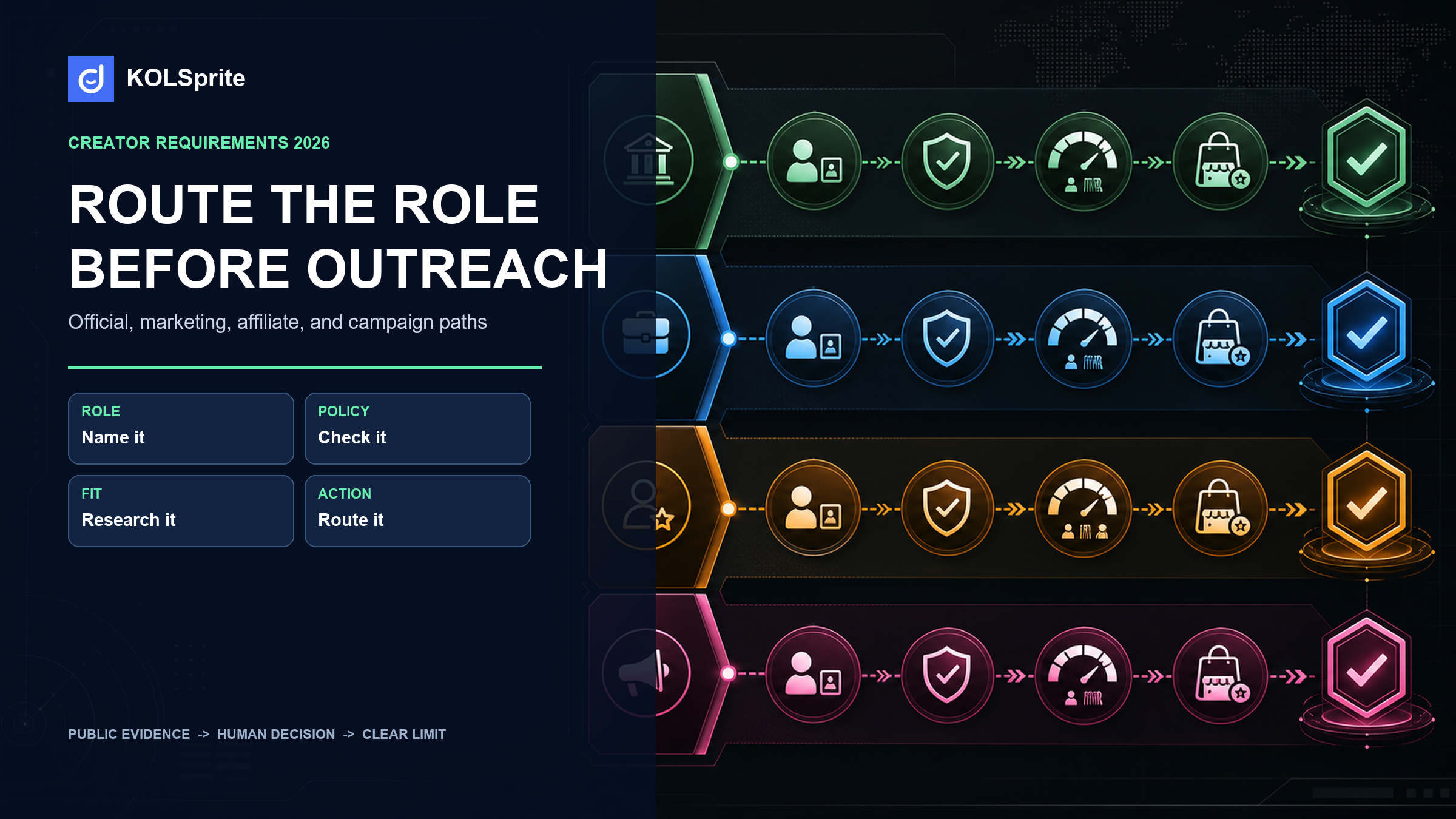
If your team keeps finding different answers about who can join a TikTok Shop campaign, the problem may be the question. TikTok Shop creator requirements vary by role, program, market, and current account status. There is no single follower-count rule that settles every case. Before you shortlist, invite, bind, or ship a sample, identify the relationship you want and verify that path in TikTok. This guide gives seller teams a four-lane routing map and a pre-invite record they can hand from operations to creator marketing.
Ten-second answer: name the intended path first: Official, Marketing, Affiliate, or a specific campaign. Verify current eligibility and account status in TikTok for that market. Only then use public content research to decide whether the creator is a good fit for the work.
Use this order: name the path. Check the rule. Review the work. Set the next step. If one part is not clear, stop there. Do not let a strong profile stand in for a policy check. Do not let a policy check stand in for product fit.
Search results often compress several creator roles into one sentence. One post may cite a follower minimum. Another may discuss sample access. A third may describe a Showcase feature. The claims may refer to different programs, markets, dates, or account states. A seller who treats them as one rule can promise access that the platform has not granted.
Official TikTok Shop policy and Seller Center guidance are the source of truth for current requirements. Those sources can change as programs, markets, and enforcement change. This article explains an operating method, not a replacement for the policy page. If a creator's current status affects a campaign, verify it where TikTok exposes it at the time you act.
Two decisions need to stay apart. First, can this account use the planned path today? Second, should your team work with this creator after reviewing public content and product demos? KOLSprite can help with the second choice. It cannot grant access, change a platform rule, or see private account status.
| Lane | What the seller is trying to do | What to verify in TikTok | What to research publicly |
|---|---|---|---|
| Official | Connect a creator identity to a seller or brand operation. | Current account role, binding process, and applicable policy. | Whether the creator's content and audience match the brand job. |
| Marketing | Use a creator account for promotional content or campaign work. | Program terms, permissions, and current campaign conditions. | Format quality, claim discipline, and past product demonstrations. |
| Affiliate | Invite or work with a creator who may promote listed products. | Affiliate availability, current eligibility, and campaign rules. | Product category fit, buyer questions, and collaboration readiness. |
| Campaign-specific | Run samples, open collaboration, target collaboration, or another defined campaign. | Campaign rules, market, stock, dates, and creator-side status. | Whether the creator can complete the proof task before you commit inventory. |
The table does not assign a single universal minimum. It shows where the answer belongs. When a teammate asks, "Can this creator join?" ask a second question: "Join what, in which market, under which current program?" That check prevents many false assumptions.
The goal should be clear before anyone opens a search tool. Do you need a creator for a Showcase? Do you plan an affiliate invite? Is this a paid campaign with a clear brief? Or do you only want to learn who talks about the category? Each goal has a different check.
For example, a seller may find a creator whose kitchen organization content is excellent. That public fit does not tell you whether the account can join the exact sample campaign you plan to run. It tells you the person may be worth reviewing after eligibility. The order matters because it keeps the outreach message honest. You can say, "We think your content may fit this product," without implying that you know their private platform status.
The current Creator Eligibility Policy, Seller Center, and campaign guidance should verify the role. Document the date, market, and screen where the decision was made. A copied social post or an old blog is not enough for a policy decision.
Once the account path is verified, use a three-day KOLSprite trial to review recent videos, product settings, scripts, and comment context. Save one fit reason and one concern for each creator. KOLSprite supports that public-fit review; TikTok remains the source of truth for eligibility.
Register and claim a three-day trial
This order lets the partnership lead work quickly without crossing boundaries. Public evidence helps you decide whether a creator deserves attention. Platform verification tells you whether the intended path is available. Both are necessary, and they should not be blended into a single score.
Once the route is clear, ask a narrow research question. Do not ask whether the creator is "good." Ask whether they can do the work your product needs. A travel organizer may need a clear packing demo. A cleaning product may need a before-and-after test. A beauty item may need plain use steps and careful claims.
KOLSprite can help you look at public creator, video, script, and comment context while the team is on TikTok. Save a short set of examples with a stated reason. When a creator enters the shortlist, add one fit note and one concern. The concern might be a weak product category match, inconsistent disclosure language, or a format that does not give enough time for a demonstration. This creates a usable handoff for the person who sends the invitation.
Simple handoff: "Eligible route verified in Seller Center on [date]. Public fit: three recent small-space organization videos use the same before-and-after format our product needs. Concern: no prior travel category content. Next action: invite for a one-product test with a clear packing proof task."
Follower counts can be useful for campaign planning, but they do not settle every eligibility question. They also do not establish content fit. A creator with a large audience may not show the product job well. A smaller creator may make clearer demonstrations and draw more relevant questions. Treat audience size as one planning input after you know the role, rules, and proof task.
When a requirement is unclear, pause rather than invent an answer. Ask TikTok's current documentation, Seller Center support, or the campaign configuration. A short delay is cheaper than sending a promise a creator cannot use. This is especially important when samples, commissions, or access are involved.
Share the market, intended creator path, official source checked, and the public-fit question. The KOLSprite community can help you spot where an eligibility assumption has slipped into a creative decision, or where a strong profile is being treated as proof of access.
 +
+
Join the KOLSprite Discord community
Eligibility work should leave a small audit trail. Record the market, intended program, policy page, check date, account action, and outcome. Do not write "eligible forever." Program conditions and account states can change. Write, "This route was checked for this campaign on this date."
This snapshot helps when a creator asks a reasonable question later. The partnership manager can show what was verified and identify the official place where the creator can confirm their own status. It also protects the team from copying an old rule into a new market or campaign. A policy note should make a future check faster, not encourage people to skip it.
An invitation should describe the opportunity, not promise eligibility. Name the product and the content task. Then name the campaign path and the next action inside TikTok or your agreed workflow. Avoid saying "you qualify" before the seller confirms that condition in the right platform screen.
A clear invitation is also better for creators. They can see whether the product fits their audience and whether the requested work is realistic. If the campaign involves samples, state the review process and any conditions that matter. If it involves a paid brief, state the deliverable and the approval path. The more precise the task, the less likely the team is to create a false expectation.
Access risk asks whether the intended path is currently available. Creator-fit risk asks whether a creator can make the product understandable to the right buyer. They need different evidence and different owners. A creator can pass one and fail the other. This is why routing early is useful: it keeps a platform check from being confused with a creative judgment.
At the end of a review, use two clear labels. For access, write verified, needs verification, or unavailable. For fit, write strong, possible, or weak, with one reason. The labels are modest, but they make a creator list far easier to operate than a single confidence score.
The selected lane belongs at the top of the campaign brief, beside the market and review date. That gives the creator manager, seller operator, and content reviewer the same starting point. When the campaign changes, repeat the policy check rather than carrying an old answer forward. This is a small step, but it avoids mixed messages when outreach is handed between teams.
The result should be easy to read. Use a short line for each creator. For example: "Affiliate path: needs a current TikTok check. Public fit: strong for small-space storage. Next step: verify the campaign route, then send one clear product ask." This is easy for a new team member to follow.
A long note should not hide the status. Put the unknown part first. Then state the fit. Then name the owner. This does not replace a policy check. It makes the check visible. It also stops a list from looking ready when it is not.
A ten-minute team review is enough. Read the route. Read the public-fit note. Read the next action. If a person cannot explain all three, keep the creator in review. If the route is clear and the task fits, move the record forward. The goal is not to rate people. The goal is to send a clear, fair request.
Each row should stay short. Name the creator. Name the lane. Add the date. Add the fit note. Add one risk. Add the next step. Each part has a job. The lane tells the team where to check. The date tells the team when to check again. The fit note tells the team why the work may suit the creator.
Plain labels work best. Say "check in TikTok" when the state is not known. Say "ready for public review" when the route is clear but the content work is not done. Say "do not invite yet" when a key fact is missing. These phrases are plain. They stop a record from sounding more certain than it is.
A short row is also kind to the creator. It helps the team make a direct ask. It avoids a message that sounds like a form letter. The person sending the invite can see the product job, the content idea, and the open question. That makes the first contact more useful for both sides.
Store the routing table with the campaign brief. Each creator record should include the intended lane, verification date, policy source, public-fit note, proof task, and next action. This makes it easier to audit a campaign later. It also helps when one seller team hands a creator list to another person.
Use the affiliate program system to understand the seller-side sequence, then build the public-fit list with the Affiliate Center shortlist. If the work becomes a broader partnership motion, the creator marketplace research workflow provides the next context. When you need to inspect public fit, use KOLSprite creator research only after the role is clear.
TikTok Shop creator requirements are easier to manage when the team routes first and researches second. That sequence keeps your campaign honest, your outreach clear, and your creator shortlist focused on work that can actually happen.
Official source: See TikTok Shop Creator Eligibility Policy for the current platform guidance used in this workflow. Recheck the source before acting because platform rules and interfaces can change.
Latest Articles
As an essential, data-driven toolkit for TikTok influencers and marketers, KOLSprite provides powerful features for effortless creator discovery, trending content identification, and actionable real-time insights.
It empowers users to make smarter decisions and significantly boosts their TikTok business.
 Refer & Earn