 +
+
Your product clip reaches followers, yet you cannot find it under the phrase a buyer would search. Before you rewrite everything, search that exact phrase yourself. Look at the clips TikTok shows and ask what each one helps a shopper understand. That gives a US ecommerce content lead a fair first decision: make one clip answer the query more clearly, or investigate an issue outside the clip. It does not reveal a ranking formula. The payoff is a one-query evidence memo and a specific revision your team can judge, without pretending to know why a result appeared in a certain slot.
Treat search visibility as a relevance problem you can inspect, then as a measurement problem you must keep honest. A result page tells you what appeared, not why it won.
Teams often use “the algorithm” as a catchall for a missing search result, a weak For You showing, or a slow post. That language hides the decision. A discussion of the TikTok search algorithm should start with a person's query, while the For You feed starts with a recommendation surface. TikTok's public explanation of recommendations describes different factors that can affect recommendations across its surfaces. It does not hand a seller a set of search weights or a recipe that secures a position for a product video.
For a search problem, write the buyer's phrase before discussing the feed. “Portable fan” is broad. A shopper who wants to see how a fan fits on a desk has a more specific question. A clip that shows the fan in use may answer that question better than one that only shows its packaging. That is an editorial judgment about the visible clip, not a claim about how TikTok scores it. Your team can improve the answer in the content it controls; it cannot inspect another viewer's personalized results or TikTok's private ranking logic.
Keep the two questions separate in reporting. “Did this post get distribution?” asks about reach across surfaces. “Does this clip plainly answer the phrase we searched?” asks about relevance to a visible query. A follower seeing a post does not prove that a searcher should see it for a chosen phrase. Nor does your own search screen represent every buyer's screen. The useful comparison is between the promise of the phrase and the proof in the clip.
A buyer types words because they need to make a judgment. What size is the item? How does it work? Will it suit a particular use? Rather than guess at the TikTok search algorithm, sellers can test the answer a clip gives: name the question implied by the phrase, then watch each clip as if you had no knowledge of the product. Can you see the answer, or must you infer it from a caption or a quick cut?
Use the same phrase each time you compare results. Capture the date, market, and wording in your memo. Record a short description of what the visible clips demonstrate: the product in a setting, an action, a close view of a feature, or a result of using it. Avoid a column called “ranking reason.” Nothing on a public result page can fill that column reliably. If you search a second phrase, treat it as a new question rather than merging both sets into a story about universal winners.
The first useful output is a gap statement. For example: “Our clip names the fan, but the buyer's phrase asks how it works on a desk. The first seconds show a box, so the use is hard to judge.” That statement points to a revision. It also tells a reviewer what they can check in the new cut. A claim such as “TikTok prefers desk demos” would go beyond the observation. A better editorial question is whether a desk demo answers this particular buyer more plainly.
For help turning a phrase into a proof question, map the buyer's phrase to a proof point before choosing footage. That keeps copy and visuals tied to the same shopper need.
Use KOLSprite to compare visible product videos, then test one clearer answer in your own content. It cannot reveal a private ranking formula. Use desktop Chrome. On a phone, open this article on your computer to install the extension.
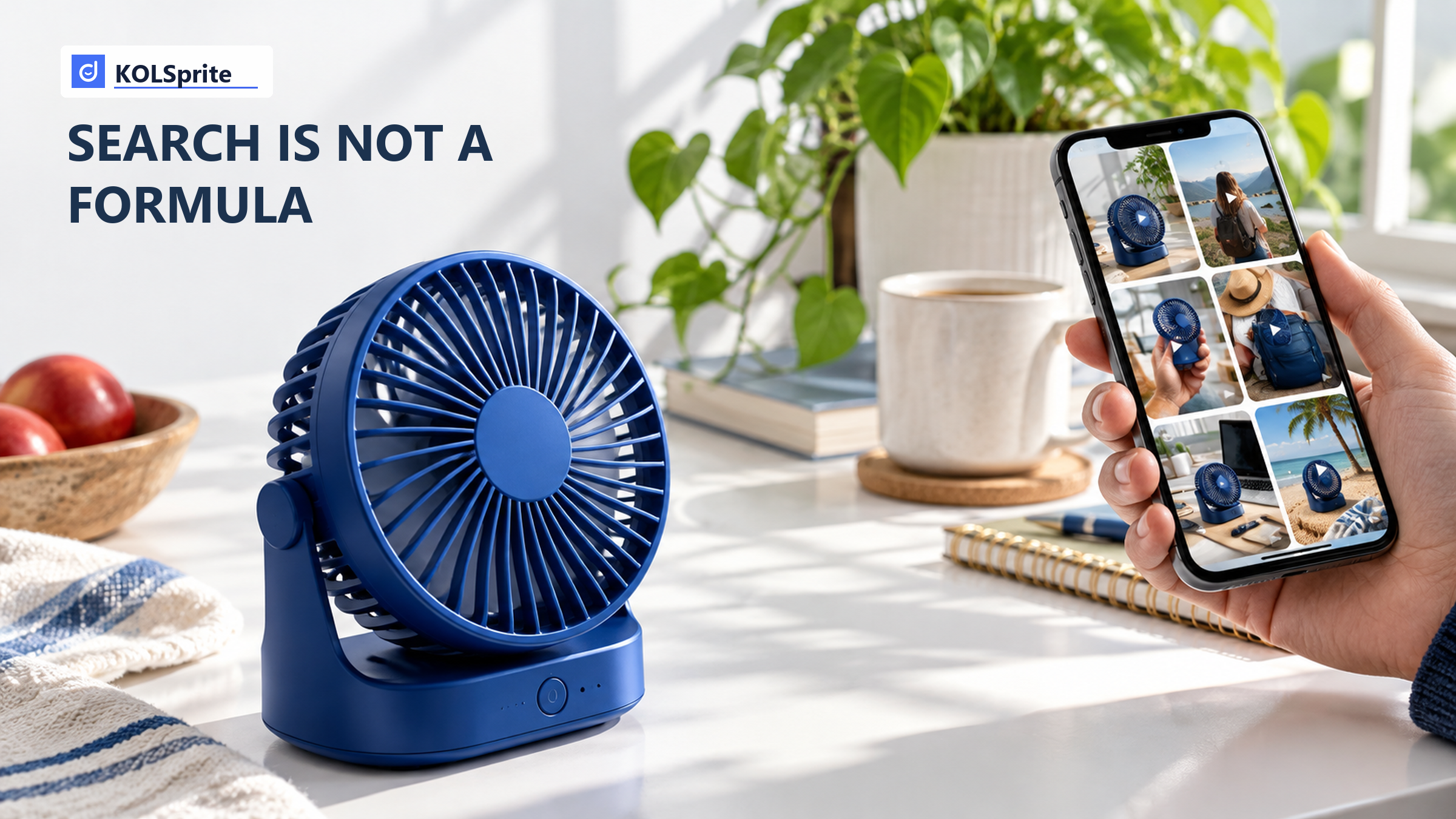
A bounded US KOLSprite search for public portable-fan product videos on October 10, 2026 returned five clips. The clips differed in visible content and public engagement totals. That is enough to make a comparison exercise real: a seller can inspect how different clips present the product under one search. It is not enough to explain the order, estimate category demand, or tell whether any given account earns search traffic. One request is a snapshot of visible examples.
One US portable-fan product-video query returned five varied public clips. Compare what each clip makes visible to a buyer; do not treat their order or engagement totals as ranking evidence.
Source: KOLSprite public video search, accessed October 10, 2026. This small sample supports clip-level observation only; it cannot explain TikTok's ordering.
Notice what the sample does not require you to do. You need not crown one format as “the algorithm's favorite.” You can describe a visible difference and decide which treatment is more useful for your buyer's phrase. A close view of a control may help someone comparing settings. A use shot may help someone judging fit in a room. Each is a hypothesis about buyer clarity. Neither becomes a platform rule because it appeared among five results.
If a stakeholder asks why a competitor appeared above you, give the narrow answer: your search showed that result at that moment, and the public view does not disclose the cause. You can still point to something actionable. If the competitor's clip shows the very action named in the query while yours waits until the end, the team can revise the opening. If both clips address the question well, stop blaming phrasing alone and look at the next plausible issue through your own available account evidence.
KOLSprite can support the observation step on supported public video and search surfaces. For this task, the input is one US public portable-fan product query; the action is to inspect a small public set and compare visible answers; the output is five scoped clip references with content differences. It does not supply private ranking factors or a causal diagnosis. See how a seller reviews public video examples if you need a repeatable way to look at clips before the edit meeting.
Choose a single clip to revise. Start with the query's implied buyer question. If the phrase asks whether a portable fan works on a desk, the clip should show that use early enough to be understood without a sales pitch. The description can name the product and the use in plain language. On-screen words can help orient the viewer, but they should not carry a claim the footage fails to show. A caption that promises a quiet room, for instance, would need support beyond a silent product shot. Do not add claims merely because another clip uses them.
Write down what changes and what stays fixed. The opening shot might change from a package view to a desk-use view. The description might move from a broad product name to the buyer's use phrase. If you change both, record both. Do not later credit one element alone. Keep the offer, product, and audience context as stable as your normal workflow allows, and mark anything you cannot hold steady. The aim is a disciplined content test, not a lab experiment.
Before publishing, ask someone unfamiliar with the product to watch without explanation. Give them the phrase and ask what the clip answered. If they cannot identify the use, fix the footage or copy first. If they can, the team has at least improved the clip's clarity. That is a result you can verify directly, even if search placement does not change. A content lead needs this distinction when reporting to a manager who expects one edit to “fix the algorithm.”
The one-query memo can stay short. Include the phrase and date, a sentence on what the visible results answered, a sentence on the gap in your clip, and one proposed revision. Add the limit beside the observation: this was a public snapshot, not an account-level search report. That memo makes the edit review concrete. It also prevents a later meeting from turning a small sample into a claim about all product searches.
Once the team has chosen the proof to show, turn one search observation into a more useful product clip. Choose a format only after the buyer's question is clear.
Bring the buyer phrase and one clip to the seller community; keep the platform limits in view.
 +
+
Suppose a revised clip says “portable fan for desk use” and shows a desk setup right away. You search the phrase again and still do not see it. That outcome does not prove the revision was wrong. It also does not justify a second round of keyword stuffing. A public search result can vary by person and context, while the platform's exact ordering is private. One before-and-after search cannot isolate the cause of a missing result.
Look at what the team can actually observe next. Is the revised clip live and viewable? Does the post description match the item shown? Does your own account reporting show any search-related discovery, if that information is available to you? Are you checking the same phrase and market at comparable times? These are investigation prompts, not promises that a seller dashboard will explain every search impression. Write down which checks are possible in your account and which are not.
If the clip itself remains vague after the revision, another content pass is fair. If the clip clearly answers the phrase but public placement remains absent, mark the content hypothesis as unconfirmed. The team may choose to test a different buyer question, review its distribution evidence, or leave the clip alone until there is more information. That is a more useful decision than inventing a hidden penalty or a guaranteed fix.
A high public engagement total is another tempting shortcut. It may tell you that a clip attracted visible activity; it does not tell you why it appeared for your phrase, who watched it, or whether it sold the item. Use such a clip to inspect its answer to a buyer question. Do not treat its total as a transferable target for your next post.
Give the memo a title that names the exact query, not “TikTok algorithm findings.” Under it, state the buyer decision in a sentence: “Can someone see how this item fits a desk?” Then note the public clips that appeared in the bounded check and the answer each visibly offered. This can be done in plain prose. The important part is that another editor can revisit the same observation without relying on a vague memory of the result page.
Add your own clip to the comparison. Describe its first clear product shot, its stated use, and any proof the viewer can see. If the description asks the viewer to believe something the video never demonstrates, call that out. Decide on one change with a reviewable acceptance point: “The first visible use shot shows the fan operating beside a laptop, and the description names desk use.” This is an editorial acceptance point, not a forecast of placement.
Leave a short line for the outcome after publication. It can record whether the new clip is clearer to a human reviewer and what public or account-level signals the team actually has. Keep observations and interpretation in separate sentences. If you later see the clip in search, report where and when you saw it; do not convert that sighting into a claim that the edit caused it. If you do not see it, report that fact with the same care.
The best result of this exercise is a team that can distinguish a weak answer from an unknown distribution cause. The former calls for a content edit. The latter calls for more evidence or a different test. That distinction saves the next clip from carrying a stack of speculative “algorithm fixes” that may make the buyer's question harder to answer.
Stop when the clip plainly answers the chosen phrase and another edit would only add repeated keywords or claims. At that point, the search-facing content has done the job the team can verify. You can keep watching the available signals, but the public result set cannot tell you whether more copy will change placement. Rewriting a clear description every time a personal search looks different makes the test impossible to read.
Move the next content decision to a distinct buyer question. A person asking about desk use may need a different view from someone asking about travel size. Each question gives the editor a new proof job and a reason to choose different footage. Record it as a separate test. The useful unit of work is a clip that makes one purchase judgment easier, not a clip packed with every possible query term.
Keep the final memo close to the footage. Its last line should say what the team will show next and what it will check afterward. “Show the fan working in the desk setting in the opening shot; ask a reviewer whether that answers the phrase” is a decision you can act on today. Whether TikTok later places that clip for every searcher remains outside what this public comparison can establish.
Latest Articles

As an essential, data-driven toolkit for TikTok influencers and marketers, KOLSprite provides powerful features for effortless creator discovery, trending content identification, and actionable real-time insights.
It empowers users to make smarter decisions and significantly boosts their TikTok business.

 Refer & Earn