 +
+
TikTok video search becomes useful for ecommerce when the query reflects a buyer question. Searching only a product name often gives you a crowded mix of entertainment, reviews, ads, and unrelated products. This guide shows Amazon sellers, Shopify teams, and creative researchers how to search in layers, compare the result set, and save only videos that answer a business decision. You will get a query ladder, a result-quality scorecard, and a portable-blender example that separates broad reach from useful proof.
Begin with the category language. Then narrow the search by buyer job, proof, objection, or use condition. Keep product-linked and non-product videos in separate groups. Judge each result by relevance, visible proof, creator context, date, and next action. A popular clip shows distribution. It does not prove that the product or message will work for you.
A query such as “portable blender” names the object but not the decision. One viewer wants a smoothie at the gym. Another wants an easy breakfast at work. A third cares about frozen fruit, leaks, cleaning, battery life, or cup-holder fit. The same product phrase can hide several jobs.
That is why a result grid can look rich while giving the team little direction. The videos may feature different models, prices, countries, dates, and claims. Before saving anything, decide whether you are finding a product opportunity, a proof format, a creator, an objection, or an opening line. One search session should have one main job.
TikTok's own Discover and search guidance explains how people can search content, creators, sounds, and hashtags. A seller needs one extra layer. The team must turn that browsing result into a product or content choice with a clear source and limit.
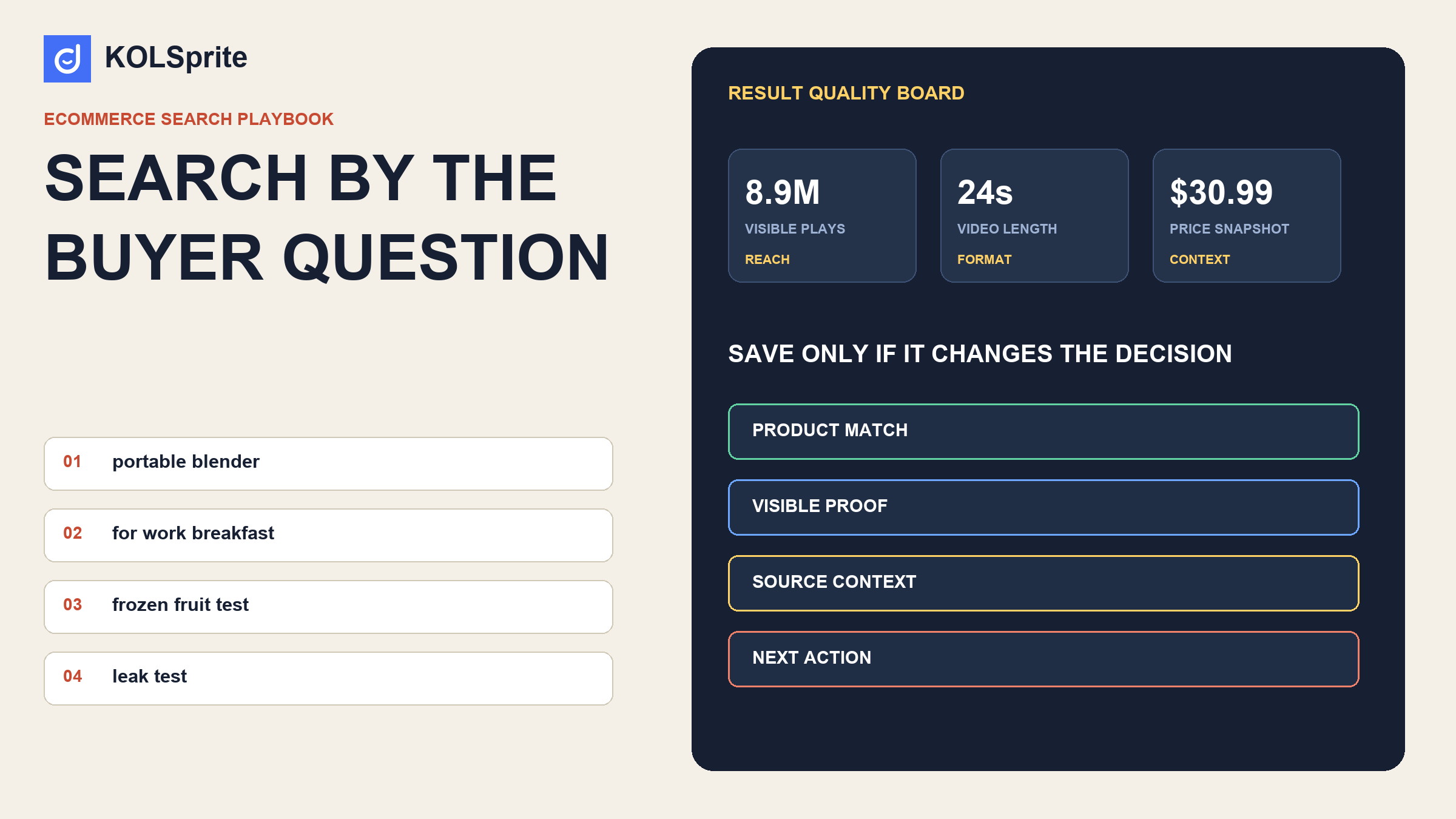
The first query shows category language. The second shows situations. The third asks the camera to prove something. The fourth reveals friction. Do not expect each rung to have the same volume. A narrow query is valuable when it produces a clearer decision, even if it returns fewer clips.
| Signal | Pass | Hold | Reject |
|---|---|---|---|
| Product match | Exact model or mechanism is visible. | Adjacent product may teach a format. | Keyword appears but product is unrelated. |
| Proof | Important action and result are shown. | Result is claimed but partly hidden. | Only reaction, price, or packaging appears. |
| Context | Use case, date, creator, and product link are clear. | One field is missing. | Source cannot be checked. |
| Transfer | Your product can run a similar test honestly. | Needs a sample or claim check. | Depends on another brand’s asset or unsupported claim. |
KOLSprite brings product-linked video search, sorting, and related research into one workflow. Register to claim a three-day trial membership.
Start a three-day KOLSprite trial
We ran two scoped KOLSprite MCP searches in the US market: “portable blender” and “portable blender review.” The broad query returned thousands of records. The first result set included short demonstrations, routine-led videos, product comparisons, and long keyword-heavy captions. Visible plays ranged from a few hundred to 8.9 million in the records reviewed.
The largest example was a 24-second product-linked clip with 8.9 million visible plays, 186,700 likes, 2,180 comments, and 22,400 shares in the accessed record. It linked to a blender priced at $30.99 at access time. Another 19-second clip showed 7.3 million plays and linked to a $109.97 tumbler blender. Those figures show distribution and commercial context. They do not tell us whether the clips answer a buyer’s cleaning, leak, or frozen-fruit question.
The review query included a 44-second comparison video and several long captions that repeated many search phrases. One low-view record used a very long, generic product description instead of a focused demonstration. That contrast is useful. Search relevance must be judged from the product and visible content, not from keyword density in the caption.
Research note: KOLSprite MCP US video search, accessed August 5, 2026. One page from each query was reviewed. Metrics are snapshots and may change. Weak matches, duplicate product treatments, and records without decision-useful context were excluded. The review is not a census of TikTok.
Buyer job: one-container breakfast for a commute. Observed proof: blending and tumbler use. Missing proof: frozen-fruit load, leak test, cleaning time, noise, and battery behavior. Decision: save the format for a routine brief, but do not use the performance or health language until the exact product is tested.
This card is more useful than a folder called “viral blender videos.” It tells the next person what the video contributes and what still needs work. It also stops a high play count from becoming an accidental product recommendation.
More clips do not always create more confidence. Ten well-matched records can reveal the main proof patterns. One hundred mixed records can hide them. Stop collecting when a new result repeats an existing lesson and no longer changes the decision.
Use a simple log. Give each saved video a one-line reason. Mark the exact product, buyer job, proof, missing proof, date, and next action. Reject weak matches at once. The log makes the search easy to review and stops the same clip from being rediscovered next week.
For product research, add the mechanism and use condition: cordless blender, frozen fruit, travel lid, or dishwasher-safe parts. For content research, add the proof format: comparison, setup, cleanup, stress test, or first use. For creator research, add the audience situation: meal prep, small apartment, gym, dorm, or busy parent.
These paths can lead to the same video, but they ask different questions. A creator may be strong at household routines but weak at technical testing. A product may have many videos but few clips that show the key mechanism. Keep the question attached to the saved result.
KOLSprite Video Search lets a team search and filter TikTok commerce videos while keeping returned product and creator context near the record. The browser extension supports inspection, sorting, saving, export, subtitle work, and permitted downloads on supported TikTok pages. For a product-first route, move from Product Search to linked video evidence instead of mixing products that merely share a word.
KOLSprite does not know your margin, inventory, rights, sample quality, or market promise. It helps narrow the public evidence. Your product test and operating data make the decision. This division of work is important: the tool reduces browsing waste without pretending that visible metrics equal profit.
Bring one broad query, one proof query, and the result-quality rule you used. The community can help identify where the search is still too wide.
 +
+
Join the KOLSprite Discord community
Pick one decision for the week. Run four query rungs. Review the first useful page from each rung. Save no more than ten records. For each saved record, write the buyer job, proof shown, missing proof, product match, and next action. If two videos teach the same thing, keep the clearer source.
At the end of the session, the output should be a short brief, test plan, or creator shortlist. If the output is only a growing folder, the search did not finish. Research earns its time when it changes what the team will do.
First, a keyword-heavy caption can rank for a query while the video proves almost nothing. Second, an old high-view clip can describe a product, price, or offer that no longer exists. Third, a broad query can merge products with different mechanisms. Always check the exact item and access date.
Also separate organic interest from commerce performance. Plays, likes, comments, linked units, and revenue fields answer different questions. None should stand alone. Use a clear metric only when its definition and time window match your decision.
Use one page. Put the buyer question at the top. Add three result cards: one strong proof, one common weak pattern, and one open question. End with the next test. The brief should make sense to a product manager who did not join the search session.
For the blender example, the strong proof is a full routine. The weak pattern is a keyword-heavy caption with little demonstration. The open question is leak and cleanup performance. The next test is clear: film one measured recipe, a bag check, and a rinse. That is enough to move from browsing to work.
A good conclusion might be: “Portable-blender videos attract broad reach, but our next brief should prove one-container cleanup and leak resistance for commuters.” That sentence names the category, the gap, the audience, and the next proof. It is far stronger than “portable blenders are trending.”
Effective TikTok video search is less about finding everything and more about ending with a defensible choice. Use the ecommerce UGC strategy guide to turn the research card into a creator brief, and the Amazon-to-TikTok workflow when the starting point is an existing marketplace winner.
Latest Articles

As an essential, data-driven toolkit for TikTok influencers and marketers, KOLSprite provides powerful features for effortless creator discovery, trending content identification, and actionable real-time insights.
It empowers users to make smarter decisions and significantly boosts their TikTok business.

 Refer & Earn