 +
+
After a month of posting, a founder often has a folder of clips, scattered comments, and an uneasy question: did this teach us anything? Activity is easy to count. A business conclusion is harder to earn, especially when organic reach and sales move for reasons the team cannot see.
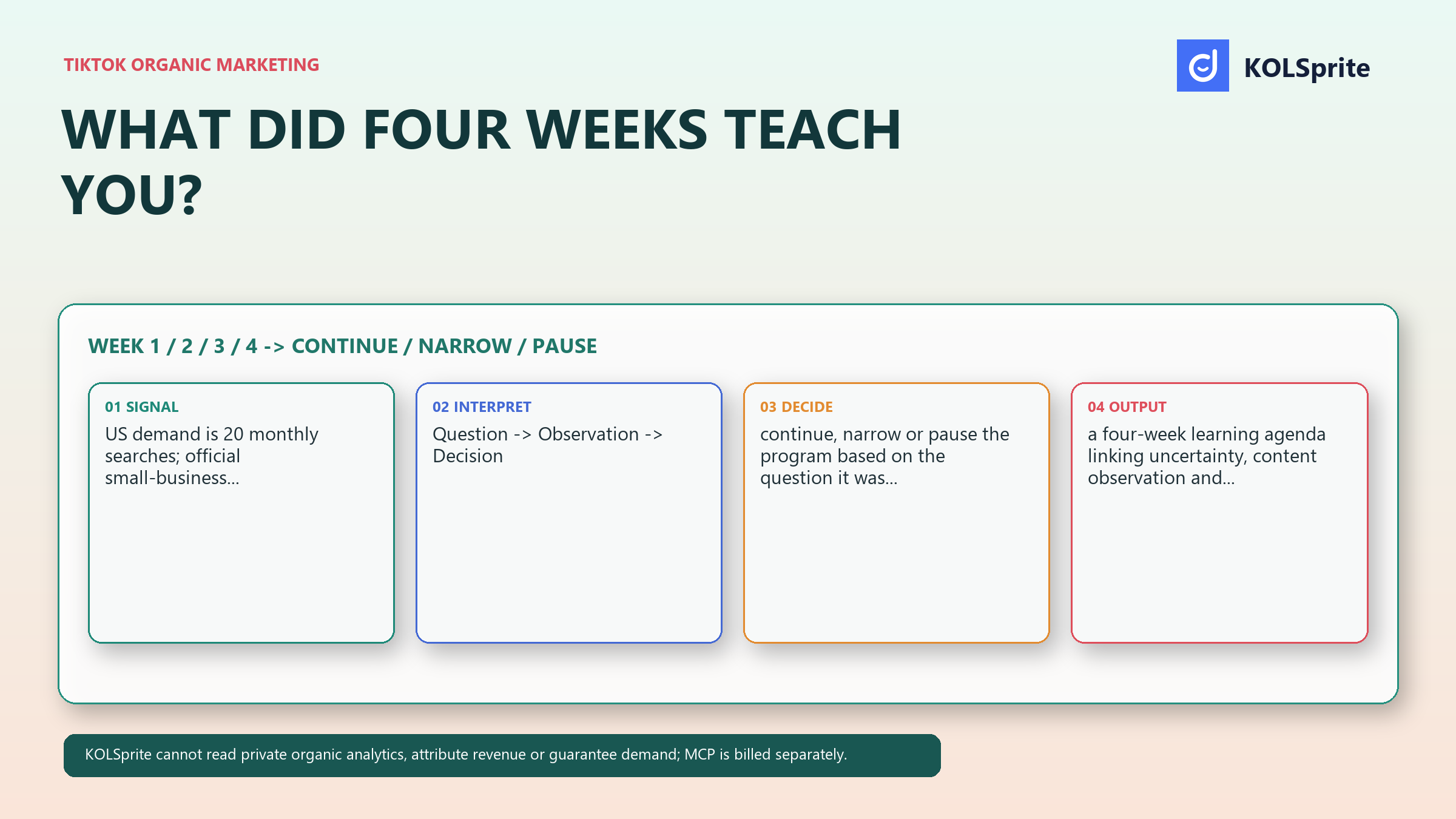
TikTok organic marketing earns continued effort when it reduces one named uncertainty. Set a four-week learning agenda. Define the observation that could change a decision, then continue, narrow, or pause based on the record.
Organic publishing is often treated as a low-cost substitute for a plan. The team posts because the platform matters, then reads views and comments as though they explain the next move. They rarely do by themselves. A post can be pleasant, widely seen, or even saved without telling a founder whether a product has a clear buyer, an understandable use case, or a viable unit of content.
Consider a fictional lunch-storage brand that makes stackable containers for office commuters. The founder is not asking, “Can we post more?” The real question is whether commuters recognize the leak-and-pack problem. If they do, a stronger product demo may be worth the effort. The team can show lunch-packing moments and record the questions that appear. It can then judge whether the problem language becomes clearer.
| Official test-and-learn step | Four-week agenda use |
|---|---|
| Define an objective before execution. | Name one uncertainty the business needs to reduce. |
| Make creative that fits the platform. | Build a scene that can produce a useful observation. |
| Review and test what happens. | Log the signal, then choose continue, narrow, or pause. |
Scope: small-business creative planning. Market: United States small businesses. Access date: 2026-09-04. Sample: one first-party planning resource. Cleaning: broad planning steps converted into a bounded learning record. Limit: no margin, demand, or conversion claim. The official guidance supports an objective-and-review cycle.
The comparison sets a clean boundary. TikTok can advise a business to review and learn. It cannot choose the uncertainty that matters most to that business. The founder must name the decision that will change if the month teaches something useful.
Good learning questions are narrow enough to change a decision. For the fictional lunch-storage brand, choose one:
Do not choose all four for one month. A TikTok organic marketing program loses its value when every post is expected to answer every market question. Pick the uncertainty that would genuinely change the next investment. If buyers do not recognize the problem, more polished product videos may be premature. If they recognize it but do not understand the solution, the content needs clearer proof.
Register for KOLSprite and claim a three-day trial of the web product. MCP access is sold separately.
Register and claim a three-day trial
This fictional agenda is a reader deliverable. Replace the examples with your product and decision. The observations are not success metrics; they are items the team can review without claiming a private revenue result.
| Week | Uncertainty | Content observation | Decision it can inform |
|---|---|---|---|
| One | Is the packing problem recognized? | Record the words people use around a rushed lunch setup. | Continue with the problem framing or rewrite it. |
| Two | Which scene makes the product legible? | Compare responses to packing, sealing, and bag-placement scenes. | Choose the next proof scene. |
| Three | What objection needs a direct answer? | Log recurring questions about size, cleaning, or leaks. | Commission an objection-specific demonstration or pause claims. |
| Four | Does the evidence point to one buyer context? | Read the observation log for a repeated use setting. | Continue, narrow the audience, or pause the program. |
The agenda has a deliberate blind spot: it does not promise that four weeks can prove demand. It can tell a founder whether the content is making the customer problem clearer enough to justify the next test.
For the fictional brand, week one might show a rushed desk lunch with a leaking container. Week two could show the packing sequence in one calm take. Week three could answer the most common size question. Week four would revisit the clearest use setting. The scenes are related, but each has a different learning job.
At the weekly review, read the log before looking at the next calendar slot. If the audience repeats the founder’s own words, that is weak evidence. If people use their own clear language for the same problem, record it. If they ask about a new issue, decide whether it belongs to the current uncertainty. Do not chase every comment.
A comment is a signal. A decision is what the team does because the signal fits the question it set. “I need this for my commute” may be evidence that a commuter context is understandable. It is not proof that the product will sell at a specific price. “Does it leak?” may identify a proof gap. It does not prove the seal works under every condition.
Create a dated observation log with four columns: source, exact observation, uncertainty, and possible next decision. That structure makes it harder to turn the loudest comment into a strategy. It also helps a founder notice when the team is collecting entertaining reactions instead of evidence related to its question.
Keep neutral notes. Write “three people asked whether the small container fits a full lunch,” not “buyers love the set but want a larger size.” The first line reports what appeared. The second invents intent. A plain log gives the week-four memo a sound base and makes disagreement easier to resolve.
For a wider set of content choices, use the TikTok content strategy decision system. The learning agenda should feed it with a small number of grounded observations, not a mood board of impressions.
Join the KOLSprite Discord to discuss the question behind your next test.
 +
+
Join the KOLSprite Discord community
At the end of four weeks, the program has three legitimate outcomes. Continue when the observation log reduces the chosen uncertainty and points to a next test. Narrow when the evidence identifies a more specific buyer context or proof scene than the team began with. Pause when the posts do not produce usable learning about the question, even after the team has made the question and scenes clear.
Pause is not a declaration that the product cannot work. It is a decision not to keep paying for vague activity. A founder may need customer interviews, a product-page repair, better inventory information, or a different research method before organic content can teach anything useful. That is more honest than treating persistence as a strategy.
After the learning question is fixed, use KOLSprite web research to review a bounded set of public product and video patterns, then save a dated observation log that separates signal from decision. This can shorten public research for a defined question.
KOLSprite cannot read private organic analytics, attribute revenue, determine private conversion economics, or guarantee demand. MCP is billed separately.
Cadence is operationally useful. It helps a team produce enough comparable material to review. But a posting schedule cannot substitute for a learning agenda. A founder who publishes five times a week without a visible question may create more data and less understanding.
Keep the uncertainty in the working brief, the caption review, and the weekly meeting. Ask the same question before approving a new clip: what observation could this produce that would change our next decision? The answer may be modest. That is fine. Organic work becomes expensive when it is asked to settle questions it cannot observe.
Cadence can still serve the agenda. Hold the posting days steady when that makes scenes easier to compare. Change one meaningful part at a time, such as the buyer setting or proof moment. If the team changes the audience, claim, scene, and offer in every post, the log will be hard to read. The goal is not a lab test. It is a useful business record.
Write a short memo after the final review. Start with the uncertainty. Name the scenes published. List only observations connected to that uncertainty. Then choose continue, narrow, or pause and state the next action. For the fictional lunch-storage brand, a narrow outcome might read: “Commuter packing scenes produced clearer problem language than general meal-prep scenes. Next, commission one seal-proof demonstration and stop broad audience tests for now.”
That memo is not a performance report. It is a record of why the team changed course. When it is time to make the next creative brief, the TikTok video ideas matrix can translate the identified proof gap into a scene without discarding the learning question.
Posting more is not learning more unless the question stays visible. At the final review, write one word at the top of the memo: continue, narrow, or pause. Then support it with the dated observations. Do not hide the decision below a recap of publishing activity.
When the program is ready to evaluate creators or public examples, use engagement as one descriptive input. It is not a shortcut to fit. The TikTok engagement calculator can support that later review.
The completed four-week table now has a clear destination. It becomes a founder memo with one uncertainty, the observations that mattered, and a stated business choice. The closing function is a decision record. It tells the next meeting whether the team will keep the course, tighten the question, or stop spending time on an agenda that did not teach enough.
Latest Articles
As an essential, data-driven toolkit for TikTok influencers and marketers, KOLSprite provides powerful features for effortless creator discovery, trending content identification, and actionable real-time insights.
It empowers users to make smarter decisions and significantly boosts their TikTok business.

 Refer & Earn