 +
+
For sellers and content teams, TikTok marketing tools is useful only when it helps make a real choice. This guide shows how to use team workflow around a car accessory without overstating the data. The direct answer is simple: a large tool stack can still fail when nobody owns the next decision. By the end, you will have a 30-day scorecard that can guide the next brief, test, or stop decision.
The point of view: Build a marketing stack around decisions, not categories. The risk is treating product research, creative review, creator work and measurement as disconnected purchases.
Start where money or time is committed. That could be a sample, an outreach list, a creative test, or a paid campaign. Work backward from that decision and name the evidence required at each step.
For the car accessory question, write one line naming the buyer job, visible proof and claim limit. Keep that line beside the 30-day scorecard so the brief stays tied to a real use case.
Do not promote the team workflow phrase into product copy until the car accessory shows the promised action in the buyer setting: a car interior, a comfort problem and a product demo.
A category manager may own the product question. A creative lead may own the proof format. A partnership manager may own creator fit. The scorecard should show a person beside every decision so a tool does not become an ownerless source of data.
Test the idea in a car interior, a comfort problem and a product demo. Ask what a colleague needs to see before accepting it. Put that answer into one scorecard check.
If the car accessory example works only in a polished setup, mark that limit. The 30-day marketing scorecard must survive a normal buyer condition, not only a perfect demo.
Try the team workflow workflow with a real decision.
New KOLSprite users can claim a three-day trial membership to compare the product, creator and video evidence behind one car accessory question.
Start your three-day trial
The car-accessory examples are a reason to inspect the setup, hook and use case. They do not reveal profit, paid spend, incremental sales, or customer satisfaction. Record those unknowns instead of allowing reach to fill every blank.
At the team workflow handoff, attach the source and next owner. That keeps the source open to a later check instead of turning it into a takeaway nobody can revisit.
Keep the original wording beside the 30-day scorecard. That lets the team separate what was observed, what was inferred and what still needs a test.
For each tool, record the input, output, decision and follow-up action it changed. A tool that produces a list but never changes a brief is not necessarily useless. But it has not proven its place in the stack yet.
If the car accessory result is weak, record the missing proof, fit, offer, or cost beside the 30-day scorecard. A precise failure note prevents the next browse from repeating the same mistake.
A weak team workflow result can still teach the owner what to change. Record the missing car accessory fact instead of smoothing it over with a stronger headline.
| team workflow field | What to record | Decision it supports |
|---|---|---|
| Observed signal | two returned car-accessory videos showed 21.3 million and 29.9 million visible plays, with 2,326 and 1,896 recent units | Whether the car accessory example deserves closer review |
| Proof need | One visible action in a car interior, a comfort problem and a product demo | What the next brief must demonstrate for this use case |
| Known limit | treating product research, creative review, creator work and measurement as disconnected purchases | What the team must check outside public platform data |
| Next action | a 30-day scorecard | A named test, hold, or handoff for this decision |
Marketing Operations source note: KOLSprite MCP public US-market snapshot for the car accessory, accessed August 7, 2026. This example shows how to use a 30-day scorecard. It does not estimate the whole category.KOLSPRITE_DISCORD_CTA
A marketing tool earns its place when it changes a decision or removes a repeatable piece of work. Score each tool on evidence quality, speed to insight, collaboration, exportability and how often the team returns to the result. A feature list alone will not show whether the stack is useful.
For cross-platform sellers, the best stack connects discovery to action. A TikTok signal may shape an Amazon listing test, a Shopify landing-page angle, or a creator brief. The connection should be written down so the team can tell which insight led to which experiment.
KOLSprite is valuable in that bridge because it keeps content and creator research close to the browsing moment. The team can move from a promising video to saved evidence, creator context and a practical next step without rebuilding the research in another system.
A marketing stack is healthy when its evidence can travel into a channel decision. Before you share the marketing scorecard, mark what was observed, what was inferred and what still needs a check.
The channel owner should leave one business question, one evidence source and one budget rule for the next review.
When a channel result arrives, revise the scorecard and keep the owner beside the budget choice.
Close the marketing scorecard by naming the channel question, evidence owner, test window, result threshold and budget decision. Save the channel result beside its owner. At the next scorecard review, decide whether the stack deserves more budget this month.
Want a second set of eyes on the 30-day scorecard?
 +
+
Join the KOLSprite Discord community
An Amazon listing, a Shopify product page and a TikTok video can all use the same underlying buyer question. Their format changes. The evidence need should not. That is how a cross-platform team avoids sending mixed promises into market.
Keep the detail that changes the next team workflow brief. The 30-day marketing scorecard should make the car accessory choice easier to defend, not summarize every signal in the category.
Use the 30-day scorecard to choose one next clip, creator, listing change, or sample check. More examples are not better when the car accessory decision stays open.
KOLSprite helps connect product, creator and content research before a campaign choice. It is not a replacement for attribution, financial reporting, or a brand’s own conversion data. It gives those systems a better question to measure.
Finish the research step by naming the next move: test, hold, compare, or stop. KOLSprite can keep the car accessory source and creator context near that choice for the next owner.
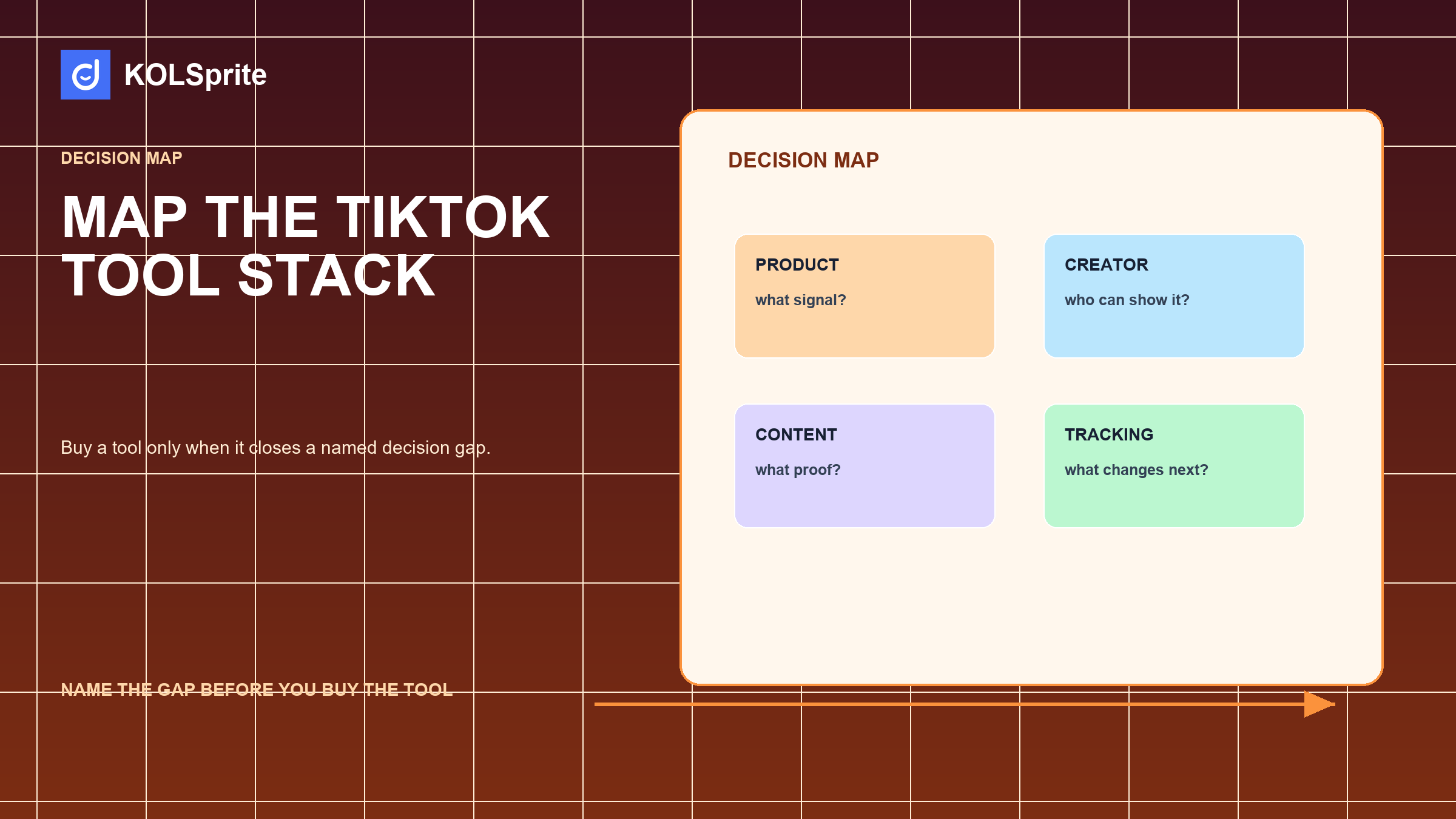
This decision map is complete when another owner can explain the car accessory choice and repeat the check without asking for hidden context.
For team workflow work on a car accessory, keep the buyer job intact when the format changes. The TikTok marketing tools question decides whether this source becomes an Amazon brief, a Shopify page test, or a creator request.
Start the car accessory handoff with the scene that makes the need obvious: a car interior, a comfort problem and a product demo. For a team workflow review, ask which action earns belief and which product limit must appear before the viewer accepts the claim.
Give the 30-day scorecard its own source, signal, proof, limit and next-action fields. The marketing handoff should state why the example matters. It should not send the next owner back through a folder of screenshots.
In this decision map, compare the team workflow example with a car interior, a comfort problem and a product demo. A high-play result is not enough when treating product research, creative review, creator work and measurement as disconnected purchases. Record the proof gap, creator fit and next choice in the 30-day scorecard.
Run the smallest team workflow test that can change the choice. For this team workflow work, expand a supported test idea, record a failed one and move on when the car accessory evidence stays weak.
A useful TikTok marketing tools process ends with one concrete commitment: who will run the next team workflow check, which car accessory condition they will review and what result would alter the plan. Keep the source beside the scorecard. Then choose one next move: test, hold, or ask for better proof.
For a related next step, use product research, compare it with creator search and move the resulting decision into MCP for ecommerce. For the platform-level boundary relevant to this decision map, see TikTok reporting metrics guidance.
A short scorecard makes the next owner, test, budget choice, and review date clear.
Before the meeting, each owner should bring one saved example and one open question. The group can then decide whether to test, wait, or stop.
Newer Article
<<TikTok Video Ideas: Build a Product Proof Matrix
Latest Articles

As an essential, data-driven toolkit for TikTok influencers and marketers, KOLSprite provides powerful features for effortless creator discovery, trending content identification, and actionable real-time insights.
It empowers users to make smarter decisions and significantly boosts their TikTok business.

 Refer & Earn