 +
+
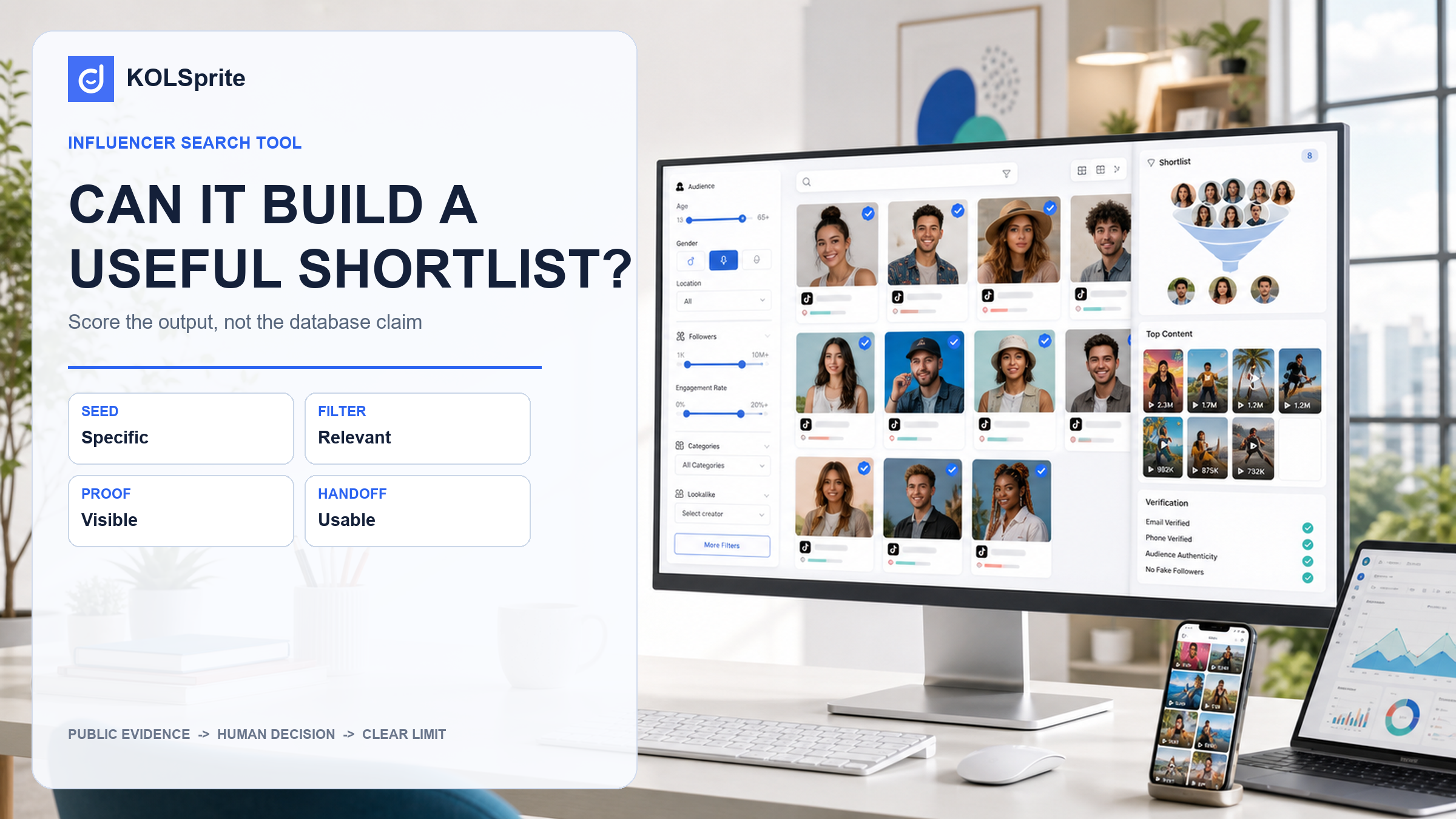
A creator search can return thousands of names and still leave a partnership manager with nobody worth emailing. If you are comparing software for a brand or agency, judge it by the shortlist it produces, not the database size in the sales deck. A TikTok influencer search tool should help you turn one real campaign need into ten reviewable accounts, each with a visible fit reason and an open question. This guide shows you how to run that test before you buy.
Ten-second answer: give each tool the same product, audience, and content task. Keep only creators whose recent work supports a specific reason to review them. The better tool is the one that gets more of those names to a contact-ready handoff with less manual repair.
Teams often buy creator software after a painful search day. The pitch is easy to understand: more profiles, more filters, more data. The practical issue comes later. A database can return many accounts that look plausible but have no link to the buyer problem, product category, or content format you need. The team then opens profile after profile and starts selecting people because they are available, not because the work makes sense.
A broad public search illustrates the problem. A KOLSprite MCP creator query for a general skincare term returned a universe of roughly 10,000 results with mixed categories. That is not a defect in the data. It is what a broad term means. The term can include makeup, skin care routines, wellness, beauty commentary, and unrelated creator labels. The output becomes useful only after the team adds a product job, a content proof task, a market, and a reason to include or exclude a person.
Start with the work, not the tool. For example, "find creators with people who ask about small-apartment storage" is better than "find home creators." It tells the researcher what a relevant video, comment, and creator pattern should look like. The tool then has a fair job: make that context easier to find and document.
Run this test during a free trial, a demo, or a one-hour research sprint. Pick one real product and one audience. Do not use a vague category because vague inputs make every system look busy.
| Test field | What good looks like | Failure signal |
|---|---|---|
| Seed | A product job, buyer setting, and content proof task are stated. | The team can only type a broad niche word. |
| Results | You can narrow the pool with filters or related examples. | Every result needs a manual rescue. |
| Context | You can inspect recent videos and public audience signals near the profile. | A score appears with no clear basis. |
| Reason | Each accepted account has a written fit reason and a concern. | The list is only names, follower counts, and links. |
| Handoff | A colleague can review, export, or continue the shortlist without starting over. | The research is trapped in one browser session. |
Set a pass mark before you begin. For instance, eight of ten accounts should have a specific content example, a buyer-job match, and one open question. The remaining two may be "maybe" accounts, but they should not be there because the list needs to reach ten. The point is not to prove that a tool is perfect. It is to see whether it makes your next human judgment faster and better.
Can the tool start from an account, video, phrase, product, or use case that is close to your real need? A useful seed helps avoid the common jump from an abstract niche to a random creator. Similar-account research is often stronger than a blind niche search because it gives the system a visible format to expand from.
Filters should help remove false positives. They might narrow by market, content topic, audience size, recent activity, or product relevance. Do not reward filters just because there are many of them. Ask which filter would cause you to contact, verify, or skip a creator.
Follower count does not explain why an account belongs in a campaign. You need recent content, audience language, format fit, and the product setting. KOLSprite can keep creator research close to the TikTok pages where those public signals appear. That supports a faster review than moving names into a spreadsheet before anyone sees the actual work.
Use a three-day trial to start from one relevant creator, video, phrase, or product use case. Review the public content behind each result, then save only the ten accounts you would defend to a campaign manager. The test will show whether this flow fixes the real sourcing problem.
Register and claim a three-day trial
A shortlist is a decision document. The next person should see the creator name, the proof task, a supporting link, the fit reason, the risk, and the suggested next action. A tool that exports rows but loses the reason for each row creates the same problem as a long database search.
No public search surface can confirm private audience quality, current availability, fee expectations, contract fit, brand safety review, or a creator's willingness to accept a sample. A sound tool makes public proof easier to read. Its score cannot replace outreach or basic checks.
Keep three states: candidate, review, and contact-ready. A candidate has a plausible topic or content connection. A review account has a visible example that fits the buyer job. A contact-ready account has a documented reason, a concern, and a suggested ask. This simple funnel protects the partnership manager from a spreadsheet full of names that have never been watched.
Keep only enough detail to find the account again: name, link, source, and one sentence on why it entered the pool.
Add a recent relevant video, the buyer setting, the format, and an objection the creator may need to answer.
Add the proposed collaboration task, a personal detail from the work, a risk note, and a clear next step.
The funnel also makes tool comparison easier. If one tool returns 300 candidates but only two reach contact-ready, while another returns 60 candidates and twelve reach contact-ready, the second system may be more valuable for your team. That is the real cost question, not the number displayed on a landing page.
In KOLSprite, use the creator and similar-account workflow to move from a seed to public creator and content context, then export or save the small group that passes your rule. This is a natural fit when the team does its research while browsing TikTok. It is not a substitute for current in-platform eligibility checks, direct contact, or contract review.
Bring your campaign task, three accepted creators, and three rejected creators. The KOLSprite community can help you see whether your rule is filtering for real product fit or simply favoring familiar-looking profiles.
 +
+
Join the KOLSprite Discord community
A sourcing test becomes more reliable when the team records why it rejected an account. "Wrong audience" is too vague to help later. A useful rejection reason is specific: the creator makes product hauls but does not explain use; the recent content is in the right category but targets a different buyer setting; the format depends on before-and-after claims the brand cannot make; or the account has not posted relevant material recently.
These notes help you calibrate the search. If the first 30 results all fail for the same reason, change the seed or filter rather than reviewing another 100 profiles. If a creator passes only because the team likes the editing style, mark that. It may be a content inspiration lead, not a partnership lead. This separation keeps the outreach list from becoming a mood board.
Ask someone who did not do the search to take three names from the list. They should be able to tell you, in less than two minutes per account, why each person belongs, what content proves the fit, what concern remains, and what first message or task makes sense. If they cannot, the tool may have collected data without creating a usable decision record.
The second review also catches false precision. A profile score can look authoritative even when the person has not watched the recent videos. A short written reason forces the researcher to use public evidence in plain language. It does not need to sound formal. "Shows small bathrooms every week and answers storage questions in comments" is more useful than a generic engagement label.
A good result is easy to explain. Each name has one clear reason to stay. Each rejected name has one clear reason to go. The next person can open the saved video, see the product job, and decide whether outreach makes sense. If the team still needs hours of repair, the tool did not save enough work. If the list is small, clear, and ready to use, the test has done its job.
The handoff should feel simple. A manager can scan ten names in a few minutes. The fit note says why each person is here. The risk note says what still needs a check. The saved clip shows the work. The next step says contact, review, or skip. No one has to guess why a creator made the list. This is the point of the trial: less searching, less cleanup, and a clear first outreach group.
Some teams need a faster way to move from a good seed account to similar public creators. Others need help comparing recent videos, saving examples, or passing a shortlist to an outreach owner. The right choice depends on where the current process breaks. If the real bottleneck is legal review or reply management, another search platform may not solve it.
Document the bottleneck after the one-hour test. If the team reached ten contact-ready names but could not personalize outreach, improve the handoff. If it could not find relevant names at all, improve the seed and evidence surface. This keeps the software decision tied to a real operating gap instead of an attractive feature comparison.
The cleanest shortlist question is, "Can this person show and explain the buyer problem in a format we can use?" That question can be answered with public work. It is stronger than, "Does this person have more followers than the last account?" A smaller creator with repeated, clear demonstrations may be a better test partner than a larger creator whose content has no link to the product job.
Use a concern column as well as a fit column. A creator may have strong content but a weak product match. Another may have the right buyer setting but no evidence of clear disclosure habits. The concern does not force a rejection. It tells the next reviewer what to verify before sending an invite.
For the surrounding workflow, start with the creator discovery guide, use similar-account research when a good seed exists, and compare the final candidates with creator analytics by job. When the list is ready, continue in KOLSprite creator search with the reasons attached.
A TikTok influencer search tool earns its cost when it turns an oversized pool into a defensible shortlist. Test that output first. The database can be large. Your decision should be small, clear, and ready for the next action.
Official source: See TikTok One for the current platform guidance used in this workflow. Recheck the source before acting because platform rules and interfaces can change.
Latest Articles
As an essential, data-driven toolkit for TikTok influencers and marketers, KOLSprite provides powerful features for effortless creator discovery, trending content identification, and actionable real-time insights.
It empowers users to make smarter decisions and significantly boosts their TikTok business.

 Refer & Earn