 +
+
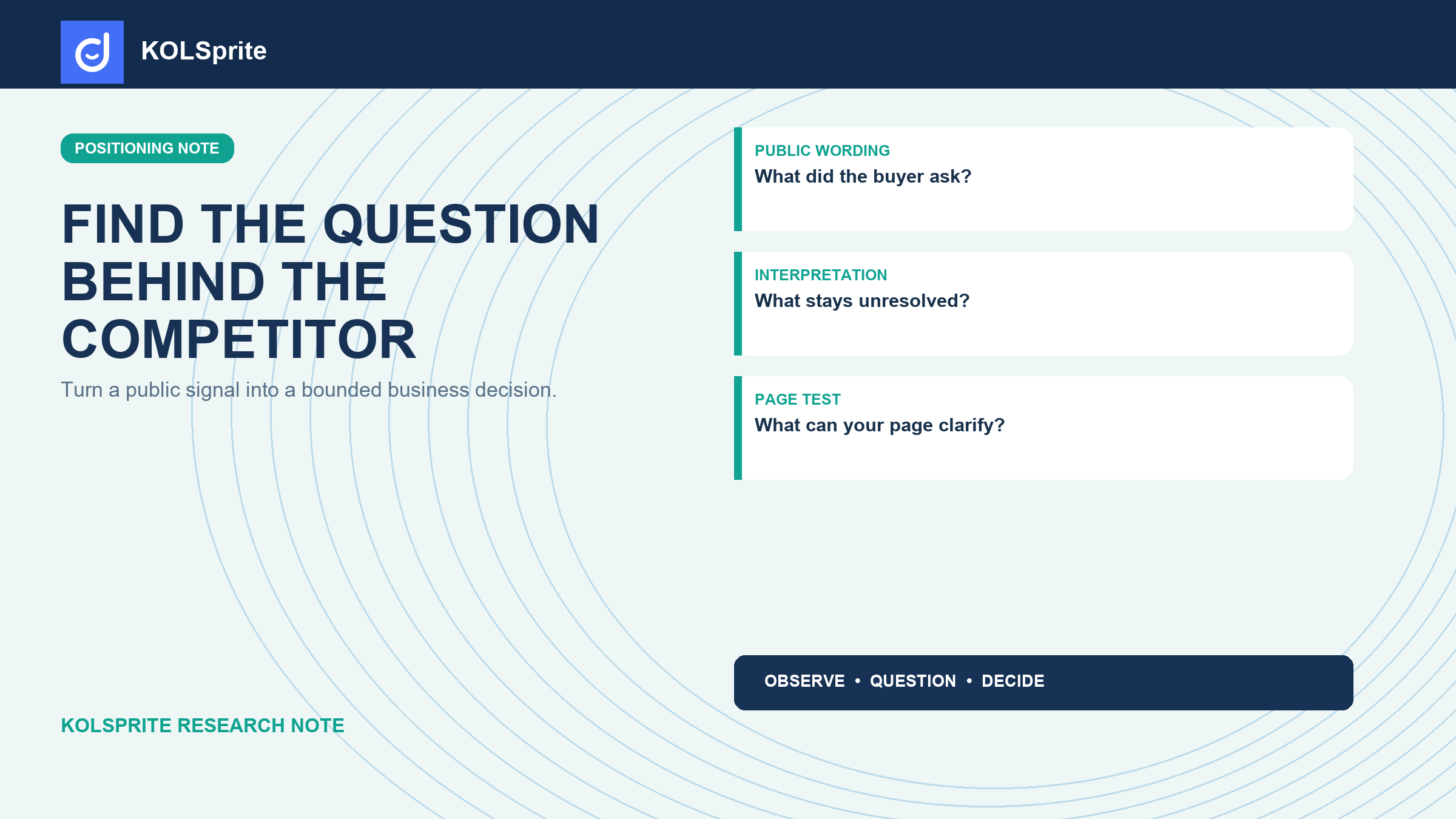
Shopify product positioning can get stuck inside a team’s own vocabulary. The product page says what the brand wants to emphasize, while buyers ask a different question in a competitor’s comments. That gap is useful, but only when a team treats public questions as evidence of an unresolved tension rather than a license to copy another brand’s answer. This annotated teardown shows how to turn a competitor question into an original positioning decision for a Shopify page, product demonstration, or test brief.
Ten-second answer: Find the buyer question behind the competitor comment, identify the unresolved tension, and decide what your own page or demonstration can truthfully clarify. Do not copy the competitor's script, claims, or creative treatment.
Competitor research often starts with a brand name and ends with a list of claims. That is a weak way to improve positioning. Claims tell you what a competitor chose to say. Questions tell you where the buyer still has work to do.
Open a public comment thread with one goal: find the question that keeps the buyer from moving forward. It may concern size, use, setup, compatibility, durability, or the reason to switch. Write the question without the competitor’s branding language.
One comment is not a market finding. A question becomes more interesting when it reappears across related clips, sits near a clear demonstration gap, or matches a concern your own team already hears. The point is not to manufacture certainty from a few lines of text.
A margin note works well here. On the left, preserve the observed wording. On the right, write the narrowest possible interpretation. In the middle, leave room for what the evidence does not settle. That structure protects a team from overreading a convenient complaint.
The positioning decision should be about the buyer’s job, not about beating a named competitor. If buyers cannot tell whether an item fits, the page may need a clearer size demonstration. If they do not understand compatibility, the page may need verified guidance. If they cannot see the difference, the brand may need a more honest comparison frame.
This is where Shopify product positioning from TikTok competitor questions becomes practical. The question produces a page hypothesis. The page hypothesis produces a fact check. The brand owns the final language because it must be accurate for its own product, offer, and customers.
Register for KOLSprite and claim a three-day trial to save the public context behind a positioning question before your team changes a Shopify page.
Register and claim a three-day trial
Public comments can reveal wording and friction. They cannot confirm why every buyer left, what the full audience believes, or whether a claim is commercially viable. Use them to shape a question, then verify the answer with product facts, customer research, and the people responsible for the page.
KOLSprite’s AI Comment Analysis can structure supported comment areas into topics, pain points, use cases, intent signals, and competitor mentions. A reviewer should still open representative original comments before a brand changes a page or claim. The analysis is a way to organize the research, not a substitute for judgment.
| Observed public wording | Careful interpretation | Original Shopify implication |
|---|---|---|
| “Will this fit in a small cabinet?” | Space is an unresolved buying condition | Show dimensions in a real cabinet scene |
| “Does it work with the older model?” | Compatibility is not clear | Add a verified compatibility section |
| “Why is this different from mine?” | The distinction is not visible | Test a plain comparison claim only if supported |
Source scope: public comments are research context, not a representative survey. Use TikTok Creative Center as a platform research surface; the table preserves observed wording, a narrow interpretation, and the product facts still needed before a page claim is changed.
A positioning insight does not need to trigger a homepage rewrite. Pick one place where the buyer needs the answer: a product-page image, a short comparison block, a FAQ, an email, or a creator brief. Small tests make it easier to learn whether the question was actually central.
Write the test in a sentence that can fail. For example: if the page shows the product in a standard cabinet, fewer shoppers will need to ask about fit. The sentence does not promise an outcome. It gives the team a clear observation to make.
A useful positioning note should let another teammate trace the path from public wording to interpretation to page test. KOLSprite can keep the public clip, comment context, and saved research together while a brand team decides what it can say. That is especially useful when the same question reappears months later.
Do not save every comment. Save the examples that explain why the question mattered, plus one note about the limit. A small traceable record is more valuable than a folder of screenshots with no decision attached.
Join the KOLSprite Discord to compare buyer questions, page hypotheses, and evidence limits without copying another brand's answer.
 +
+
Join the KOLSprite Discord community
A competitor’s unanswered question may lead to a stronger product story. It may also show that your brand should say less until it has better proof. Both outcomes improve positioning. The goal is to reduce the buyer’s effort without borrowing a competitor’s identity.
Before you publish a new claim, ask whether the page now answers a real question with a fact the brand can stand behind. If it does, the research has done its work. If it does not, keep the margin note open and gather better evidence.
Start with one real question. Keep the words plain. A buyer may ask if the item fits, works with an older model, cleans fast, or solves a problem they already have. Do not turn that question into a grand market claim. It is a prompt for a page check. The team can then look at the page and ask whether the answer is easy to find, easy to trust, and backed by a fact.
The page test should have one owner. A designer may own a new image. A product lead may own a fact check. A copywriter may own a short FAQ answer. Each person needs the same source note. For Shopify product positioning from TikTok competitor questions, the source note should show the public wording, the narrow interpretation, and the limit. It should not ask the reviewer to trust a memory of a comment thread.
Keep the test small. Add a verified dimension to one image. Put a clear compatibility line near the add-to-cart area. Test a short explanation of a routine problem. Then compare the question with the new page. Did the page make the answer easier to find? Did it add a claim the brand can prove? If the answer is no, remove the change and go back to the question.
KOLSprite can help the team return to the saved public context when a page decision is reviewed. That does not make the comment set a survey. It makes the source trail easier to inspect. The brand still needs product evidence, customer evidence, and its own voice. This is why Shopify product positioning from TikTok competitor questions should result in an original test, not a copy of the competitor's content.
A good note also names the choice not to make. The team may decide not to compare products on price. It may decide not to promise universal compatibility. It may decide a question is too thin to change the page. These are useful outcomes. They protect the page from loud but weak language. A buyer should leave with less work, not with a new set of claims to decode.
Before the next review, read the changed section aloud. Could a new shopper tell what is different in one pass? Could the product team show the proof? Could support answer the follow-up question? If those answers are clear, the positioning work is ready for a small test. If they are not, the comment did its job by showing where more work is needed.
Keep the before-and-after page language together in the note. A future reviewer should be able to see what was changed and why. This is especially useful when a small test works only for a certain product or audience. The record stops a narrow lesson from becoming a broad rule. It also lets a brand return to its own customer language instead of inheriting a competitor's tone. Good positioning becomes more distinct when the evidence trail is easy to read.
The note should end with a simple status: test, hold, or close. Test means the page change has proof and an owner. Hold means the question is good but the facts are not ready. Close means the public thread did not give enough context. The status keeps a useful observation from sitting in a research folder with no next decision.
Continue the research: remove false positives from competitor research · AI comment analysis for TikTok research · turn a buyer question into a proof brief.
Latest Articles
As an essential, data-driven toolkit for TikTok influencers and marketers, KOLSprite provides powerful features for effortless creator discovery, trending content identification, and actionable real-time insights.
It empowers users to make smarter decisions and significantly boosts their TikTok business.
 Refer & Earn