 +
+
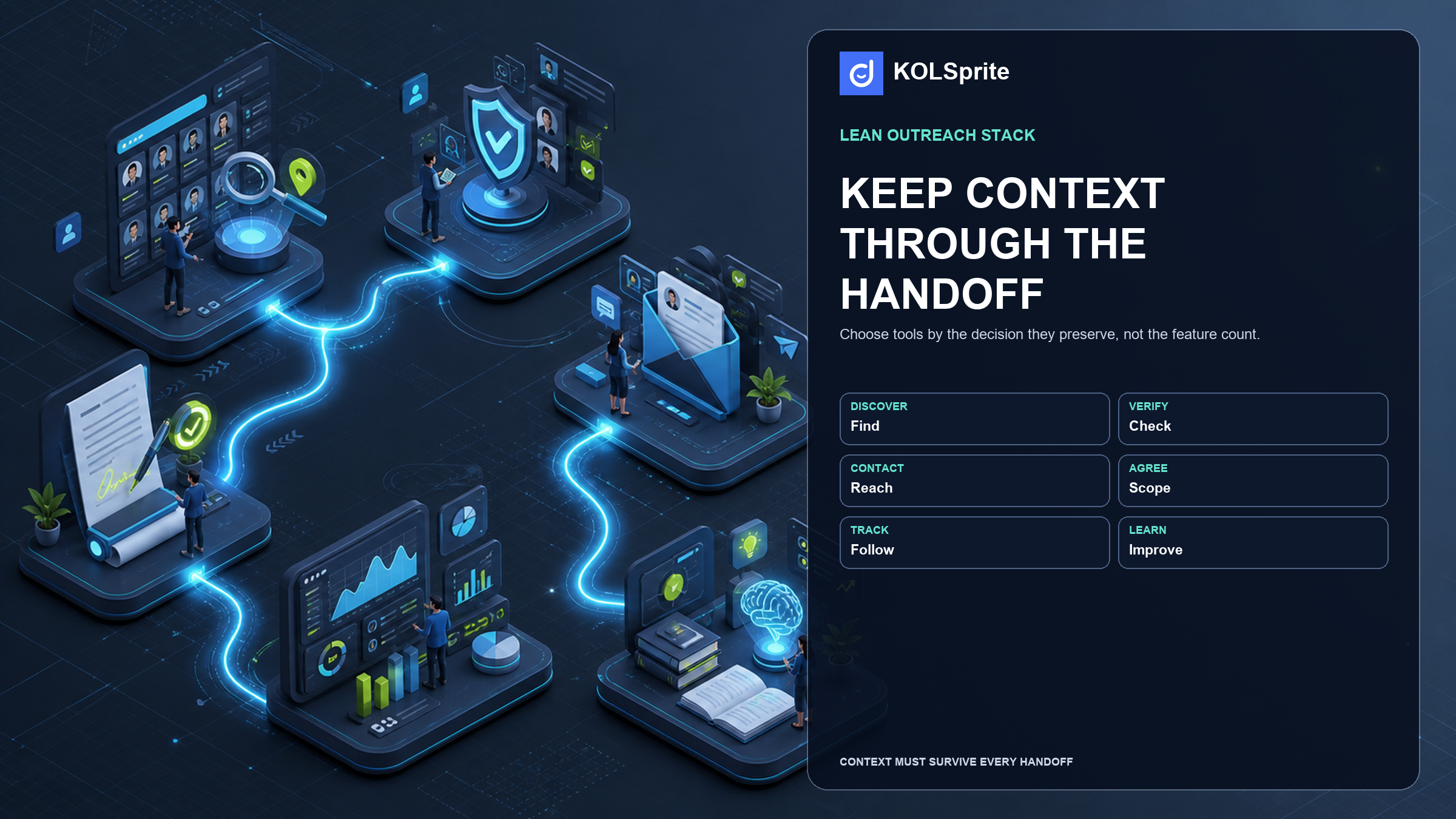
Growth teams and agencies can use five tools and still lose the reason they picked a creator before the first follow-up, because influencer outreach tools help only when the original evidence reaches the sender and the campaign review. Map six jobs, then name one owner and one output for each transfer. Remove any tool that cannot pass along the facts the next person needs. You will leave with a lean stack map and a 30-minute vendor test based on real work, not a feature list.
Most stacks fail between tools, not during discovery. A researcher finds a strong public example, but the sheet keeps only the handle, so the sender sees no fit reason and writes a broad note. Later, the campaign lead sees a posted video but not the first idea behind it. Each tool may work on its own while the facts get lost on the way.
The supplied U.S. keyword snapshot lists volume 90, CPC of $59.36, and difficulty of 13 for this category. That shows search demand, not a vendor rank. Search results split the work across discovery, CRM, email, contracts, and measurement. Your team does not need an "all-in-one" tool unless the work proves it.
Start with the work, then choose the tools. One tool may cover several jobs, while several tools may share one job; what matters is whether the next owner gets useful facts.
| Job | Required output | Owner | Failure to watch |
|---|---|---|---|
| Discover | Public creator or content lead with source link | Research | List has handles but no reason for fit |
| Verify | Specific evidence note and decision | Partnership lead | Popularity replaces relevance |
| Contact | Message, channel, date, and next action | Sender | Duplicate or generic outreach |
| Agree | Approved private terms in the correct system | Operations/legal | Private terms copied into research notes |
| Track | Deliverable status and source of truth | Campaign owner | Unclear approval or publishing state |
| Learn | Recorded hypothesis and outcome review | Marketing lead | Published work is not connected to next choice |
Limitation: One vendor does not need to cover every job. Legal review, contracts, payments, email delivery, and first-party results need the right systems and clear owners.
Trace one recent creator from the public video or profile through every tool. Where did the source link go? Where is the fit reason? Which tool holds the first message? Where do terms live? Who can see both the final content and the first brief? Mark each answer that is "in someone's inbox" or "we just know."
You do not need special software. Draw six boxes and connect them. Label each line with the one item that must cross it: source link, evidence note, offer state, agreement link, work status, or learning note. If a line has no named item, the next person will have to guess.
Register for KOLSprite and claim a three-day trial to test how creator evidence, saved resources, and supported outreach workflows fit your stack.
Register and claim a three-day trial
KOLSprite fits at the start and middle of this map. It does not replace the full stack. Teams can find and review creators, save resources and notes, and use supported templates, batch tasks, promotion plans, and follow-up tools where they fit. This helps the short-list reason reach the next owner.
The limit should stay clear. KOLSprite does not replace legal review, payments, email delivery checks, or first-party results. The KOLSprite Workbench is the right product page when the team needs to discuss saved work and shared collaboration tasks. Contract and payment details belong in approved tools.
Skip the feature tour. Give each tool the same small test with three real creator records that contain no sensitive details.
Do not score features you did not test. Ask one narrower question: can the next owner understand the choice without private data or a vague note?
| Handoff | Context that must travel | Current loss | Fix |
|---|---|---|---|
| Research to sender | Relevant video and fit reason | Sender sees only a handle | Require a source-linked evidence field |
| Sender to operations | Offer state and next decision | Terms are buried in email | Link the approved private record |
| Operations to campaign lead | Deliverables and owner | Approval status is unclear | Set one source of truth |
| Campaign to learning | Original hypothesis and published URL | Team sees result without rationale | Attach a short learning note |
Limitation: This sheet checks how well work moves between people. It does not prove revenue or creator results.
If email is part of the stack, treat delivery health as a separate operating job. Google's current email sender guidelines require authentication and set additional requirements for bulk senders. A creator-discovery or workflow tool does not replace those controls.
Join the KOLSprite Discord community to discuss practical tool boundaries, integrations, and workflow handoffs.
 +
+
Join the KOLSprite Discord community
The first common failure is a split identity. One creator appears as a handle in research, a display name in email, and a legal name elsewhere. Use stable links and one record owner before you automate. The second failure is a missing fit note: the sender gets a score but not the public fact behind it. The third is a false source of truth, such as contract terms stored in a campaign task with no clear approved version.
A sound stack keeps sensitive work where it belongs and sends only the facts needed for the next job. A few connected tools can work better than a wide stack with weak transfers.
Keep a tool when it has an owner, a clear output, and a tested path to the next job. Remove it when it copies data, drops the fit reason, or puts private data at risk. Start with a written creator outreach SOP, then test discovery with this influencer database fit test.
The right influencer outreach tools stack is not the largest one. A new owner should be able to see why the team chose a creator, what happened, and what comes next.
A clean map can still fail if people avoid it, so test one week of normal work before you build a large link between systems. Ask researchers to write fit notes, senders to use them, and a campaign lead to review one full transfer. Side sheets and private messages show where the real friction lives.
More automation may not be the answer. A side sheet may exist because no one has defined "qualified." A private message may fill a gap because no one owns approvals. The rule and owner come first. Automation can move stable facts, but it cannot make an unclear choice clear.
A small brand may need only three connected places: one for research, one for outreach, and one approved system for contracts and payments. Research holds source links and fit notes. Outreach holds the send date, reply state, and next action. The private system holds the agreement. After a post runs, the campaign owner adds a short learning note.
An agency may need stricter access and a clearer campaign record, but the six jobs stay the same. Do not add a tool because a larger company uses it. A new tool is justified when a named owner cannot finish a job with the current stack and can point to the missing output.
| Program size | Minimum proof of need | Do not buy yet |
|---|---|---|
| Early program | One owner cannot retain sources and next actions in current work. | A reporting suite without a regular campaign review. |
| Growing team | Several owners duplicate contact or lose campaign handoffs. | An integration before field definitions exist. |
| Agency | Client, creator, and campaign access need separate, reviewable paths. | A shared list that exposes private client details. |
Limitation: Team size does not decide the right stack. Look for a work problem that happens more than once.
Before a trial, write down when you will remove the tool. Remove it if a second owner cannot find the source note, it copies the current final record, its access rules do not fit, or no one owns it. This rule keeps setup effort from becoming the reason to pay for weak software.
Review the stack every quarter with the six-job map. Remove old links, update each owner, and make sure public research notes are not standing in for private records. This basic upkeep keeps the creator evidence tied to the work.
Use one operating measure during the trial: the time a new owner needs to reconstruct a creator decision from the records they may access. Do not use it as a broad benchmark. Compare it only with your old process, and note what made the task easy or hard.
Log the exceptions too. A tool may work for discovery but fail at private approval. It may keep source links but create repeat outreach tasks. These details show where work breaks and support a fair choice better than a long feature list.
When a tool passes, add its input, output, owner, and exit rule to the six-stage map; when it fails, note the missing context and remove it from the future map, so the result is a working stack rather than a list of subscriptions.
Anchor the stages in the TikTok creator outreach SOP, pressure-test discovery with the influencer database Fit Test, test the next handoff with the creator seeding workflow. After publication, add maintained inbound links from the first two pages.
Latest Articles
As an essential, data-driven toolkit for TikTok influencers and marketers, KOLSprite provides powerful features for effortless creator discovery, trending content identification, and actionable real-time insights.
It empowers users to make smarter decisions and significantly boosts their TikTok business.

 Refer & Earn