 +
+
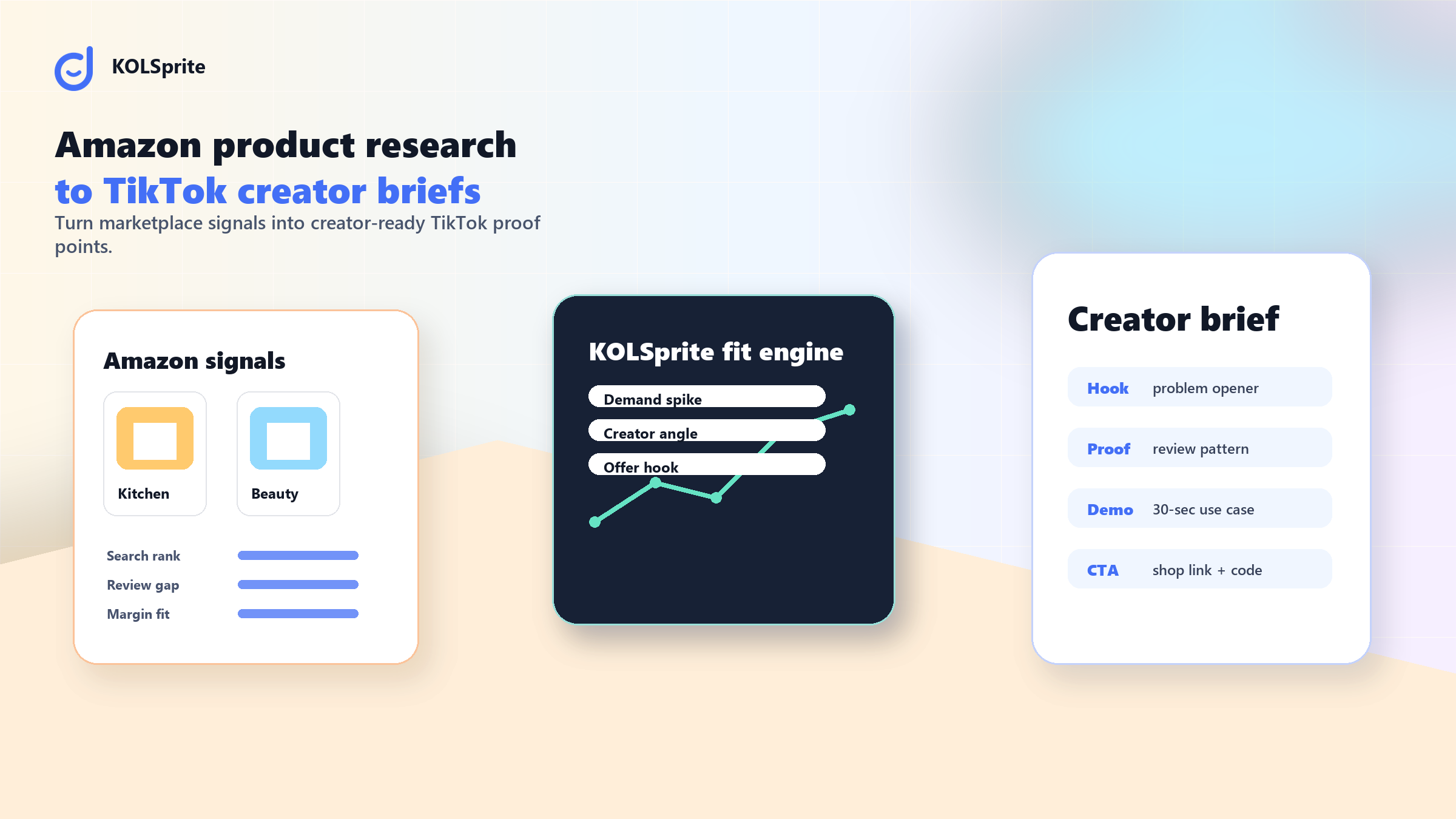
AI Amazon product research becomes useful for TikTok when it turns marketplace signals into creator-ready briefs. The best workflow is to use AI to summarize product benefits, objections, reviews, and competitor claims, then validate those ideas against TikTok videos, creators, comments, and content formats.
AI product research is attractive because Amazon data is dense. Reviews, listings, competitor bullets, search terms, pricing, and Q&A can produce more information than a seller can process manually. The risk is that AI turns all of that information into a generic summary that does not work on TikTok.
TikTok content needs a specific job. A creator must show the product, explain the buyer problem, handle one or two objections, and make the recommendation feel natural. That is why AI Amazon product research should not stop at a product summary. It should become a TikTok creator brief.
Before asking AI for hooks, collect the product truth. This includes the core benefit, buyer type, price point, use case, proof points, claim limits, common complaints, and comparison products. If the input is vague, the output will sound like every other AI script.
A seller named Marcus used AI to summarize reviews for a posture corrector. The first script draft promised instant comfort, which was too strong and risky. After reviewing buyer objections and TikTok comments, the team reframed the brief around daily desk posture reminders and fit guidance. The content became more accurate and easier for creators to demonstrate.
AI can suggest angles, but TikTok tells you whether people respond to them. Search for similar products, category problems, and buyer use cases. Then inspect video formats, creator types, and comments. If multiple creators already explain the same problem, that is a stronger signal than a clever AI hook alone.
Use KOLSprite product search for product-side thinking, KOLSprite video search for TikTok examples, and the KOLSprite Extension to inspect creators and content while browsing.
A creator brief is different from a script. A script tells the creator what to say. A brief tells the creator what must be communicated, what must be avoided, and what buyer question the content should answer. That gives the creator room to keep their voice while keeping the product message accurate.
| Brief field | What to include | Why it matters |
|---|---|---|
| Buyer problem | The problem the product solves. | Keeps the video from becoming a feature list. |
| Proof point | What the creator can show safely. | Makes the product believable. |
| Objection | The concern buyers repeat. | Turns comments and reviews into content direction. |
| Format | Demo, review, routine, comparison, or live clip. | Matches the product to creator style. |
| Claim limit | What the creator should not promise. | Protects trust and compliance. |
Want to compare notes with other TikTok commerce operators? Join the KOLSprite Discord community for creator research, product research, and campaign workflow discussions.
 +
+
Join the KOLSprite Discord community
AI Amazon product research for TikTok briefs becomes valuable when it turns into a repeated operating habit. One person can notice a useful TikTok pattern, but a team needs shared criteria. Every saved video, comment thread, creator profile, and product note should answer the same question: what decision does this help us make?
For Amazon sellers, Shopify brands, and cross-border operators, the workflow should connect product data review, AI synthesis, TikTok validation, creator matching, brief creation, and campaign feedback. If those steps live in separate browser tabs, spreadsheets, and chat messages, the team will keep relearning the same lessons. A repeatable workflow preserves the reason behind each decision.
A practical rhythm is weekly. Pick one category, collect a focused research set, score the signals, decide which creators or angles deserve outreach, and review results after content goes live. This keeps TikTok research from becoming passive scrolling.
Most teams track visible numbers first: views, likes, follower count, and number of creators contacted. Those numbers matter, but they are not enough. The better metrics show whether a signal helps the next campaign decision.
| Metric | Why it matters | How to use it |
|---|---|---|
| review themes converted into content angles | Shows whether the research is producing a decision signal. | Review this after each batch and use it to update the next brief or shortlist. |
| TikTok videos matched to each product objection | Shows whether the research is producing a decision signal. | Review this after each batch and use it to update the next brief or shortlist. |
| creator brief acceptance rate by angle | Shows whether the research is producing a decision signal. | Review this after each batch and use it to update the next brief or shortlist. |
The common mistake is letting AI create scripts before the team validates the product signal on TikTok. TikTok gives fast feedback, but fast feedback can be noisy. A single video, creator, or comment thread should start a hypothesis, not end the decision. Look for repeated patterns across creators, comments, formats, and buyer questions.
AI can help summarize signals and speed up review, but it should not replace product judgment. Sellers still need to check claims, product fit, creator fit, market timing, and customer experience before scaling any idea.
KOLSprite is useful here because it keeps the research step close to the real TikTok browsing moment. A seller can open TikTok, review a creator or product-related video, save the material for later review, compare visible engagement signals, inspect related creator pages, and move the most useful examples into a campaign planning workflow. That matters because TikTok research loses context quickly. If a team only pastes links into a spreadsheet, it often forgets why the link was saved, what buyer question mattered, or which creator behavior made the video worth studying.
A stronger workflow uses KOLSprite as a lightweight research layer over browsing. The user can move from discovery to evidence collection without treating every TikTok session as a separate project. Product teams can look for demand signals. Content teams can study hooks, demonstrations, and objections. Influencer teams can compare creator fit before outreach. Managers can review the saved research trail and ask why a trend, creator, or content angle deserves budget.
This is also why KOLSprite should not be evaluated only as a downloader. Downloading is the entry point for saving research material, but the larger value is the decision loop around that material. A downloaded clip becomes more useful when it is connected to comment insights, creator quality, product-market fit, audience objections, and the next content brief.
Before turning the research into a published campaign, use a short handoff checklist. First, describe the product hypothesis in one sentence. Second, list the buyer questions found during TikTok review. Third, name the creator traits that made the examples credible. Fourth, identify the content angle that should be tested first. Fifth, document the reason a team should not copy the source video directly. This protects the campaign from shallow imitation.
The handoff should also explain what would change the decision. For example, a team might decide that a creator shortlist is only strong if several creators can explain the same use case naturally. A product angle might only be worth testing if comments show repeated pre-purchase questions. A video format might only deserve budget if the hook is connected to a real product proof point rather than a generic viral style.
Good TikTok operations are built from these small decisions. The goal is not to chase every trend. The goal is to collect enough evidence to choose better products, briefs, creators, and follow-up tests.
No. AI can summarize and organize product information, but sellers still need marketplace data, TikTok content signals, creator fit, and operational judgment.
Reviews reveal benefits, complaints, use cases, and buyer language. These can become creator brief inputs after claim and compliance review.
It should include buyer problem, product proof, objections, claim limits, suggested formats, creator fit, and success criteria.
KOLSprite helps sellers validate AI product ideas against TikTok videos, comments, and creator profiles while browsing.
Latest Articles
As an essential, data-driven toolkit for TikTok influencers and marketers, KOLSprite provides powerful features for effortless creator discovery, trending content identification, and actionable real-time insights.
It empowers users to make smarter decisions and significantly boosts their TikTok business.

 Refer & Earn