 +
+
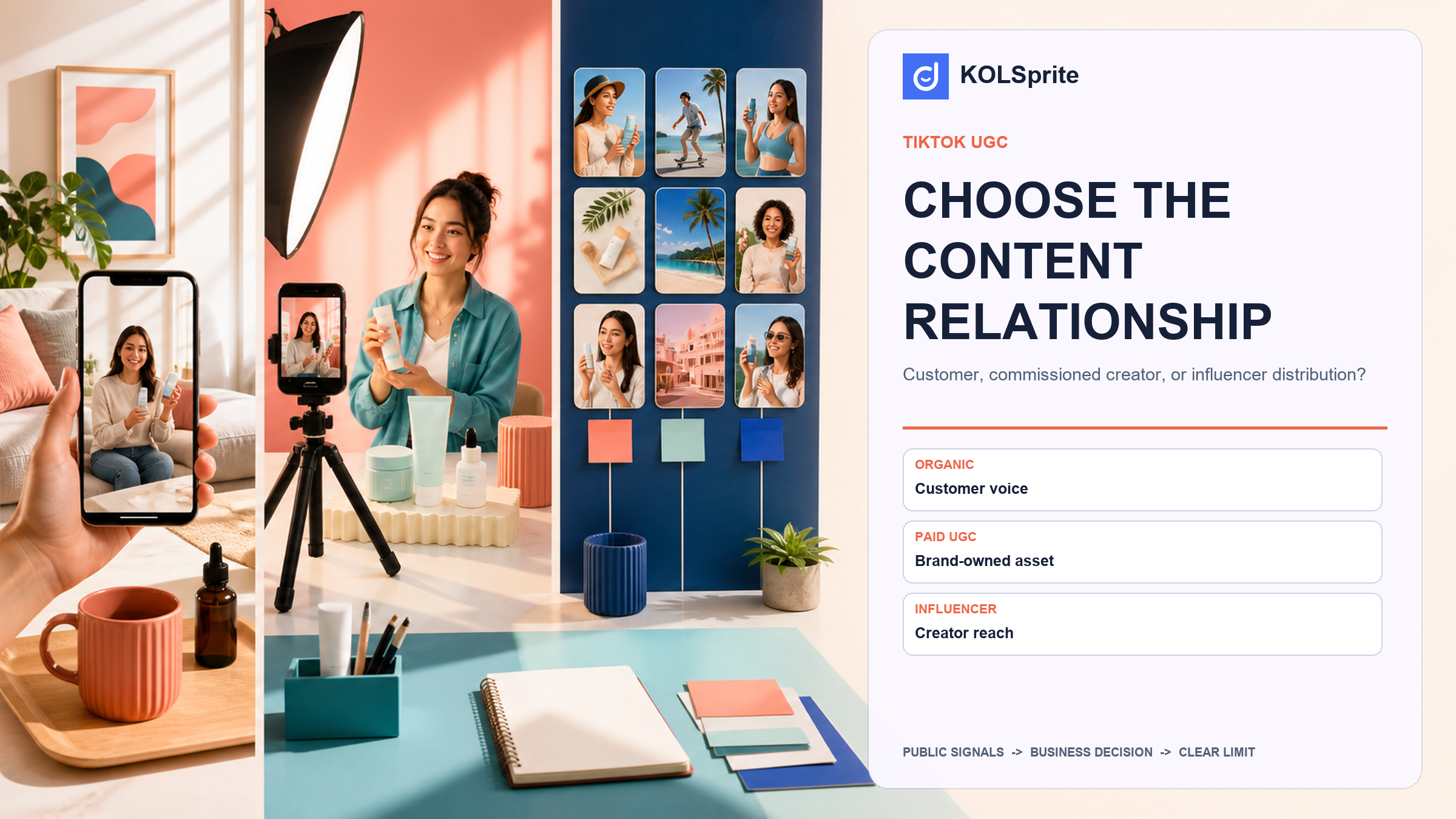
A Shopify or DTC team can call three very different things "UGC" and get the wrong deliverable every time. A customer review, a paid creator-made asset, and an influencer post may look similar on screen, but they differ in source, distribution, rights, and the proof job they can do. TikTok UGC should be chosen as a content relationship, not as a loose visual style. Use the three-lane decision below to decide what you need before you source a creator, request permission, or write a brief. You will leave with a proof-role brief and a sourcing checklist that makes the next request clear.
Choose organic customer content when you need independent customer proof. Commission UGC-style assets when you need a controllable content library for your own channels. Partner with an influencer when you need distribution to that creator's audience. Do not use a vague request for "authentic content" in place of this choice.
The confusion starts because all three lanes can feature a person speaking casually about a product. The surface is similar. The operating conditions are not. A customer may post without a prompt. A paid UGC creator may deliver files but never post them. An influencer may publish to an audience but retain a different role in the campaign. Each path changes what you can ask for, what you must license, and how you should evaluate the result.
Shopify makes the distinction plainly: organic UGC comes from customers who were not paid or prompted, while paid UGC is commissioned customer-style content; influencer work pays for access to an audience as well as content. Read the full definitions and permission guidance in Shopify's 2026 UGC guide. The point for a busy team is not vocabulary. It is avoiding a brief that promises an asset, a post, and usage rights without arranging all three.
| Lane | Best when you need | Primary proof | What the brief must settle |
|---|---|---|---|
| Organic customer content | Independent customer experience and social proof | A real use case, review, photo, or voluntary post | Permission, attribution, claim review, and where it may appear |
| Commissioned UGC-style asset | Several product demonstrations or ad-ready angles under your control | A creator showing a specified proof task | Deliverables, revisions, usage channels, term, territory, and paid-media rights |
| Influencer distribution | Reach into a creator's audience with a product story | The creator's fit, disclosure, content, and distribution | Posting terms, product claims, content approval, exclusivity, usage, and measurement |
No lane wins every time. A new product with few customers may need paid assets first. A product page with repeated questions may need permission to show real customer proof. A launch that needs a trusted niche voice may need an influencer partner. Choose based on the missing proof, not the latest format.
Make the choice in a short team note before you start outreach. Write the buyer doubt, the lane, and the place where the content will live. For example: "Buyers need to see size at home; we need a paid asset for our product page and ads." That note gives the creator, legal owner, and media buyer the same starting point. It also shows when one request is trying to do too much.
Create a KOLSprite account and claim a three-day trial. Use the time to inspect relevant creator work, save evidence, and decide whether your real need is production, distribution, or both.
Register and claim a three-day trial
Before researching people, write the customer doubt the content must answer. "Show the product" is too broad. "Show whether it fits under a standing desk" is a proof role. "Explain whether the serum layers under sunscreen" is a proof role. "Show how the return process works" may be a customer-service proof role, not a creator brief at all.
Use one of these roles per asset. A creator can add their own voice, but the team should be able to see whether the evidence appeared:
This is where a UGC request often fails. The team buys a polished clip with no clear proof job, then calls it inauthentic when it cannot answer a buyer's actual doubt. The better question is: what should a buyer be able to see or understand by the end?
For a paid asset, look for people who can show the proof task well. Recent product fit, clear on-camera work, routine context, and similar examples matter more than a large following. For influencer posts, add audience and reach fit. For customer content, do not use a creator search in place of customer permission or a review plan.
The lane changes what belongs in the shortlist. A commissioned-asset search should favor demonstrated production skill and a close match to the proof role, even when the creator has limited reach. An influencer search adds distribution fit and recent audience-facing work. That distinction prevents a large account from outranking a better demonstrator simply because the team never named what it was buying.
In KOLSprite, use creator search for research, then save a short list with a fit reason. The signal is public profile and content work. The question is whether that work can carry the proof you need. The output is a list with known facts and open questions. The decision is contact or hold. It cannot prove free time, rates, audience mix, safety, or usage rights. Begin in KOLSprite creator search.
Each lane needs a different review. For customer content, ask if it shows a real experience, has permission for the planned use, and makes a claim that needs context. Do not edit a customer post until it becomes a brand claim. For a paid asset, check that the agreed proof is clear and the deal covers the planned channels. For an influencer post, add reach and disclosure checks. Do not reduce the review to followers.
Set a separate success record for each job. A customer review can answer a product-page doubt. A paid asset can give your team two clear ad tests. An influencer post can reach a useful audience and introduce the product. Do not roll those into one "UGC performance" number without saying what the team bought or earned.
Keep a reason to reject as well as a reason to shortlist. A creator may be good but wrong for the role. A nice routine video may not show the setup question your brief needs to answer. This saves the next sourcing round from reopening the same candidate just because the content looks polished.
Use this compact brief for a paid asset or an influencer post. It is intentionally not a script. A strong brief protects the buyer proof while leaving room for the creator's natural delivery.
Lane: customer permission / commissioned asset / influencer distributionBuyer and moment: ____________________
One doubt to resolve: ____________________
Proof role: demonstration / objection answer / comparison / routine fit / discovery
Must be visible or said: ____________________
Claims or boundaries to review: ____________________
Deliverables and publishing path: ____________________
Permission and usage terms owner: ____________________
Success evidence and review date: ____________________
For paid use beyond a social repost, get written permission that says where and how the content will be used. Shopify makes the same point: a content asset is not cleared for commercial use by default. Put that check in the deal, not in a comment after the files arrive.
Share the content relationship, proof task, and rights question you have written. Operators in the KOLSprite community can help identify where a vague UGC request may create avoidable rework.
 +
+
Join the KOLSprite Discord community
Run this list against each candidate. It prevents the team from solving the creative question first and discovering the commercial question later.
The checklist is not a legal substitute. It is a handoff tool. Put the answer beside the creator's name so the next teammate can tell what was researched, what was agreed, and what is still unknown.
Name the planned route before work starts: organic post, creator channel, paid social, product page, email, retailer page, or learning library. That list guides the deal and the format. A vertical review may work on TikTok and fail on a product page without a new crop or more copy. Decide whether you need raw footage, cutdowns, stills, captions, or only a live post before you agree to the work.
Do not add a paid-media plan after the creator delivers. Paid reuse, whitelisting, creator identity, disclosure, and claim review can each change the deal or the work needed. Put the approved use in the agreement and have the right owner review it. This article helps name the request; it cannot set deal terms for a market or campaign.
When reuse is not clear, label the content a learning asset. Do not schedule it in a paid or owned channel. That avoids a rights issue after the team builds a campaign around a good video.
Give the team a plain name for the task before it asks for a price. Say, "We need one home-use demo for our own ad test," or "We need a live post for this niche group." A short line like this cuts through vague notes about a "UGC vibe." It also makes the handoff clear when a new person joins the work. Keep one role, one use path, one rights check, and one date for review. When any one of those is not set, pause the ask. A clear no is less costly than a good clip with no safe place to use it.
Commissioned assets can give a lean brand material to test across paid social, product pages, or email when the contract permits it. Influencer work can add a distribution hypothesis. Organic customer content can offer a different kind of proof. Those are separate jobs, and they can work together. They should not be reported as the same result.
For example, use an influencer post to learn whether a creator's audience reacts to a product angle. Use a commissioned asset to test a clearer demonstration in your owned channels. Use a customer review, with permission, when a product page needs credible evidence from a real buyer. Keep your first-party commerce data separate from public response when you decide which lane to repeat.
Make the lane call in one sentence. “We need independent customer proof,” “we need a commissioned demo for owned media,” or “we need a creator to carry this story to an existing audience.” Then add one proof role, one use path, and one permissions owner. That short record is the finish line for this decision. It gives the creator room to sound believable while protecting the job the content must do. Treat TikTok UGC as a choice about proof, source, distribution, and permission before anyone opens outreach.
Keep the decision connected. Use the related KOLSprite operating guide to frame the wider workflow. Open the supporting research guide when the next question needs a deeper evidence check, then continue with this next-step KOLSprite guide when the team is ready to turn the record into action.
Latest Articles
As an essential, data-driven toolkit for TikTok influencers and marketers, KOLSprite provides powerful features for effortless creator discovery, trending content identification, and actionable real-time insights.
It empowers users to make smarter decisions and significantly boosts their TikTok business.

 Refer & Earn