 +
+
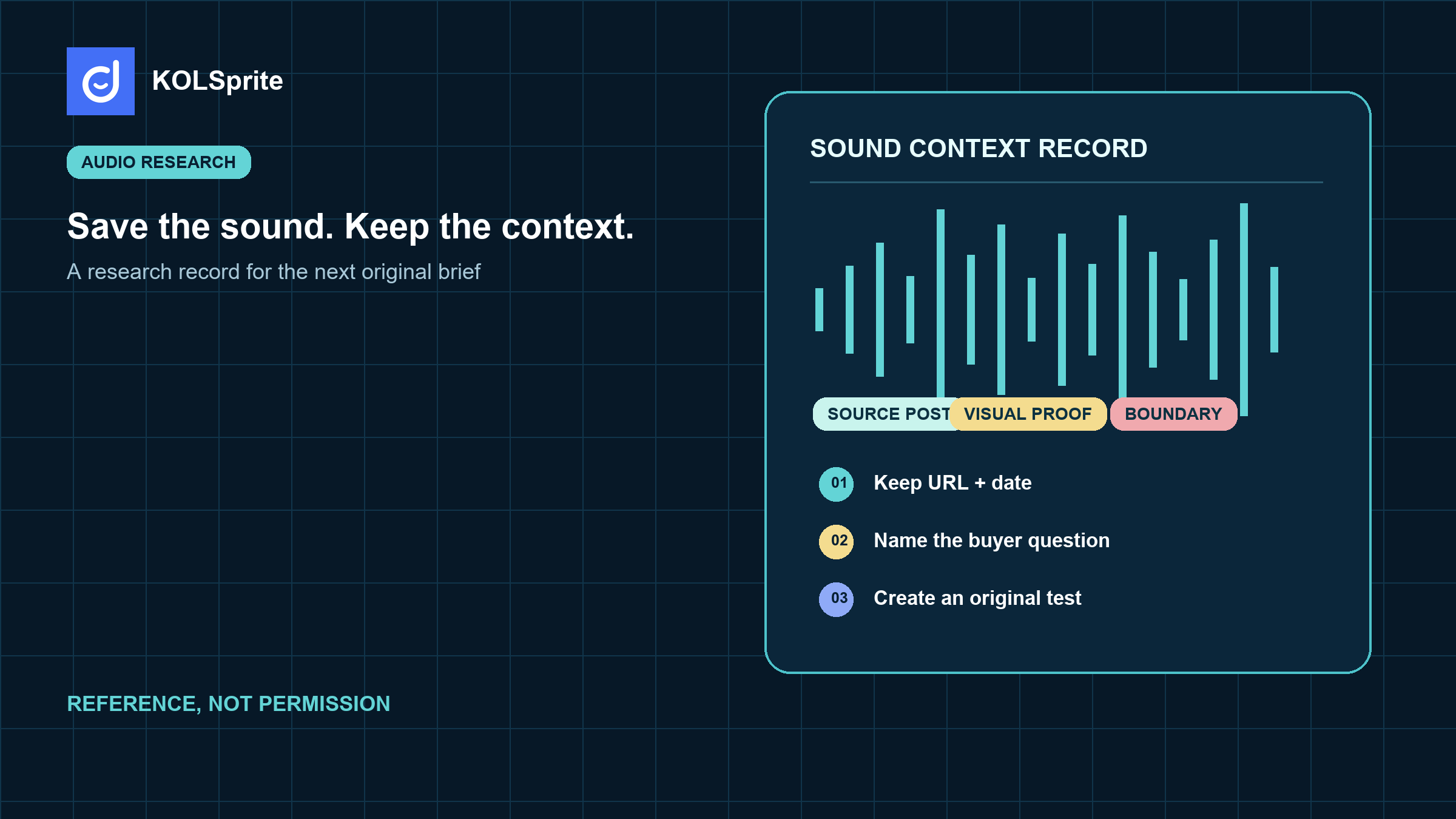
A TikTok sound downloader is useful when your team needs to revisit a public audio reference while planning content. It is not a shortcut to ownership, a license, or an answer of why a video worked. The useful move is to save the sound with its original video context, then decide what question the reference can help you answer. By the end of this guide, you will have a Sound Context Record that keeps the creator, spoken claim, visual proof, and reuse boundary together.
Ten-second answer: Download only eligible public material for a defined research task. Keep the audio attached to the source post, note what you observed, and treat it as a reference for a new brief rather than something to copy.
Teams often start with a practical request: save the audio so it can be replayed in a meeting. That is reasonable. The problem begins when the file becomes the entire record. A sound can carry a hook, a pace, a phrase, or an emotional cue. But it does not show the camera setup, the product being held, the comments that challenged the claim, or the creator's link to the audience. Once those details disappear, a team can mistake a memorable sound for a reusable idea.
A better question is, “What did this sound help the viewer understand?” Sometimes the answer is that the first spoken line named a familiar frustration. Sometimes the audio gave a demo enough rhythm to keep moving. Sometimes it did very little and the useful part was the visual proof. Your record should allow the team to say which of those explanations has support and which remains a guess.
TikTok says that a post can be saved to a device when the creator allows downloads. That setting is a platform permission for the post. it is not a transfer of copyright or a blanket business-use right. The boundary matters for a seller team. A saved clip may be a helpful research reference. But it should not quietly become a paid ad, a repost, or a creator's voiceover without the rights and approvals that use would require.
Source: TikTok Help Center: video downloads. Scope: Download access depends on the creator's setting. Rights and reuse decisions still need human review.
This is also why “no watermark” is not the main research outcome. If a teammate cannot identify the source post, the original creator, and the observed moment, the research got less useful even if the media is easier to play. Keep the source URL and an access date in the same record as the file.
A Sound Context Record is on purpose small. It is not a content calendar and it is not a legal clearance form. It gives a creative or product team enough context to decide whether a reference deserves a closer look. Write the record while the original post is open, not from memory after a batch download.
| What to record | What it can support | What it cannot settle |
|---|---|---|
| Source post and date | Lets another reviewer reopen the public example | That the post is example of a market |
| First spoken or musical moment | Identifies the attention cue worth discussing | That the cue caused every view or sale |
| Visual proof beside the sound | Separates audio rhythm from product proof | That the visual claim is accurate |
| Comment or caption context | Surfaces a buyer question or creator framing | A complete audience census |
| Reuse boundary | Keeps research and publishing decisions separate | A rights clearance or platform-policy opinion |
Observed-output table. Review the original public post and its current current status before relying on any row. this table is a research record, not a licensing decision.
A good source note has a few plain facts. It says where the sound came from. It says what the viewer saw. It says what the team wants to test. It also says what the team must not reuse.
Use KOLSprite to review supported public TikTok content, subtitles, and creator context before you decide whether a saved reference belongs in the next brief.
Register and claim a three-day trial
KOLSprite is useful before and after the save action because it keeps research close to the TikTok page. A team can inspect supported public video context, extract or review subtitles where open, sort a larger result set, and save permitted material for a research library. That reduces the common handoff where someone drops an audio file in a folder and no one remembers why it was kept.
Use the tool to gather context, not to let an audio clip make the decision. For example, a content lead can compare several public examples that use a similar opening rhythm, write down the product question each one addresses, and ask a creator to develop an original demo around that question. The output is a brief with a reason, not a copy request.
For more detail on saving eligible research references, use KOLSprite's video download tool; for browser-side research context, see the extension overview. Those pages describe product surfaces, while the final rights and creative decision remains with the team.
Give the record a simple outcome: keep, compare, or release. Keep it when the sound and visual proof answer a question your product team is already trying to solve. Compare it when the opening is interesting but the reason for result is unclear. Release it when the only note says “viral sound” or “good energy.” That last category is the easiest to collect and the least likely to improve a next video.
This stop rule is useful because it protects a small team from building a large archive of unsearchable inspiration. A reference library becomes valuable when each item has a job. It becomes a distraction when it only preserves a mood.
A downloaded file cannot confirm product demand, creator fit, permission to reuse, or the reason a viewer converted. It also cannot replace the original post when you need to inspect captions, comments, clear sponsorship note language, or a changing public context. Keep those limits visible in the record. They make the next conversation more honest and make it easier to decide what proof to collect next.
A short team check can keep the record honest. Play the source once with the screen on. Then play it with the screen off. Ask what each version adds. If the sound alone does not state the buyer problem, write down the visual proof that does. If the picture alone does the work, the audio may not need a place in the brief.
Next, ask one plain question. Could a new creator make an original clip that does the same job with new words and a new scene? If yes, the note is ready to keep. If no, the team has saved a file but has not found a usable idea. That is a good reason to pass.
These checks are quick. They stop a team from mistaking a strong mood for a clear message. They also give the person who owns the next brief a clean start. The brief can say what the viewer must learn. It does not need to copy a sound, a line, or a scene.
Join the KOLSprite Discord to compare research records, source boundaries, and ways to turn public examples into original creative questions.
 +
+
Join the KOLSprite Discord community
The best result of a TikTok sound downloader is not a bigger folder. It is a short, defensible note that lets a colleague understand what was observed and decide whether to build an original test. Save the eligible reference, retain the context, and write the next question before the team moves on. That is how a simple download becomes research rather than clutter.
When possible, have a second reviewer open the original post before the reference moves into a brief. One person may hear a useful phrase while another notices that the phrase only makes sense because the creator is standing in a familiar setting or responding to a question in the caption. This is a small check. But it keeps the record from turning a moment of personal taste into a team recommendation.
The second reviewer does not need to agree that the sound is good. Their job is to challenge the answer. Ask what a viewer learns in the first seconds, what the sound contributes that the picture does not, and what would be lost if an original creator used different words or music. If the answer is still clear, the reference has a useful creative principle. If it collapses into “it just feels viral,” release it.
This approach also protects creative teams from copying the surface of a reference. An original video can keep the same underlying job, such as making a compact product feel easy to set up. At the same time, using a different scene, script, demo, and pace. The research note should make that distinction explicit. It is the difference between learning from public work and treating another creator's work as a production template.
Give the saved file a name that begins with the research question, not the sound title. For example: small-space-setup-question__source-date__creator-handle. The name makes the file discoverable when someone is looking for a proof problem months later. Add the original URL and access date in the companion record. If a creator has changed settings or removed the post, the team can say what it observed at the time instead of treating an unavailable clip as current proof.
Do not let the archive become the approval system. The final content, rights, claims, and clear sponsorship note decisions need their own owners. The Sound Context Record is simply the bridge between a public reference and a better conversation about an original test.
Before a reference is shared outside the research group, test that the original URL still opens and that the description makes sense without the saved file. This protects the team from a common failure: a meeting built around a clip that no one can trace. If the source has disappeared, retain the access date and treat the item as a past observation, not a current example.
That distinction is modest but important. It makes the archive more useful for training new teammates and less likely to turn a past creative moment into a claim about what TikTok users are seeing today. Research is stronger when its time limit is obvious.
One final check helps: ask whether a teammate could find the record by the problem it documents, not by the sound's popularity. If the answer is no, improve the note before the archive grows. The goal is a small library that gives future briefs a starting point, not a private collection of fragments whose original meaning has been lost.
Before finalizing the record, label it as a reference rather than approved creative. That one label helps prevent a useful research artifact from being treated as permission to reuse someone else's expression.
Related KOLSprite research: Review the extension research setup, the AI comment analysis guide, and the creator brief template when a saved reference becomes a new creative question.
This audio record preserves the source, the observed creative cue, and the boundary the next brief must respect.
Latest Articles
As an essential, data-driven toolkit for TikTok influencers and marketers, KOLSprite provides powerful features for effortless creator discovery, trending content identification, and actionable real-time insights.
It empowers users to make smarter decisions and significantly boosts their TikTok business.

 Refer & Earn