This step-by-step guide teaches beginners how to extract the highest-value content from TikTok comments and translate it into short, conversion-focused scripts. The methodology relies on KOLSprite’s comment analytics and export features to identify top objections, common questions, and phrasing used by potential buyers.
 +
+
Intro — Why most CTAs fail (and what buyers actually want)
Typical beginner CTAs:
- “Check the link”
- “Follow for more”
These work for attention but not for purchases. Buyers want answers: cost, fit, shipping, and proof. If you answer a core objection before the CTA, you shorten the decision path — that’s how conversions happen.
Section 1 — What to mine from comments (and how to read them)
Comments contain four gold types:
- Buying intent — “link pls”, “how much?”
- Objections — “will it fit X?”, “how long does it last?”
- Use-cases — “Can I use it for Y?”
- Social proof — “I tried it and it works”
Using KOLSprite you can extract comment clusters and see frequency. Look for the top 2–3 repeating lines; those are your script inputs.
Section 2 — Build hooks that answer objections (practical templates)
A hook that answers a top objection converts better. Templates:
Price hook (for impulse items)
- Hook (0–2s): “Only $19 — here’s why it’s worth it”
- Demo (3–12s): clear value + quick use-case
- CTA: “Link in bio — limited stock”
Compatibility hook (for gadgets)
- Hook: “Works on iPhone & Android — no app”
- Demo: show pairing
- CTA: “Link, ships in 48h”
Trust hook (for new brands)
- Hook: “Free returns + 30-day try”
- Demo: show benefits
- CTA: “Link in bio — use code X”
Use the exact phrasing from comments where possible — it sounds authentic.
Section 3 — Short scripts that fit TikTok rhythm (15–20s)
Write scripts in micro-chunks:
- Line 1 (0–2s): Hook answering top objection
- Line 2 (2–8s): Demo or proof
- Line 3 (8–12s): Remove smaller objection (e.g., shipping)
- Line 4 (12–16s): CTA (exact step, e.g., “link in bio, use code SAVE10”)
Keep each line simple. Rehearse with a stopwatch to ensure pacing.
Section 4 — Test two CTAs per video and measure intent
A/B test CTAs:
- CTA A: “Link in bio”
- CTA B: “Comment ‘YES’ for link” (drives comments and builds an engaged list)
Measure which CTA yields more buying-intent comments or clicks. Use KOLSprite to compare comment intent changes after each CTA test.
Section 5 — Scale scripts that reduce objections — and why it matters
If a script consistently reduces the top objection (e.g., price or compatibility) in comment threads, it’s a keeper. Scale by:
- Making 3 variations that preserve the objection-answering hook
- Boosting the best performer slightly to test paid performance
- Reusing the core objection-answer phrase in captions and pinned comments
That makes your CTA part of a system, not a hope.
Table — Script test matrix
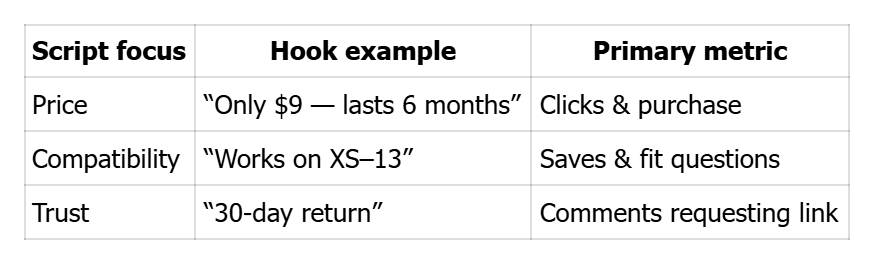 +
+
Checklist — 1-week script refinement plan
- ⬜ Export top 10 videos & comments in KOLSprite
- ⬜ Identify top 2 objections by frequency
- ⬜ Write 2 scripts answering each objection
- ⬜ Post both; track intent & CTR for 72 hours
CTA
Stop guessing what to say — pull it from comments. Use KOLSprite’s comment clusters to write short scripts that remove objections and make people click.


 Refer & Earn