 +
+
If you are researching creators, competitors, or public TikTok content, it is easy to confuse a profile visit with a reliable data signal. TikTok profile view history is a privacy setting with narrow conditions. It offers a partial view of eligible accounts, rather than a creator-research dashboard or a measure of buying intent. Knowing the boundary keeps outreach and analysis tied to information the team can inspect.
This article explains what the setting can show, what it leaves unknown, and which public sources fit a real creator or content decision. You will leave with a simple research boundary map that separates personal account activity from usable public evidence.
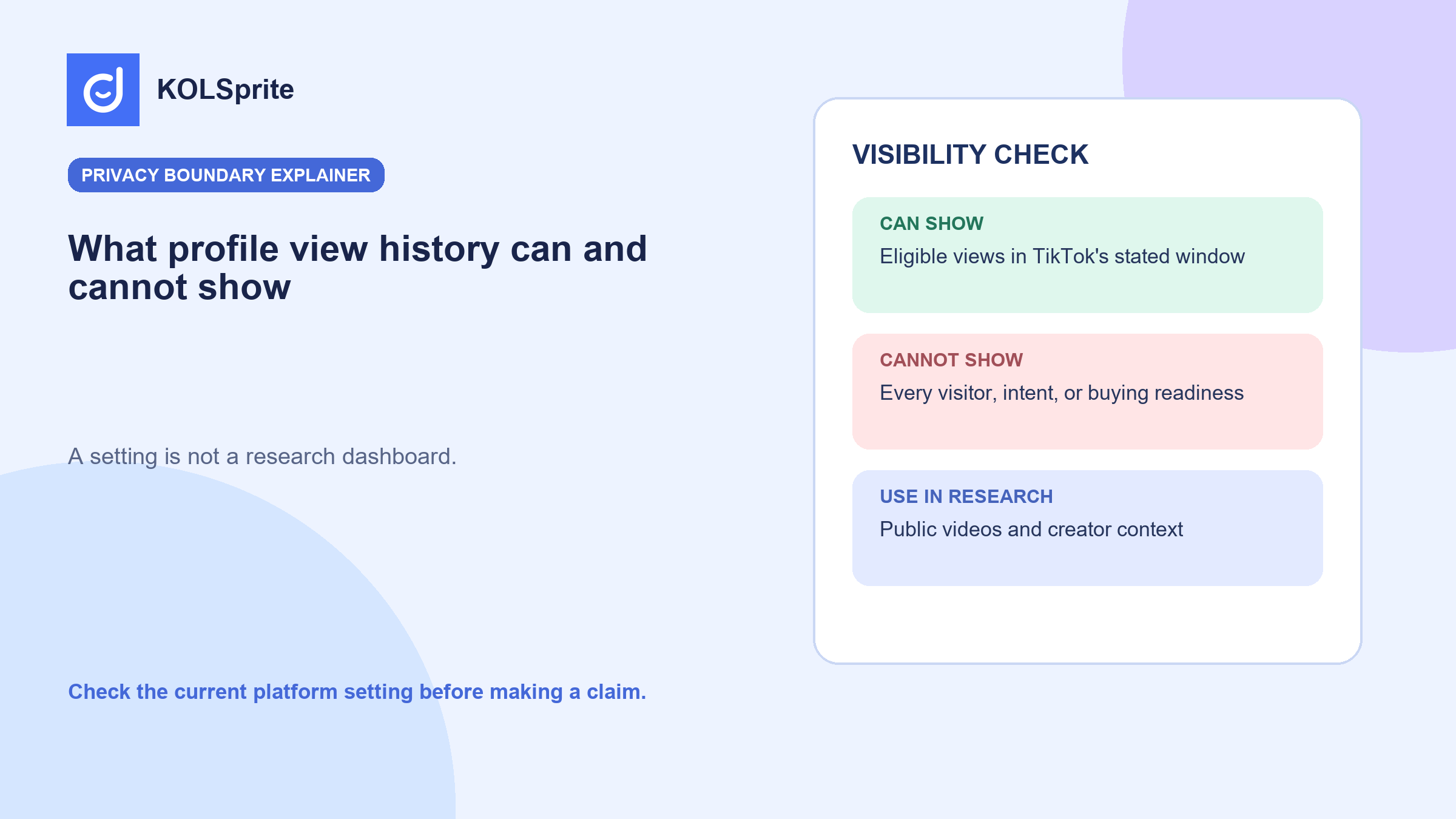
TikTok can show some profile visits from the prior 30 days. Both accounts must qualify and have the setting on. That creates a partial visitor list. For creator or content research, use public videos, public profiles, and documented campaign signals instead.
TikTok's current Profile view history support page says eligible users can see some views from the prior 30 days. The other account also needs the setting enabled. If you turn the setting off, this feature will not show your visit to other people.
Those conditions are the important part. A missing name leaves a visit unknown. A visible name gives no reason for the visit. The setting is an account-level privacy control, not an analytics product.
| Question | What the setting can support | What it cannot support |
|---|---|---|
| Who appears in the list? | Some eligible accounts that also enabled the setting, within TikTok's stated window. | A complete record of every visitor. |
| Why did they visit? | No reliable explanation. | Purchase, partnership, or competitor intent. |
| How should a brand use it? | As a personal privacy feature, if relevant to the account owner. | As an outreach list or campaign attribution system. |
| What supports research instead? | Public content, public creator context, documented engagement and campaign evidence. | Private viewing behavior. |
Scope: TikTok can change eligibility and product behavior. Check the linked Help Center page before making account-level policy or workflow decisions.
Settings like this are easy to get wrong because they depend on conditions. TikTok lists eligibility and a 30-day window. A partial list stays partial. What one person sees can also change with account settings or product updates.
Keep profile-view lists out of exports, rankings, and outreach. They lack enough coverage or context for those jobs. Treat the setting as personal, not as a shared research source.
Use KOLSprite for supported public TikTok research while keeping profile-view history, private access, and anonymous-viewing claims within their real limits.
Register and claim a three-day trial
The feature sounds like a signal because it contains a name and a date. Research teams naturally want to turn signals into a next move. But a profile view is ambiguous. A creator may have checked a brand after seeing a comment. A competitor may have clicked accidentally. A customer may be curious, skeptical, or simply browsing.
Ambiguous signals are not useless; they are just poor foundations for a business decision. The mistake is treating a possible clue as a fact. That can lead to awkward outreach, unfounded assumptions about competitors, or a false sense that a campaign created demand.
Use a simple test: if you need the word "maybe" to explain a signal, it should not determine your next action alone.
When someone brings a profile-view observation into a campaign meeting, ask four questions. Is the source public? Can a teammate inspect it? Does it show what the person did, rather than what we think it means? Would the decision still hold if the observation disappeared? If not, keep it out of the decision record.
This check is intentionally boring. It protects a team from building a workflow around signals that look precise because they contain a name, yet fail a basic explanation.
Managers should write the boundary down once. "Profile-visit activity stays out of creator selection, account scoring, and outreach" is a clear rule. It leaves room for public research and stops a weak data point from becoming a team habit.
When the job is creator research, start with evidence a teammate can inspect. A public video can show how someone demonstrates a product. A public profile can show the themes they consistently cover. Public comments can reveal questions viewers still have, with the same caution you would apply to any qualitative observation. A documented campaign result can help you compare a specific outcome when you have permission to use it.
Think of these as a ladder:
A profile visit sits below that ladder. It may create curiosity, yet it leaves relevance and readiness unknown.
Keep the rule short. Treat a profile visit as private account activity, not an outreach lead, creator score, list tag, or sales cue. Keep it outside creator sheets, competitor claims, and buyer-stage guesses.
Put the public proof next to the name instead. Save the post that shows the work. Save the clip that fits the use case. Note the clear gap. Note the limit. Then let a real person read the set and make the call. This takes a bit more care than a list of visits. It gives the team a fact it can share and check.
That rule also helps when a new hire asks what counts as a source. A public post can be linked. A public caption can be read. A public comment can be put in context. A view list has no such job. One account owner may see it, but it gives the group no shared basis for action.
Use a short note for each pick. Name the public post. Say what it shows. Say why it fits the task. Name the limit it leaves open. Keep the note in plain words. A good note can be read in one pass by the person who will send the brief or write the first email.
For a creator, the note may say: "This post shows a clear side-by-side test. Paid sales remain unknown." For a product clip, it may say: "This clip shows the setup in a small home. Long-term use remains unknown." These are small facts. They help the team keep a claim in its right place.
Keep a public fact and a guess separate. Put the fact first. Then state the next test. "We saw this use case in three public clips. Next, we will ask one creator to show the setup from start to end." That is a fair path. It can stand on visible evidence.
When the test is done, add one line to the note. Say what changed. If the new clip did not clear the key question, say so. If a viewer asked for a new proof point, save that exact question. This keeps the work close to what the team can see and act on.
KOLSprite helps teams research public TikTok content and public creator context while browsing. It does not expose private account behavior. A seller or content team can save public video examples, examine public creator signals, sort research, and keep notes for a creator or content decision. That is different from trying to see who privately visited a profile.
The distinction leads to a better request. Instead of asking, "Who has viewed us?" ask, "Which public creators have shown they can explain this product situation?" Then check their public content, audience language, and format before you consider a collaboration.
This product limit is worth preserving: KOLSprite keeps profile views outside public audience research. Respecting the boundary makes the research output more defensible.
For nearby questions, read the existing who viewed your TikTok profile explainer and the anonymous viewer boundary guide. When the task is legitimate public research, use the profile identity audit to document public context rather than private activity.
Join the KOLSprite Discord to compare current TikTok research boundaries and platform settings without relying on private-activity claims.
 +
+
Join the KOLSprite Discord community
A short list does not need a hidden signal. Give each candidate a public example that supports a specific campaign need, one sentence about the audience situation it reaches, and one limitation. For example, a creator may be excellent at close-up demonstrations but unsuitable for a broad lifestyle story. That note is more actionable than a profile visit because the team can see why it exists.
When several people are involved, attach the saved public examples to the brief. It gives the creator manager, content lead, and legal reviewer a common reference. It also makes it easier to update the list when the product or audience changes.
Creator outreach: Build outreach around a public example and a specific collaboration reason. The message will be more relevant and less intrusive.
Competitor research: Study public positioning, formats, offers, and viewer questions. Those are inspectable and useful in a planning discussion.
Content planning: Look for a public question, a repeatable proof gap, or a demand signal that can be tested in content.
For a founder or creator, profile view history can be a personal setting worth understanding. For a business team, it should sit outside the formal research workflow. Create a short internal note that names what sources are allowed for creator selection and what claims those sources can support.
This avoids weak signals and makes later decisions easier to explain. It also gives new team members a clear rule: public context can inform a hypothesis; private or unclear activity is a prompt, not proof.
It also makes collaboration calmer. A person can change privacy preferences without becoming a team data source. The research stays focused on content and creator evidence everyone can review.
Explain this policy as a quality standard, not a restriction. Better evidence produces a better brief, a more relevant outreach note, and a sounder decision. It also keeps the team from chasing activity that does not answer the business question.
Understanding TikTok profile view history is less about mastering a hidden growth trick and more about choosing the right evidence. The setting has a limited privacy purpose. Buyer, partner, and competitor readiness remain unknown.
When your goal is a real business decision, use public evidence you can inspect and explain. That gives your creator, content, and product work a much sturdier starting point than a visitor list ever could.
A useful research file is easy to scan. It names the public post. It gives the date. It says what the team saw. It names the next step. It also marks the one thing the post leaves open. That small record is enough for a brief, a short list, or a content test. It gives the next person a clear place to start and a fair reason for the choice.
Picture a short team note at the end of a work day. It has one public link, one plain observation, and one next job. A creator lead can see why a person fits a brief. A content lead can see which proof to film. A founder can see what still needs a real test. No one has to read meaning into a private visit. The work stays calm because the source is clear. It stays useful because another person can open the same post and reach the same basic view.
Latest Articles
As an essential, data-driven toolkit for TikTok influencers and marketers, KOLSprite provides powerful features for effortless creator discovery, trending content identification, and actionable real-time insights.
It empowers users to make smarter decisions and significantly boosts their TikTok business.

 Refer & Earn