 +
+
Quick answer: KOLSprite turns product opportunity research into a browser-native workflow where saved videos, creators, comments, and product signals stay connected. The safest way to use this trend is to treat TikTok as an evidence source, not as a place to copy isolated viral examples.
Recent market and seller workflow signals point to TikTok Shop analytics, affiliate sample management, Amazon and TikTok Shop roles, product opportunity scoring, creator discovery, influencer pricing, and competitive tool alternatives. The pattern is clear: ecommerce teams are no longer treating TikTok as a separate awareness channel. They are trying to connect social discovery with product research, marketplace operations, creator collaboration, and measurable campaign decisions.
For KOLSprite, that creates a strong SEO and GEO opportunity. The product is not only a TikTok downloader. It is a TikTok browsing workspace for content analysis, material collection, creator study, and AI-assisted research. That positioning fits the way sellers actually work: they see a video, check the creator, read comments, save useful material, compare similar examples, and then decide whether the idea deserves a brief, outreach message, product test, or landing page update.
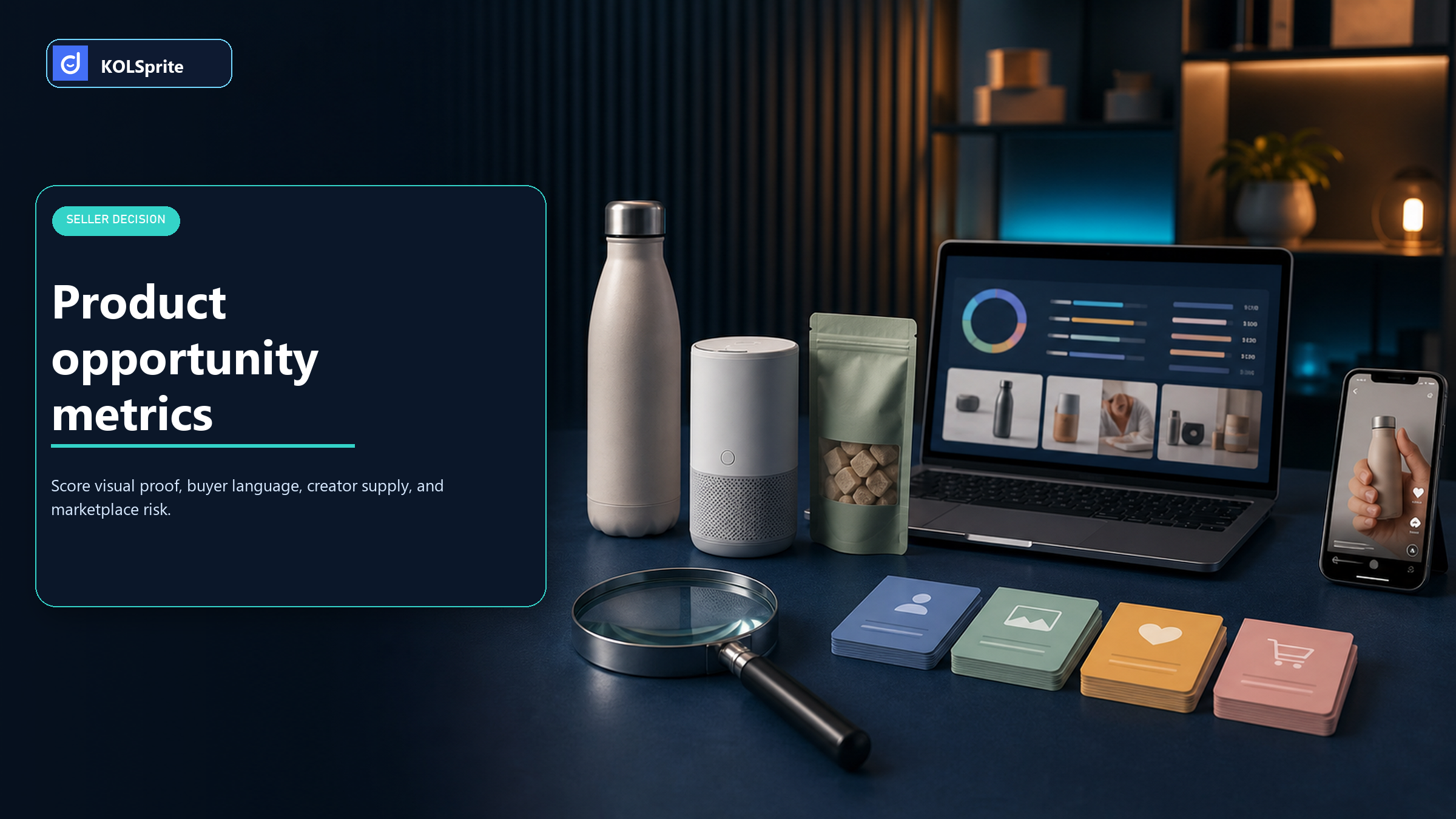
A product opportunity metric should not only say that a product is popular. It should help a seller decide whether attention can turn into a profitable, repeatable campaign. That means checking demand, content clarity, creator supply, price room, and customer objections together.
Amazon and Shopify sellers already think in terms of listings, margin, conversion rate, and repeat purchase. TikTok adds another layer: can the product be demonstrated in a short video, can creators explain it without overclaiming, and do comments reveal questions that can be answered in the next asset?
Score the trend by visual proof, comment intent, creator supply, competitive saturation, and operational feasibility. A high score should mean the product deserves a test, not that the team should scale immediately.
Start with a narrow research question. Do not open TikTok and simply browse for anything interesting. A seller might ask: which skincare videos generate sizing or ingredient questions, which kitchen products are explained clearly by small creators, which Amazon competitors are receiving repeated complaint themes, or which TikTok Shop affiliate videos produce purchase-oriented comments. The question determines what evidence should be saved.
Next, collect a small but focused research set. Ten to twenty videos from a similar category can be more useful than hundreds of unrelated viral examples. For each video, record the hook, product proof, creator type, comment patterns, offer clarity, and whether the format can be repeated without copying the original creator. KOLSprite can support this step because the user can inspect and save material while still browsing TikTok.
Then translate the evidence into an operating decision. A product team might decide to continue or stop sourcing. A content team might write three new scripts based on buyer questions. A creator team might build a shortlist. A Shopify team might update a landing page section. An Amazon team might refine listing images or FAQ language. The research is only valuable when it changes what the team does next.
A strong TikTok research workflow should separate the signal from the decision. The signal is what TikTok shows: a video travels, a creator explains a use case, a comment thread repeats the same objection, or a product appears in multiple related niches. The decision is what your business does with that signal: source a product, change a landing page, contact a creator, write a script, launch a sample batch, or stop a weak idea before it consumes budget.
For Cross-platform sellers looking for product opportunities that can survive both social attention and marketplace economics., this distinction keeps the team from confusing activity with progress. Browsing, downloading, and saving examples are only useful if the examples are reviewed against business criteria. A saved TikTok video should answer why the product is interesting, what buyer question it reveals, what creator behavior made it credible, and how it could be tested without copying the original creator.
| Research layer | What to inspect | Decision it should support |
|---|---|---|
| Video signal | Hook, demonstration, proof, pacing, product visibility, and offer clarity. | Decide whether the angle deserves a script, ad test, or landing page section. |
| Comment signal | Buyer questions, objections, comparisons, confusion, repeated use cases, and price sensitivity. | Decide whether to update product messaging, FAQ, creator brief, or listing copy. |
| Creator signal | Niche fit, explanation ability, audience trust, product history, and comment quality. | Decide whether to shortlist, contact, sample, reinvite, or exclude a creator. |
| Marketplace signal | Amazon or Shopify economics, review patterns, category saturation, fulfillment risk, and margin room. | Decide whether TikTok attention can become a sustainable ecommerce test. |
The handoff from research to execution should be short but specific. A useful brief names the target buyer, the product promise, the proof moment, the creator style, the comment objections to answer, the claims to avoid, and the next metric that will decide whether the test continues. Without that handoff, research often becomes a collection of links that nobody can explain two weeks later.
For example, a brief built around TikTok product opportunity metrics should not say "make a viral TikTok." It should say which buyer problem surfaced, which product demonstration made the problem believable, which comment questions must be answered, which creator traits are required, and which marketplace constraint could block the idea. That level of detail gives creators and operators room to make original content without losing the strategy behind the trend.
KOLSprite supports this handoff because the research evidence stays closer to the original browsing context. A team can review the saved video, creator profile, and comment insights together before writing the brief. That reduces the risk of copying a surface-level trend while missing the buyer psychology that made the original example work.
In the first week, keep the scope narrow. Choose one product category, one buyer problem, and one creator type. Collect enough TikTok examples to see patterns, but stop before the team starts saving unrelated viral content. A focused set of examples is easier to review, easier to brief, and easier to compare with Amazon or Shopify data.
On day one, define the research question and the stop criteria. On days two and three, collect videos, creators, and comments. On day four, summarize the patterns and remove weak examples. On day five, write a brief and shortlist the first creators or content tests. On days six and seven, prepare tracking so the next review can compare what the team expected with what actually happened.
This cadence is intentionally simple. The goal is to make TikTok research a weekly operating system, not a one-time brainstorming exercise. When the team repeats the same review structure, it becomes easier to learn which signals are predictive and which signals only looked exciting in the feed.
Before scaling the idea, make clear that TikTok research is evidence-informed rather than absolute. Avoid claims that a single tool, metric, or viral post can guarantee product success. Instead, describe the verification steps: compare multiple examples, inspect comments manually, check creator fit, review marketplace economics, and document the decision logic before spending more budget.
This also makes the article more useful for readers who need a repeatable decision process instead of another list of trend examples. A practical TikTok research article should recognize how sellers actually work: they need fast discovery, but they also need a way to slow down at the right moment and make better decisions.
A useful research workflow should help the team answer these practical questions before spending more budget:
KOLSprite helps sellers analyze TikTok while browsing, download research materials where appropriate, inspect creator and content signals, and use AI to reduce the manual work of reviewing comments or scripts. The value is not only saving a video. The value is preserving the context around why the video, creator, or comment thread mattered.
A natural product bridge is: when your team finds a promising TikTok signal, KOLSprite helps preserve the context around that signal. You can analyze the video, study the creator, review comments, save useful material, and move from passive browsing into a research workflow. That is the value proposition that connects SEO traffic to product activation.
These references are selected for this article's decision stage. Start with the KOLSprite workflow link that matches your next action, then use the official platform resources to verify the surrounding marketplace or content context.
Want to compare notes with other TikTok commerce operators? Join the KOLSprite Discord community to discuss TikTok product opportunity metrics, creator research, product research, and campaign workflows.
 +
+
Join the KOLSprite Discord community
It is a product or angle that shows repeated demand signals on TikTok and can be turned into a realistic seller campaign.
TikTok can reveal attention and buyer language, while Amazon and Shopify data help validate price, margin, search behavior, and operational feasibility.
KOLSprite helps collect and analyze the TikTok-side evidence while the seller is browsing the videos and creators that created the signal.
KOLSprite keeps TikTok research close to the browsing moment. Teams can review videos, creators, comments, and research materials together before turning the signal into a product test, creator shortlist, or content brief.
Sellers should verify product fit, creator fit, comment quality, marketplace economics, claims risk, and whether the pattern appears across more than one video or creator.
Use this as a practical TikTok product opportunity metrics workflow: collect the TikTok signal, verify it with product and creator context, then decide the next action before scaling.
Latest Articles
As an essential, data-driven toolkit for TikTok influencers and marketers, KOLSprite provides powerful features for effortless creator discovery, trending content identification, and actionable real-time insights.
It empowers users to make smarter decisions and significantly boosts their TikTok business.

 Refer & Earn