 +
+
If you manage creator partnerships, a ranked list can make a weak choice look precise. The partner with the most followers may not be the best fit. Another person may prove the product, answer a buyer doubt, or offer a safer first test. This guide uses TikTok creator analytics to build a three-role group around one exact product. You will compare people under the same product context. You will also mark the limits of the data. Then you will assign one person to reach, one to proof, and one to sales learning. The output is a test mix, not a popularity contest.
Name the partner's job before you compare metrics. Then review follower scale, average reach, response, product-linked work, recent activity, and the exact proof shown. Keep rate, rights, audience quality, schedule, and brand safety as open checks.
The right partner is not first on a list. The right partner has a clear job in the test.
A first group usually needs more than one type of contribution. A reach partner can place the product in front of a larger audience. A proof partner can make a difficult benefit visible. A sales-learning partner can test an exact objection, use case, or offer with a smaller spend. One person may cover two roles, but the team should not assume that before reviewing the work.
TikTok One's official creator search and filtering guide lists follower count, median views, response rate, audience location, recent content, and audience demographics among the fields brands can use. It also defines median views and response over recent videos for its own system. Those definitions matter. A metric is only comparable when its window and denominator are clear.
KOLSprite gives commerce teams a clear research route. Start from an exact product, inspect its linked videos, and save the creator ID with each record. This lets the team compare people who have already shown some relationship to the same item rather than starting with unrelated profile totals.
| Observed field | What it may help answer | What it does not settle |
|---|---|---|
| Followers | Potential account scale | Buyer group fit, expected views, or sales |
| Average or median views | Typical recent reach under the source definition | Future reach for your product |
| Response rate | How viewers respond under the stated formula | Buy intent or comment quality |
| Product-based video result | Observed work around the exact item | Causal attribution or repeatability |
| Recent activity | Whether the account appears active | Schedule or willingness to work |
This separation prevents the most common mistake in partner reporting: turning a visible metric into a deal promise. A high view count can earn a deeper review. It cannot approve the rate, rights, or brief. A strong product-linked result can show relevant work. It cannot prove the partner will repeat it for your store.
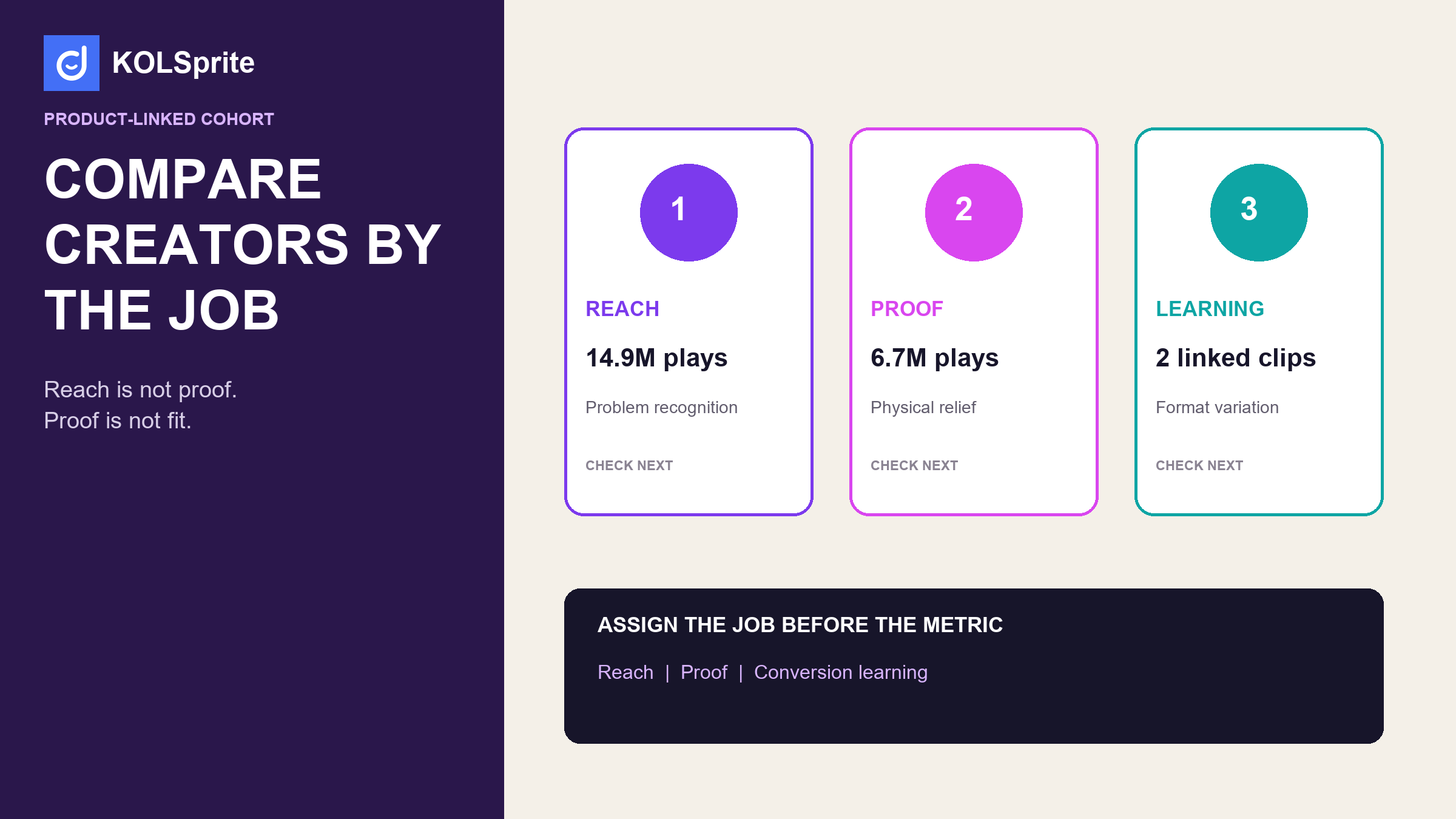
We followed one electric spin scrubber into its linked US videos. Three records illustrate why the team needs roles. Creator ID 7318238687262016555 made a 13-second move-in cleaning video. The record showed 11,996 followers, 14.9 million plays, a 16.71% response field, and 5,098 recorded 30-day product units. A 14-second “saves my back and knees” video from creator ID 7000174255821685765 showed 25,566 followers, 6.7 million plays, a 0.19% response field, and 2,010 units. A 30-second bathroom-cleaning video from creator ID 7532243988770997279 showed 11,024 followers, 6.1 million plays, a 0.11% response field, and 1,121 units.
The third partner also had another product-linked clip in the same sample: 25 seconds, 1.6 million plays, and 356 recorded 30-day units. That second record is useful because it begins to show variation within one partner instead of treating one viral clip as a permanent average.
Research note. KOLSprite exact-product video records for product ID 1732021482392031405; US market; accessed July 30, 2026. The public table uses three stable creator IDs and four linked videos from one product. It is a scoped review, not a partner benchmark or attribution study.
| Partner proof | Visible strength | Main risk | Planned test job | Next check |
|---|---|---|---|---|
| 11,996 followers; 14.9M plays; 13-second move-in clip | Large reach and a strong first-frame situation | One exceptional clip may dominate the picture | Reach and problem recognition | Review recent non-product content and buyer group fit |
| 25,566 followers; 6.7M plays; back-and-knees promise | Clear buyer pain and product relief | Low response field relative to reach | Proof and accessibility angle | Inspect comments, disclosure, and claim support |
| 11,024 followers; two linked clips at 6.1M and 1.6M plays | More than one observed execution | Two examples still do not prove a stable baseline | Sales-learning and format variation | Ask for recent product results and schedule |
The card does not name a universal winner. It gives each person a different learning role. The first partner can test whether the move-in problem attracts the right audience. The second can test whether physical relief is a stronger product promise. The third can test whether the result survives a second format or setting. That is a more useful first group than three partners chosen because they occupy the top of one follower list.
Start in KOLSprite product search with the exact item or a carefully cleaned category. Follow the product ID into product-linked videos. Save the creator ID, source clip, product ID, market, access date, visible metrics, proof type, and reason the partner entered the group.
Then move to creator search for a broader profile and category review. Do not join a video and profile only because the display names look alike. Use a stable ID or verified handle when the tools return one. If the account cannot be confirmed, keep it on hold. The earlier creator outreach SOP becomes useful after identity, role, and product fit are clear.
This workflow makes KOLSprite part of the reasoning rather than a detached product mention. It preserves the proof trail from item to clip to partner, which is the trail another teammate needs to challenge the recommendation.
The questions also protect the partner. A clean role prevents the brief from expanding after the quote. Clear proof limits reduce pressure to make unsupported claims. A clear tracking plan makes the review fair. It also keeps stock, price, and page issues from being blamed on the partner.
Give each partner one main learning job. Keep the product facts and claim limits consistent, but allow other openings and settings. The reach partner can open with the move-in surprise. The proof partner can show reduced bending or scrubbing effort without making a health claim. The sales-learning partner can compare two surfaces or brush heads and answer one buyer doubt.
Choose the primary measure by role. Reach can use qualified views and relevant audience response. Proof can use completion around the demo and the quality of product questions. Sales learning can use product-page actions, tracked orders, or another agreed commerce measure. Do not force every partner into one view-based score.
After the test, compare each partner against the job assigned, not against the biggest account. The engagement benchmark guide can help frame response in context, but it should not override the exact content and buyer fit you observed.
Public partner fields do not reveal the actual quote, rights package, revision limit, audience quality, schedule, or willingness to work with your category. Product-based unit fields do not prove that the partner caused each buy. A dramatic ratio between followers and views may justify a deeper check, but it is not proof of fraud or guaranteed reach.
The group stays tentative until direct outreach fills the deal fields. Use TikTok creator analytics to decide who deserves that conversation and what proof to request. Do not use it to pretend the conversation already happened.
A beauty device might need a demo partner, an education partner, and a routine partner. A kitchen tool might need speed, cleanup, and taste or outcome proof. Apparel may need fit, movement, and styling roles. The metrics stay useful, but the partner jobs and acceptable proof change with the buyer's risk.
Keep the group card after the campaign. Replace the planned role with the delivered role, add the content result, and record whether the partner should be reinvited. Over time, the team builds proof about roles and products instead of collecting unrelated profile screenshots.
Invite three partners only after identity and deal checks. Use creator ID 7318238687262016555 for reach and problem recognition. Use creator ID 7000174255821685765 for physical-effort proof. Use creator ID 7532243988770997279 to test repeatability across two formats. Judge each against the assigned job. That is a practical use of TikTok creator analytics: a balanced learning mix instead of a follower ranking.
Create a KOLSprite account and claim a three-day trial membership. Use the trial to research creators, compare content signals, and prepare a stronger shortlist or brief.
Register for a three-day KOLSprite trial
Share the three roles in your next test and get a second opinion before outreach.
 +
+
Join the KOLSprite Discord community
Latest Articles
As an essential, data-driven toolkit for TikTok influencers and marketers, KOLSprite provides powerful features for effortless creator discovery, trending content identification, and actionable real-time insights.
It empowers users to make smarter decisions and significantly boosts their TikTok business.

 Refer & Earn